
Every business changes hands eventually. The only question is whether that happens on your terms or by accident. This guide explains succession planning for business owners in the UK: the four main routes, the tax rules that shape them, and a five-year plan you can start with today.
Why do so many UK owners need a succession plan?
The UK had 5.7 million private sector businesses at the start of 2025, of which 1.4 million employed staff, according to the Department for Business and Trade. Most are owner-managed, and many owners are approaching retirement without a successor. In Dealsuite’s survey of UK and Irish M&A advisers, age and the lack of a successor explained 41% of business sales in H2-2025.
A succession plan answers three questions: who will own the business, who will run it, and how you will be paid or provided for. Those three answers do not have to point to the same person. A family can keep ownership while professional managers run the company; a buyer can acquire it while you stay on for a transition.
What are the succession options?
| Route | Who takes over | Typical strengths | Typical challenges |
|---|---|---|---|
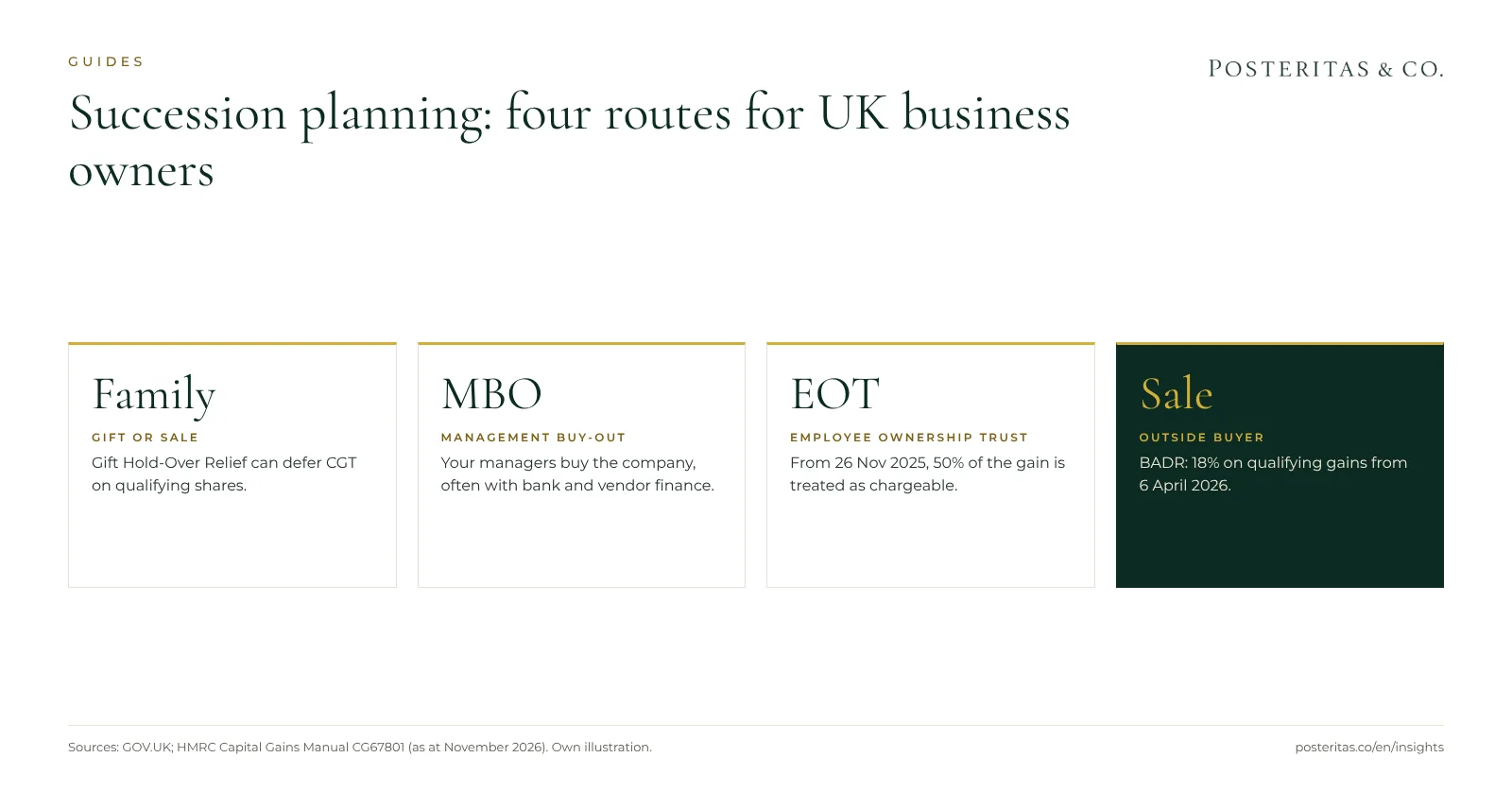
| Family succession | Children or other relatives | Continuity, values, often tax efficient by gift | Fairness between children, readiness of the successor |
| Management buy-out (MBO) | Your current managers | They know the business, smooth handover | Managers rarely have capital; you may need to fund part of the price |
| Employee ownership trust (EOT) | A trust for all employees | Keeps independence and culture | Price paid over time from profits; CGT relief reduced since 26 November 2025 |
| Sale to an outside buyer | Trade buyer, private equity, individual | Usually the highest price, paid largely on completion | Confidential process, due diligence, integration changes |
There is no best route in general, only the best route for your goals. Owners who want maximum value at completion usually sell to an outside buyer. Owners who care most about continuity lean towards family, managers or an EOT. Our guide how to sell a business in the UK covers the outside sale in detail; family business succession planning covers the handover within the family; and our glossary explains the management buy-out.
How do the tax rules differ between the routes?
Tax rarely decides the route on its own, but it changes the net result considerably. The key rules according to GOV.UK and HMRC:
| Route | Main tax point | Rule |
|---|---|---|
| Sale to an outside buyer or MBO | Capital Gains Tax for the seller | Business Asset Disposal Relief: 18% on qualifying gains from 6 April 2026, lifetime limit £1 million; otherwise up to 24% |
| Gift to family | Capital Gains Tax deferred | Gift Hold-Over Relief for business assets and unlisted trading company shares; the recipient takes over the gain; giver and recipient claim jointly |
| Gift or inheritance | Inheritance Tax | Business Relief: 100% on the first £2.5 million of qualifying property from 6 April 2026, 50% above; asset generally owned for 2 years |
| Sale to an EOT | Capital Gains Tax relief | For disposals from 26 November 2025, 50% of the gain is treated as chargeable (HMRC CG67801) |
Two consequences are worth noting. First, the Business Relief allowance of £2.5 million is transferable between spouses and civil partners, so a couple can shelter up to £5 million at 100%. Second, qualifying periods matter: Business Asset Disposal Relief requires conditions to be met for 2 years before a sale, and Business Relief generally requires 2 years of ownership. Restructuring shortly before an exit can cost you relief. This guide is general information, not tax advice.
How do you prepare the business for a successor?
Whichever route you choose, a business that runs without you is easier to hand over and worth more. Buyers and successors look at the same points:
| Area | What to build | Why it matters |
|---|---|---|
| Management | A second tier who can run daily business | Reduces owner dependence, the biggest discount in small deals |
| Customers | Relationships held by several people | Customers stay after you leave |
| Figures | Monthly management accounts, clean annual accounts | Successors and banks can plan and finance |
| Contracts | Written agreements, change of control clauses known | No surprises in due diligence |
| Ownership | Shareholders’ agreement with transfer and exit rules | Prevents deadlock between shareholders |
Our exit readiness service works through these points with owners, typically over one to three years before a handover.
What does a five-year succession plan look like?
A practical timetable, which we adapt to each owner:
- Five years before: clarify your goals (income, timing, role after the handover, legacy). Check the shareholders’ agreement, your will and a lasting power of attorney.
- Four years before: decide on the preferred route and a fallback. Start building the second management tier.
- Three years before: get an independent valuation. Review whether you and the business meet the conditions for Business Asset Disposal Relief, Gift Hold-Over Relief or Business Relief, with a UK tax adviser.
- Two years before: implement structural changes, transfer key customer relationships, document processes. For a family or MBO route, define the successor’s responsibilities and financing.
- One year before and the year itself: run the sale or the handover, agree your transition role in writing, and inform staff and customers in a planned sequence.
Who should be involved in your succession plan?
Succession planning touches tax, law, finance and family at the same time. A typical team, and what each brings:
| Role | Main contribution |
|---|---|
| UK tax adviser or accountant | Reliefs (BADR, Gift Hold-Over Relief, Business Relief), timing, structure, valuation for tax |
| Solicitor | Shareholders’ agreement, articles, wills, lasting power of attorney, sale contract |
| M&A or corporate finance adviser | Valuation, buyer search, negotiation, management buy-out structuring |
| Bank or other lenders | Financing for a management buy-out or a family buy-out of siblings |
| Successor or management team | Business plan, readiness, the commitment to take over |
| Family members | Expectations, fairness, the parents’ income after the handover |
The owner remains the decision-maker. One adviser should coordinate, so that the tax structure, the contracts and the timing fit together instead of being optimised in isolation.
What if something happens to you before the plan is in place?
Succession planning also covers the unplanned case. A property and financial affairs lasting power of attorney lets a trusted person act for you if you lose capacity. GOV.UK states that registration costs £92 and takes 8 to 10 weeks if there are no mistakes; it is legally binding in England and Wales. Business decisions in a company may also need clear rules in the articles and the shareholders’ agreement, and in some cases a separate business power of attorney. Discuss the structure with your solicitor.
A short emergency file helps too: bank access, key contracts, passwords, a list of advisers, and who decides what if you are not available.
Conclusion: decide early, keep options open
Good succession planning gives you choice. If you start three to five years ahead, you can compare a family handover, a management buy-out, an employee ownership trust and a sale on their merits, rather than accepting whatever is available when you need to stop. If you want to know what your business is worth today, start with our business valuation calculator UK. For a confidential discussion of your options, see our succession planning service or sell my business UK.
Sources
- Age and lack of succession main reason for business sales in the UK, Dealsuite, 26 February 2026
- Business population estimates for the UK and regions 2025: statistical release, Department for Business and Trade, GOV.UK, 2025
- Agricultural property relief and business property relief changes, GOV.UK, updated 3 March 2026
- Business Relief for Inheritance Tax, GOV.UK
- Business Asset Disposal Relief, GOV.UK
- Gift Hold-Over Relief, GOV.UK
- Capital Gains Manual CG67801: employee ownership trusts, the relief, HMRC
- Make, register or end a lasting power of attorney, GOV.UK
Frequently asked questions
What is business succession planning?
It is the process of deciding who will own and manage your business after you, and preparing the business, the people and the tax structure so the transfer works. It covers a planned exit as well as what happens if you are suddenly unable to work.
When should I start succession planning?
Three to five years before you want to step back is a sensible minimum. Building a management team, reducing owner dependence and meeting the two-year qualifying periods for tax reliefs all take time.
What are the succession options for a UK business owner?
Passing the business to family, a management buy-out, a sale to an employee ownership trust, or a sale to an outside buyer such as a trade buyer, private equity or an individual. Closing the business is the fallback if none of these works.
How does inheritance tax affect business succession from April 2026?
Business Relief at 100% now applies to the first £2.5 million of qualifying business and agricultural property; value above that receives 50% relief. Unused allowance can pass to a surviving spouse or civil partner, so a couple can have up to £5 million.
Is selling to an employee ownership trust still tax free?
Not fully. According to HMRC's Capital Gains Manual, for disposals on or after 26 November 2025 where a gain accrues, 50% of the gain is treated as a chargeable gain. Other conditions, such as the controlling interest requirement, still apply. Take specialist advice.
Do I need a lasting power of attorney as a business owner?
It is strongly advisable. A property and financial affairs LPA lets someone you trust act for you if you lose capacity. GOV.UK states that registration costs £92 and takes 8 to 10 weeks if there are no mistakes. It is legally binding in England and Wales.