
When you sell your company, you first ask about its value. What matters, however, is the price that ultimately appears in the purchase agreement and actually reaches your account. Between the two lie negotiation, competition and a number of technical mechanisms. This guide explains how the purchase price is arrived at and at which points sellers gain or lose money.
What is the difference between value and price?
Value is a subjective assessment, price is the result of a negotiation. Business valuation theory speaks of the decision value or reservation price (Entscheidungswert or Grenzpreis). This is the value of a company from the perspective of a particular person (source: FAU Erlangen-Nürnberg). For the seller, it is the minimum price; for the buyer, the maximum price.
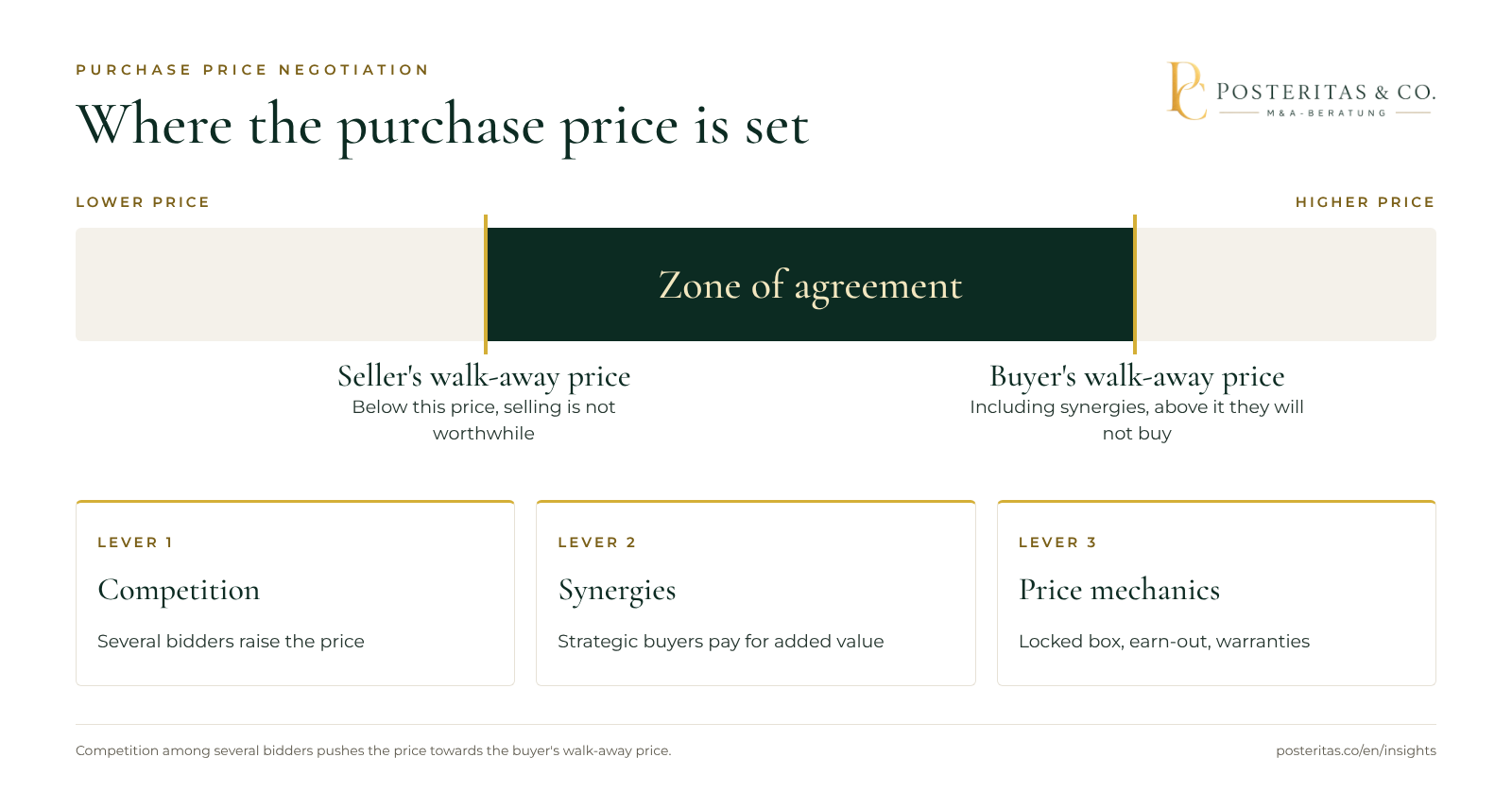
If the buyer’s maximum price is below the seller’s minimum price, there is no deal. If it is above, a zone of agreement arises. Exactly where the price lands within it is decided by the negotiation. Arguments, alternatives and time pressure play a greater role here than the valuation formula.
A well-founded business valuation nevertheless remains the basis. It shows you where your own reservation price realistically lies. And it provides arguments in discussions with buyers. How buyers calculate is explained in our article on EBITDA multiples.
Realism is a genuine bottleneck here. According to the DIHK Business Succession Report 2025, 36 percent of outgoing owners expect excessive prices. KfW Research reports that the purchase prices targeted by mid-sized companies have risen by around 34 percent since 2019.
How does competition among bidders affect the purchase price?
Competition is the strongest lever for moving the price towards the highest willingness to pay. With only one interested party, you negotiate against their reservation price without knowing it. With several bidders, buyers gradually reveal their willingness to pay.
A structured auction process follows a clear timetable. Several pre-selected interested parties receive the same information and submit offers on fixed dates. This makes offers comparable, and no bidder can drag out the process.
Strategic buyers often have the highest reservation price. They can realise synergies, for example through combined purchasing volumes, cross-selling or the elimination of duplicate structures. They will only pay for part of these synergies if another bidder forces them to. Without competition, the buyer keeps the synergy value for itself. You can read more about the types of buyer in the article on selling to investors.
How do you get from enterprise value to the purchase price for the shares?
Offers usually state an enterprise value on a cash-free/debt-free basis. The buyer therefore values the operating business without cash and without financial debt. A bridge leads from enterprise value to equity value, meaning the price for your shares.
- Plus: freely available cash
- Minus: financial liabilities and debt-like items, for example pension provisions, shareholder loans or tax back payments
- Plus or minus: deviation of net working capital from the agreed peg
The net working capital peg is a normal value for inventories, receivables and trade payables. It is usually derived from a twelve-month average. This prevents receivables from being collected and invoices from being left unpaid before the reference date. For sellers, the rule is: the definition of debt and the level of the peg are pure price negotiation, even if they look technical.
Locked box or closing accounts: which purchase price mechanism fits?
With a locked box, the price is finally fixed at signing; with closing accounts, it is adjusted after completion on the basis of financial statements drawn up at the reference date. With the locked box, the price is based on a historical balance sheet, usually the last annual financial statements. From this reference date onwards, no value may flow out to the seller. Such outflows are called leakage and are reimbursed euro for euro (source: Rödl & Partner).
| Criterion | Locked box | Closing accounts |
|---|---|---|
| Price determination | Final at signing | Provisional, adjusted after closing |
| Reference date | Historical balance sheet (locked box date) | Day of completion |
| Result up to closing | Economically with the buyer, often in return for interest | With the seller, via the adjustment |
| Buyer protection | Leakage prohibition, euro-for-euro indemnity | Settlement of cash, debt and working capital |
| Potential for disputes | Low after signing | Higher, disputes over closing items |
| Suitability | Stable businesses, robust financial statements | Volatile balance sheets, carve-outs |
The CMS European M&A Study 2026 analyses 601 transactions from 2025. In the German-speaking region, only 33 percent included a purchase price adjustment, the lowest figure in Europe. Of the deals without an adjustment, 64 percent used a locked box here. For sellers, this is a good signal: the locked box is established in the DACH market (Germany, Austria, Switzerland) and readily negotiable.
Which components can a purchase price consist of?
A purchase price rarely consists of just one payment at closing. Buyers often combine several components in order to manage risk and financing. According to CMS, 30 percent of deals in the German-speaking region in 2025 included an earn-out, usually linked to EBIT or EBITDA.
| Component | Function | Advantage for the seller | Risk for the seller |
|---|---|---|---|
| Fixed purchase price | Payment at closing | Certainty, immediate liquidity | Low, except for warranty liability |
| Earn-out | Additional payment if targets are achieved | Higher total price possible | Targets missed, buyer’s influence on metrics |
| Vendor loan | Deferral of part of the price | Closes a financing gap, interest income | Default risk, usually subordinated |
| Rollover equity | Reinvestment in the acquisition vehicle | Participation in the second exit | Minority position, fluctuations in value |
You should therefore never compare offers on the headline figure alone. A higher price with a large earn-out can be worth less than a lower fixed price.
What role do warranties, indemnities and W&I insurance play in the price?
Warranties and indemnities allocate risks. This makes them economically part of the price. Any liability you assume as the seller can reduce your effective proceeds later. According to CMS, the liability cap in 2025 was below 50 percent of the purchase price in 58 percent of deals.
W&I (warranty and indemnity) insurance covers claims arising from breaches of warranty. In this way, the seller can often reduce their liability significantly. According to CMS, 22 percent of deals in the German-speaking region used such a policy in 2025. For smaller transactions below €25 million, the figure was only 7 percent. You should nevertheless look into the option early. It can make an offer with a smaller retention more attractive than one with a higher price.
How does the price change during the negotiation phases?
The price becomes more concrete step by step and only becomes binding with the purchase agreement. The overall process is described in our article on the business sale process.
| Phase | Document | Binding effect | Relevance to price |
|---|---|---|---|
| First round | Indicative offer | Non-binding | Price range, selection of bidders |
| Exclusivity | Letter of intent (LOI) | Largely non-binding, exclusivity binding | Price and mechanism are recorded |
| Review | Due diligence report | None | Discounts for new risks |
| Contract | Share purchase agreement (SPA) | Binding | Final price, warranties, liability |
| Completion | Closing documents | Binding | Payment, adjustment if applicable |
The phase after the LOI is critical. With exclusivity, you lose competition. If the buyer finds weaknesses in due diligence, they will demand discounts. Good preparation with your own vendor due diligence reduces this exposure.
What does purchase price negotiation look like in an example?
Fictitious example, all figures freely chosen: a mechanical engineering company generates sustainable EBITDA of €2.0 million. The owner sets his reservation price at an enterprise value of €10.0 million. A financial investor could pay a maximum of €11.5 million. A strategic buyer can realise synergies and has a reservation price of €13.5 million. The zone of agreement with this buyer therefore spans €3.5 million.
In the auction process, the parties agree on €12.0 million, which corresponds to 6.0x EBITDA. The bridge to equity value:
- Enterprise value: €12.0 million
- Net financial debt: minus €2.0 million
- Working capital of €2.6 million against a peg of €3.0 million: minus €0.4 million
- Purchase price for the shares: €9.6 million
Of this, €8.0 million is paid as a fixed purchase price at closing, which is 83.3 percent. €1.0 million is an earn-out and €0.6 million a vendor loan. Without competition from the financial investor, the strategic buyer would hardly have needed to bid more than €11.5 million.
Which mistakes cost sellers the most money in purchase price negotiation?
The most expensive mistakes rarely arise in the valuation, but in structure and process.
- Negotiating with only one interested party, without a real alternative.
- Comparing offers only on the headline price.
- Leaving the definition of debt and the working capital peg unresolved in the LOI.
- Granting exclusivity too early and for too long.
- Unprepared due diligence that provokes discounts.
- Earn-out targets over which the seller no longer has any influence after closing.
- Excessive price expectations that deter serious buyers early on.
What role does the M&A advisor play in purchase price negotiation?
The M&A advisor ensures that you receive as much of the zone of agreement as possible. They determine a realistic price range, identify suitable buyers and organise the competition. They translate offers into comparable net proceeds and negotiate the mechanism, the peg and the components. How to estimate the value yourself in advance is shown in our guide Calculating business value.
Note: This article does not replace legal or tax advice. You should always negotiate the purchase agreement, warranties and liability with an experienced M&A lawyer.
What is your next step?
First clarify your own reservation price and the factors that drive it. After that, it is worth looking at potential buyer groups and their willingness to pay. You will find an overview of the entire process in the guide Selling a business. If you would like to assess your starting position, we offer you a confidential, non-binding introductory meeting.
Get your business valued
You receive an initial, market-based valuation indication for your company. Prepared personally, without obligation and strictly confidential. We will get back to you within two business days.
Sources
- CMS European M&A Study 2026 (18. Ausgabe), CMS, 2026
- CMS European M&A Study 2025, CMS Deutschland, 2025
- M&A Vocabulary: Experten verstehen Closing Accounts, Locked Box Mechanism und Leakage, Rödl & Partner, 2026
- Nachfolge-Monitoring Mittelstand 2025: Pläne für Geschäftsaufgaben wachsen erneut, Kaufpreisvorstellungen deutlich gestiegen (KfW Research Fokus Nr. 526), KfW Research, 2026
- Unternehmensnachfolge-Report 2025, DIHK, 2025
- Unternehmensbewertung, Kapitel 1: Grundlagen (Entscheidungswert, Argumentationswert, Schiedswert), FAU Erlangen-Nürnberg, Lehrstuhl für Rechnungswesen und Prüfungswesen
Frequently asked questions
What is the difference between business value and purchase price?
Business value is an assessment from the perspective of a particular party, for example using the capitalised earnings method or multiples. The purchase price is the result of the negotiation. It lies in the zone of agreement between the seller's minimum price and the buyer's maximum price.
What does reservation price mean in a business sale?
The reservation price is the price at which a party is just indifferent. For the seller, it is the minimum price below which they would rather not sell. For the buyer, it is the maximum price above which the acquisition is no longer worthwhile.
Which is better for the seller: locked box or closing accounts?
For sellers, the locked box is usually more attractive. The price is fixed at signing, and the business result up to closing belongs economically to the buyer. The prerequisites are robust, ideally audited financial statements and a clean leakage provision.
What does cash-free/debt-free mean?
The buyer offers a price for a company without cash and without financial debt. Existing cash increases the purchase price for the shares, while financial liabilities and debt-like items reduce it. Which items count as debt is a matter of negotiation.
What is a net working capital peg?
The peg is an agreed normal value for net working capital, usually derived from the average of the last twelve months. If working capital is below this on the reference date, the purchase price falls accordingly. If it is above, the price rises.
How common are earn-outs in business sales?
According to the CMS European M&A Study 2026, 27 percent of the transactions analysed across Europe in 2025 included an earn-out, and 30 percent in the German-speaking region. The earn-out is usually linked to EBIT or EBITDA.
Is W&I insurance worthwhile for the seller?
W&I insurance can significantly limit the seller's liability under warranties and enable a cleaner exit. According to CMS, 22 percent of deals in the German-speaking region used W&I insurance in 2025, considerably less often for small transactions than for large ones.
When does the purchase price become binding?
Only when the purchase agreement (SPA) is signed. Indicative offers and the letter of intent are generally non-binding. Between the LOI and the SPA, the price can still fall as a result of findings from due diligence.