
The letter of intent (LOI) is the moment a business sale becomes concrete. Several interested parties become one preferred buyer, and discussions become written key terms. Legally, the LOI is largely non-binding, but commercially it shapes almost everything that follows. This guide explains what an LOI contains, which clauses are binding and what you should look out for as the seller.
What is a letter of intent in a business sale?
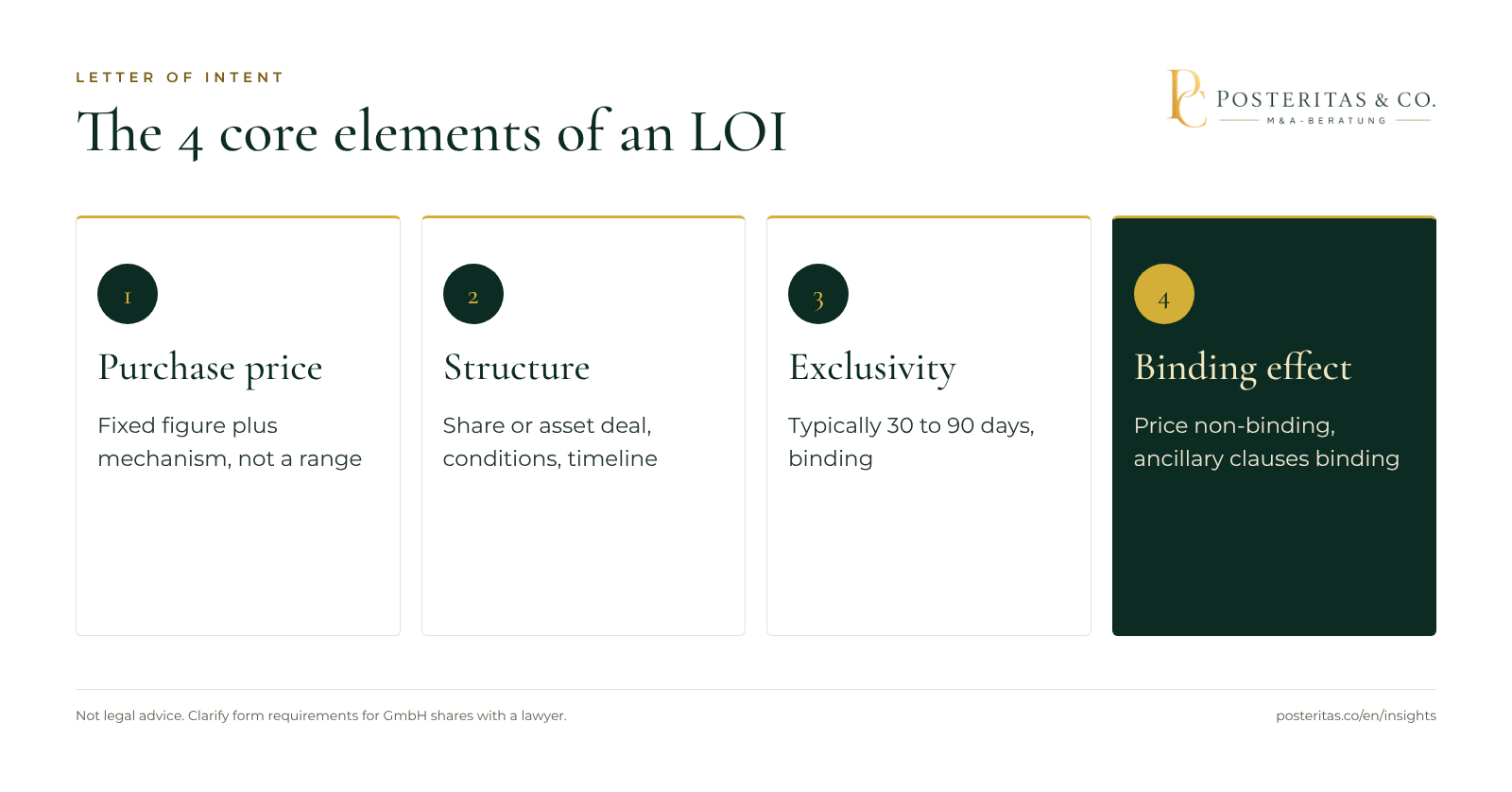
A letter of intent is a written declaration of intent in which a prospective buyer sets out the key terms of its offer: purchase price, structure, financing, scope of review and timetable. It is generally not binding and does not create a claim to conclude the purchase agreement (SE Legal). Individual clauses such as confidentiality and exclusivity, however, are usually expressly made binding. If the seller countersigns the LOI, this signals a wish to complete the deal on that basis (ROSE & PARTNER).
How does the LOI differ from an indicative offer, a term sheet and an MoU?
The LOI is more concrete than an indicative offer and less binding than a preliminary agreement. The terms are not used consistently in practice. What always matters is what the document says about its binding effect, not the heading.
| Document | Timing | Typical content | Binding effect |
|---|---|---|---|
| Indicative offer | After the teaser and information memorandum | Price range, basic assumptions, financing concept | Non-binding |
| Letter of intent | After management meetings, before due diligence | Price, mechanism, structure, exclusivity, timetable | Commercially non-binding, ancillary clauses binding |
| Term sheet | Alongside or instead of the LOI | Key terms in bullet points, often negotiated by both sides | As LOI, depending on the wording |
| Memorandum of understanding (MoU) | After countersignature or joint drafting | Interim results of both sides | Stronger than an LOI, but no claim to completion |
| Declaration of intent (Absichtserklärung) | German umbrella term | As LOI | As LOI |
| Preliminary agreement (Vorvertrag) | Rare in M&A | All essential points of the purchase agreement | Binding; notarisation required for GmbH shares |
According to SE Legal, an MoU is created when the seller signs the LOI or both sides draft it jointly. A preliminary agreement, by contrast, already contains all the essential points and is binding (WEKA).
When is the LOI signed in the sale process?
The LOI comes after the indicative offers and the management meetings and before the in-depth due diligence. In a structured auction process, the seller usually obtains several LOIs, compares them and grants one bidder exclusivity. This is followed by due diligence, negotiation of the share purchase agreement (SPA), signing and closing. Our guide to the business sale process describes the overall sequence.
Important: with signature, negotiating power shifts. Before the LOI, several buyers compete for your company. Afterwards, you negotiate with only one, who collects arguments for price reductions during due diligence. Anything you do not record in the LOI will be harder to enforce later.
Which clauses does a typical LOI contain?
An LOI sets out the commercial key terms and the rules of play for the exclusivity phase. The following overview shows the usual clauses and their typical binding effect.
| Clause | Content | Binding? |
|---|---|---|
| Purchase price and mechanism | Enterprise value, bridge to equity value, locked box or closing accounts, earn-out where applicable | No |
| Structure | Share deal or asset deal, scope of shares, rollover equity | No |
| Proof of financing | Own funds, bank commitment, fund commitment | No |
| Due diligence scope | Areas (financial, tax, legal, technical), data room, expert sessions | No |
| Timetable | Review period, SPA draft, target signing | No |
| Exclusivity | No parallel negotiations for a fixed period | Yes |
| Confidentiality | Reference to the NDA, non-solicitation of employees | Yes |
| Costs | Each side bears its own costs, exceptions | Yes |
| Break-up fee | Lump sum if negotiations are broken off without reason | Yes, if agreed |
| Role of the seller | Transition period, consulting agreement, management after closing | No |
| Conditions | Board approval, merger control, financing, outcome of due diligence | No |
| Choice of law and jurisdiction | Applicable law, competent court | Yes |
On exclusivity, the law firm ARROWS cites a typical duration of 30 to 90 days, or longer where appropriate. Due diligence then usually takes 2 to 6 weeks, but in practice often stretches over several months (ARROWS). It is also customary for each side to bear its own advisory costs, even if the deal fails (ROSE & PARTNER).
How binding is an LOI under German law?
An LOI does not oblige the parties to complete, but it does create a pre-contractual obligation. Under § 311 (2) BGB, the mere commencement of contract negotiations gives rise to duties of consideration under § 241 (2) BGB. If these are breached, damages may be due under culpa in contrahendo (§ 280 (1) BGB).
Breaking off contract negotiations. Each party may in principle withdraw at any time. A claim only arises if one side has attributably created confidence that the deal would certainly be concluded and then breaks off without good reason. For contracts subject to formal requirements, such as share purchases requiring notarisation, the German Federal Court of Justice (BGH) additionally requires a serious, intentional breach of good faith (SE Legal). As a rule, only the reliance damage is compensated, that is, wasted costs, not the lost purchase price.
Notarial form for GmbH shares. Under § 15 (4) GmbHG, any agreement that creates an obligation to assign a share in a German GmbH requires notarial form. An LOI with a genuine obligation to sell would be void for lack of form without a notary. Indirect pressure can also suffice: in the view of the Paderborn Regional Court (LG Paderborn), a break-up fee so high that it in effect compels completion can trigger a notarisation requirement. The Munich Higher Regional Court (OLG München), by contrast, considered a pure reimbursement of proven due diligence costs, subject to a cap, to be free of formal requirements (Heuking). You can read more about formal requirements when selling shares under selling a GmbH.
Note: This article does not replace legal or tax advice. Have every LOI reviewed by a lawyer before signing, in particular the binding clauses and cost provisions.
How do sellers negotiate a good LOI?
Sellers should fix as much of the price and mechanism as possible in the LOI and keep exclusivity as short as possible. The negotiating position is strongest before signature.
Secure the price. Ask for a fixed figure instead of a range and define the bridge from enterprise value to equity value: what counts as financial debt, and what normalised working capital will be applied? You will find the fundamentals in our guides to purchase price negotiation and EBITDA multiples.
Hypothetical worked example. In the LOI, a buyer offers 6.0 times an adjusted EBITDA of €2.5 million, that is an enterprise value of €15.0 million. Less €3.0 million of net financial debt, this gives an equity value of €12.0 million. If the EBITDA is not defined as “adjusted as per annex”, the buyer can strike out €0.3 million of adjustments during due diligence. At the same multiple, this lowers the enterprise value by €1.8 million to €13.2 million and the equity value to €10.2 million, a reduction of 15 percent.
Keep exclusivity short. Agree a fixed period at the lower end of what is customary and link any extension to milestones, such as a draft purchase agreement by a set date. Exclusivity should end automatically if the buyer unilaterally lowers the price.
Limit price adjustments. Record that adjustments are only permitted in the event of material new findings from due diligence. A carefully prepared due diligence checklist reduces the scope for attack.
Check the financing. Ask for robust proof of financing. A buyer who only raises money after the exclusivity phase costs you time and market opportunities.
What are the most common mistakes sellers make with the LOI?
The most common mistake is treating the LOI as a formality. The following checklist shows typical mistakes and how to avoid them.
| Mistake | Consequence | Better |
|---|---|---|
| Purchase price only as a range | Buyer negotiates towards the lower end | Fixed figure with a defined mechanism |
| Long or open-ended exclusivity | Other bidders drop out, pressure is lost | 30 to 60 days, extension only in writing |
| Only one LOI obtained | No basis for comparison | Several bidders in parallel until selection |
| Binding effect unclearly worded | Disputes over obligations, formal risk | Name binding clauses expressly |
| High break-up fee for GmbH shares | Possible notarisation requirement | Consider a capped cost reimbursement |
| Seller’s role left open | Late surprise regarding the transition period | Outline duration and remuneration in the LOI |
| Signed without advisors | Loss of value through weak clauses | Involve a lawyer and M&A advisor beforehand |
A further mistake: earn-out components are only mentioned in the LOI, not described. The basis of calculation, term and control rights already belong in this phase. Details can be found in our guide to the earn-out.
What is the next step after the LOI?
After signature, the exclusivity phase begins, with due diligence and negotiation of the purchase agreement. The better the LOI fixes the key terms, the less renegotiation there will be in this phase. Prepare the data room, adjusted figures and contact persons before you select the bidder.
If you are planning a sale or already have an offer on the table, an external view of the price, mechanism and exclusivity rules can be useful. You can read how Posteritas supports sellers under sell-side advisory. An initial conversation is confidential and without obligation.
Sources
- § 15 GmbHG, Übertragung von Geschäftsanteilen, Bundesministerium der Justiz, gesetze-im-internet.de, 2026
- § 311 BGB, Rechtsgeschäftliche und rechtsgeschäftsähnliche Schuldverhältnisse, Bundesministerium der Justiz, gesetze-im-internet.de, 2026
- Letter of Intent: Abgrenzung von Break-up Fee und Kostenerstattungsklauseln, Heuking Kühn Lüer Wojtek, 2014
- Schadensersatz bei Abbruch von Vertragsverhandlungen, SE Legal Rechtsanwälte
- M&A-Transaktionen: Absichtserklärung, Letter of Intent, SE Legal Rechtsanwälte
- Wie wird ein Unternehmen verkauft? Die Phasen des Unternehmensverkaufs vom LOI bis zum Post-Closing, ARROWS Rechtsanwaltskanzlei, 2026
- Letter of Intent (LoI), ROSE & PARTNER
- Absichtserklärung: So verfassen Sie bei M&A Transaktionen einen detaillierten Letter of Intent, WEKA Business Media
Frequently asked questions
Is a letter of intent legally binding in a business sale?
Essentially, no. An LOI generally does not create a claim to conclude the purchase agreement. Individual clauses such as exclusivity, confidentiality, costs and choice of law, however, are usually expressly agreed as binding and are then enforceable.
When in the sale process is the LOI signed?
The LOI follows the indicative offers and management meetings and comes before the in-depth due diligence. With it, the seller selects a preferred bidder and grants that bidder exclusivity. This is followed by the review, negotiation of the purchase agreement, signing and closing.
How long should exclusivity in the LOI last?
30 to 90 days is customary. From the seller's perspective, a short period with clear milestones is better, for example completion of due diligence and a first draft of the purchase agreement. An extension should only be possible by mutual agreement and in writing.
What is the difference between an LOI and a term sheet?
The term LOI is usually used for a declaration of intent in letter form, often issued unilaterally by the buyer. A term sheet lists the key terms in bullet points and is frequently negotiated by both sides. Legally, what matters is not the title but the content and the wording of the binding effect.
Does an LOI for the sale of GmbH shares have to be notarised?
A non-binding LOI generally does not. Under § 15 (4) GmbHG, however, any agreement that creates an obligation to assign shares in a German GmbH requires notarial form. A high break-up fee that in effect compels completion can therefore trigger a notarisation requirement.
Can I claim damages if the buyer pulls out after the LOI?
Only in exceptional cases. A claim based on culpa in contrahendo under § 311 (2) of the German Civil Code (BGB) requires that the buyer created confidence that the deal would certainly be concluded and then broke off without good reason. For contracts requiring notarisation, German case law additionally requires a serious, intentional breach of good faith.
What is a break-up fee in an LOI?
A break-up fee is a lump-sum payment that becomes due if one party breaks off negotiations without an agreed reason. It compensates the seller for exclusivity and advisory costs. It must be distinguished from a pure cost reimbursement, which only covers costs that have been proven.
Should the purchase price in the LOI be a fixed figure or a range?
For the seller, a fixed figure with a clear mechanism is better. A range invites the buyer to work towards the lower end during due diligence. The assumptions on net financial debt and working capital are also important.