
A business valuation answers the question of what a company will bring its owner economically in the future. For owners of mid-sized companies (the German Mittelstand), it is the basis of every sale or succession decision. Demand is growing: according to KfW Research, around 545,000 mid-sized companies are planning a succession by the end of 2029, and 42 percent of them are considering a sale to external parties. This overview explains methods, adjustments and value drivers.
Which business valuation methods are there?
Four groups of methods are used for mid-sized companies: the capitalised earnings method, the DCF method, multiples methods and the net asset value method. For tax purposes, there is also the simplified capitalised earnings method under the German Valuation Act (Bewertungsgesetz, BewG).
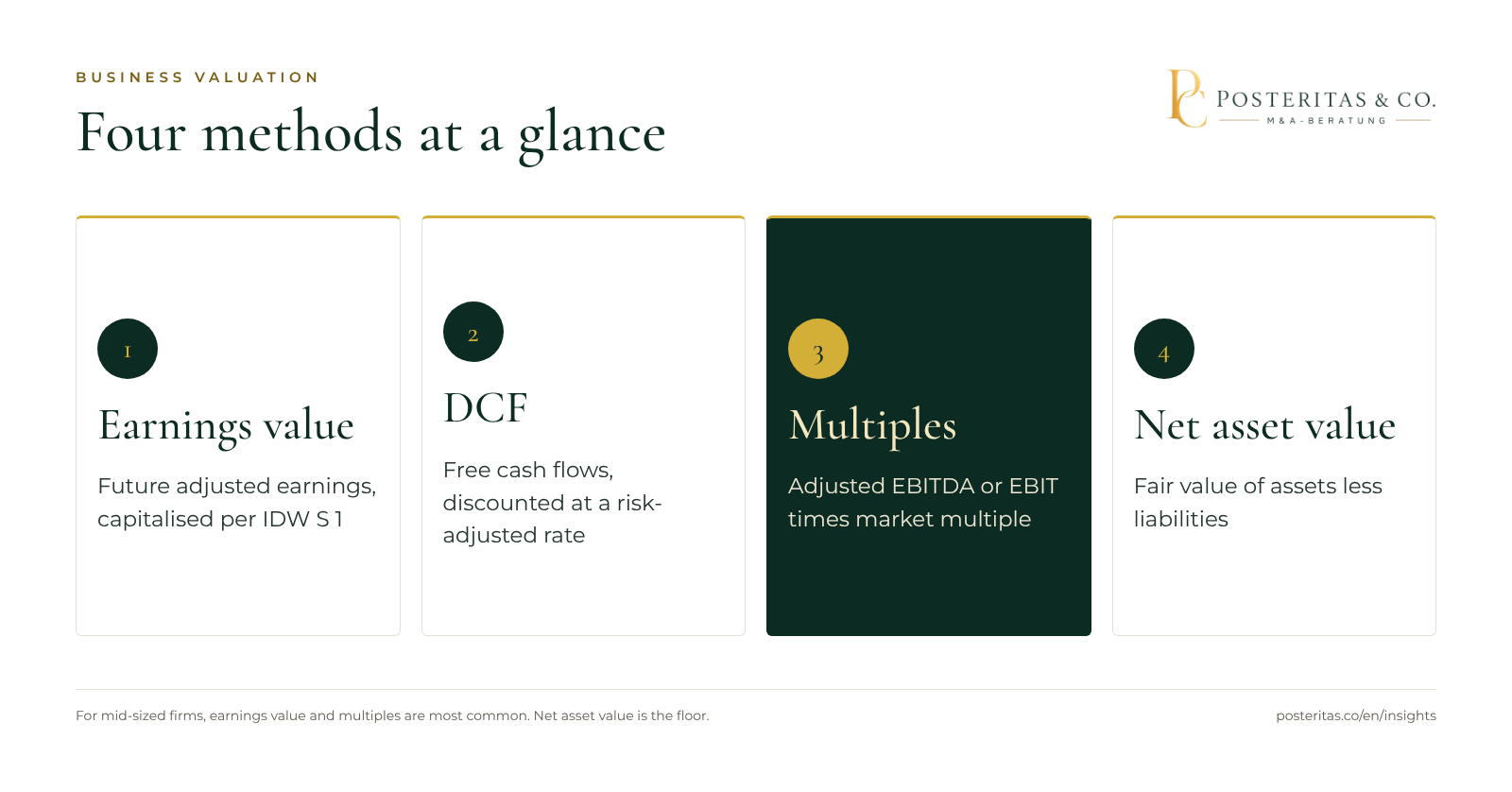
Capitalised earnings and DCF are present value methods. They discount future earnings or cash surpluses at a risk-adjusted rate. The authoritative framework in Germany is the standard IDW S 1 of the Institute of Public Auditors in Germany (IDW). On 8 April 2026, the IDW published a revised version that replaces the 2008 version. You can read how the derivation works in detail in the article on the capitalised earnings method.
For the capitalisation rate, valuers rely on the recommendations of the IDW’s Expert Committee for Business Valuation (FAUB). According to KPMG, in September 2025 the FAUB lowered its recommendation for the market risk premium before personal taxes to 5.25 to 6.75 percent, from 6 to 8 percent previously.
Multiples derive the value from the prices of comparable transactions, usually as a multiple of adjusted EBITDA or EBIT. How these factors arise and where their limits lie is explained in the article on EBITDA multiples.
| Method | Basis | Suitable for | Strengths | Weaknesses |
|---|---|---|---|---|
| Capitalised earnings (IDW S 1) | Planned, adjusted results, capitalised | Sale, succession, expert opinions, disputes | Recognised, traceable, takes planning into account | Demanding, highly dependent on planning and interest rate |
| DCF | Free cash flows, discounted | Growth companies, investors | Reflects investments and working capital | Many assumptions, terminal value often dominates |
| Multiple | Adjusted EBITDA or EBIT times market factor | Initial assessment, plausibility check | Fast, close to the market, familiar to buyers | Comparability often limited, not very individual |
| Net asset value | Fair values of assets less liabilities | Companies with weak earnings or high fixed assets | Tangible, good floor | Ignores earning power and goodwill |
| Simplified capitalised earnings method (BewG) | Average result of 3 years times 13.75 | Inheritance and gift tax | Defined by law, simple | Not a market value, often too high or too low |
When does a company need a valuation?
You need a valuation whenever shares change owner or claims have to be measured. The occasion determines the method, the depth and the appropriate valuer.
| Occasion | Typical objective | Usual method |
|---|---|---|
| Sale to external parties or investors | Realistic market price | Capitalised earnings or DCF, checked for plausibility with multiples |
| Succession within the family | Fair value, tax structuring | Capitalised earnings, plus BewG for tax |
| Inheritance or gift | Tax value under § 11 BewG | Simplified capitalised earnings method or expert opinion |
| Shareholder exit, settlement payment | Objectified, robust value | Expert opinion under IDW S 1 |
| Divorce, division of an estate | Value that will stand up in court | Expert opinion under IDW S 1 |
| Financing, strategic planning | Assessment of the current position | Multiples, short valuation |
If you are planning a business succession, an early valuation pays off. According to the DIHK Business Succession Report 2025, 38 percent of owners start planning too late, often only one to two years before their desired exit.
What is the difference between value and price?
Value is a calculated result, price is a negotiated one. A valuation provides a reasoned range. The actual purchase price additionally depends on the type of buyer, synergies, competition among bidders, financeability and contract clauses such as an earn-out or warranties.
Expectations and the market often diverge. According to the DIHK Report 2025, 36 percent of owners handing over their business have excessive purchase price expectations. According to the KfW Succession Monitor 2025, price expectations have risen by around 34 percent in nominal terms since 2019. How value and negotiation turn into a price is described in the article on purchase price negotiation.
What is the simplified capitalised earnings method under the BewG?
The simplified capitalised earnings method (vereinfachtes Ertragswertverfahren) is a German tax method for inheritance and gift tax. Under § 201 BewG, the average of the operating results of the last three financial years is calculated. § 202 (3) BewG reduces a positive result by a flat 30 percent for income taxes. Under § 203 BewG, the capitalisation factor is fixed at 13.75. This corresponds to a capitalisation rate of around 7.3 percent.
Under § 11 (2) BewG, net asset value applies as the floor. In addition, priority is to be given to the method that an acquirer would use as the basis for measuring the purchase price. Under § 199 BewG, the simplified method may only be applied if it does not lead to obviously incorrect results. In practice, a lower value can be substantiated by an expert opinion.
Worked example
The following figures are a simplified example and not industry values.
- Adjusted operating results: €900,000, €1,000,000 and €1,100,000
- Average: €1,000,000
- Less 30 percent income taxes: €700,000
- Times factor 13.75: €9,625,000 tax value
A buyer calculates differently. Suppose the same company has adjusted EBITDA of €1,400,000 and buyers in this example pay 5 to 6 times that. This results in an enterprise value of €7.0 to 8.4 million before deduction of net financial debt. Here, the tax value is therefore well above the market value. You will find a step-by-step guide in the article Calculating business value.
Note: This article does not replace tax or legal advice. Have tax values checked in each individual case by your tax advisor or auditor.
Which adjustments are needed before a valuation?
Before any valuation, the result is adjusted for items that a buyer would not take over in that form. The aim is the sustainably achievable result. § 202 BewG expressly lists these corrections for tax purposes, and the same logic applies in the sale process.
| Adjustment | Direction | Example |
|---|---|---|
| Owner’s salary | Usually reduces earnings | Owner draws €80,000, an external managing director costs €180,000 |
| Family members working in the business | Reduces earnings | Unpaid work is recognised at a market salary |
| One-off effects | Both directions | Litigation costs, insurance reimbursement, sale of assets |
| Rent paid to shareholders | Both directions | Operating property belongs to the owner, rent not at market rate |
| Private expenses | Increases earnings | Vehicles or travel without business purpose |
| Non-operating assets | Valued separately | Securities, unused land |
An example shows the leverage: if the market-rate owner’s salary is €100,000 above the salary paid so far, adjusted EBITDA falls by this amount. With an assumed multiple of 5, this reduces the enterprise value by €500,000.
Which factors increase or reduce business value?
The value of a mid-sized company is determined above all by how secure and transferable its earnings are. The IDW Practice Note 1/2014 on the valuation of small and medium-sized enterprises therefore puts transferable earning power at the centre. Earnings that depend on the owner melt away after a change of ownership.
| Value driver | Increases value | Reduces value |
|---|---|---|
| Owner dependency | Second management level, documented processes | Owner alone holds customers, sales and technology |
| Customer structure | Broad base, framework agreements | One customer with a high share of revenue |
| Earnings development | Stable or rising margins | Strong fluctuations, special effects |
| Planning | Traceable, supported by actual figures | Missing or unrealistic |
| Investments | Modern equipment, digital systems | Investment backlog |
| Recurring revenue | Maintenance, service, subscriptions | Pure project business |
Owner dependency and customer concentration are the most common reasons for discounts in mid-sized companies. Buyers respond with lower multiples, earn-outs or long transition phases.
Who prepares a business valuation?
Auditors, M&A advisors and tax advisors value companies, but for different purposes. The choice depends on the occasion.
- Auditors prepare formal expert opinions under IDW S 1. These are common for settlement payments, disputes or before courts.
- M&A advisors value from the market’s perspective. They know buyer groups, transaction multiples and room for negotiation.
- Tax advisors often value for inheritance and gift purposes and provide an initial orientation based on the financial statements.
In a sale, the roles complement each other: the tax advisor prepares the figures, and the M&A advisor estimates the achievable price.
What does a business valuation cost and how long does it take?
Costs and duration depend on the purpose, the size and the quality of the documents. There is no fixed fee schedule; billing is usually based on time spent or a flat fee.
An initial value indication based on existing annual financial statements and a rough plan is often possible within a few days. A full expert opinion under IDW S 1 with integrated planning, analysis and documentation usually takes several weeks and is correspondingly more expensive.
Which mistakes should you avoid in a business valuation?
Most mistakes arise from wrong reference figures and missing adjustments. These seven are particularly common:
- Treating the tax value as the market price. The value under the BewG is not a sale price.
- Using revenue multiples. Buyers pay for earnings, not revenue.
- Not adjusting the owner’s salary. This overstates earning power.
- Extrapolating the past. What is valued is the future, supported by a plausible plan.
- Confusing enterprise value and equity value. Net financial debt is deducted from enterprise value.
- Ignoring owner dependency. It often reduces value more than a weak balance sheet.
- Valuing too late. Value drivers can only be improved with lead time.
How do you take the next step as an owner?
The most sensible next step is a realistic value indication based on your adjusted figures. It shows where your company stands today and which levers can still increase its value before a sale.
If you are considering a sale, the article Selling a business gives you the complete overview. For an initial assessment of your situation, we offer a confidential introductory meeting.
Get your business valued
You receive an initial, market-based valuation indication for your company. Prepared personally, without obligation and strictly confidential. We will get back to you within two business days.
Sources
- Bewertungsgesetz (BewG), § 203 Kapitalisierungsfaktor, Bundesministerium der Justiz, Gesetze im Internet
- Bewertungsgesetz (BewG), § 202 Betriebsergebnis, Bundesministerium der Justiz, Gesetze im Internet
- Bewertungsgesetz (BewG), § 11 Wertpapiere und Anteile, Bundesministerium der Justiz, Gesetze im Internet
- Veröffentlichung der Neufassung des IDW S 1 i.d.F. 2026, Forvis Mazars, 2026
- Aktualisierte Kapitalkostenempfehlungen des FAUB, KPMG, 2025
- IDW-Praxishinweis zu Besonderheiten bei der Ermittlung eines objektivierten Unternehmenswerts kleiner und mittelgroßer Unternehmen, Betriebs-Berater (dfv Mediengruppe), 2014
- Nachfolge-Monitoring Mittelstand 2025: Pläne für Geschäftsaufgaben wachsen erneut, Kaufpreisvorstellungen deutlich gestiegen, KfW Research, 2026
- DIHK-Report Unternehmensnachfolge 2025, Deutsche Industrie- und Handelskammer (DIHK), 2025
Frequently asked questions
What is a business valuation?
A business valuation determines the economic value of a company at a specific valuation date. It is usually based on the future earnings or cash surpluses that can be transferred to a new owner. The result is a value or a value range, not a fixed purchase price.
Which valuation method is best suited to mid-sized companies?
For the sale of a profitable mid-sized company, capitalised earnings or DCF are usually combined with multiples. The capitalised earnings value under IDW S 1 provides a reasoned derivation, while multiples show what buyers pay in the market. Net asset value is relevant above all for companies with weak earnings or high fixed assets.
What is the difference between business value and purchase price?
Business value is the result of a calculation based on assumptions. The purchase price is the result of a negotiation and depends on the type of buyer, synergies, competition among bidders, financing and contract terms. The two can differ considerably.
How does the simplified capitalised earnings method under the German Valuation Act work?
Under §§ 200 to 203 BewG (German Valuation Act), the average operating result of the last three financial years is reduced by 30 percent for income taxes and multiplied by the capitalisation factor of 13.75. The method is used for inheritance and gift tax. It is unsuitable for sale negotiations because it does not reflect growth, risk or industry.
Why does the owner's salary have to be adjusted in a valuation?
Many owners pay themselves a salary that does not reflect market levels. A buyer, however, has to fill the management position on market terms. The profit is therefore corrected by the difference to the salary of an external managing director, as § 202 BewG also provides.
Who is allowed to prepare a business valuation?
In Germany, business valuation is not a reserved activity. Auditors (*Wirtschaftsprüfer*) prepare formal expert opinions under IDW S 1, for example for courts, settlement payments or shareholder disputes. M&A advisors value with a view to the achievable market price, and tax advisors often value for tax purposes and as an initial orientation.
How long does a business valuation take?
The duration depends on the purpose and on the quality of the documents. An initial value indication based on existing annual financial statements is often possible within a few days. A full expert opinion with integrated planning and documentation usually takes several weeks.
Which factors reduce the value of a mid-sized company?
Particularly value-reducing are a strong dependency on the owner, a few major customers with a high share of revenue, an investment backlog and unclear planning. A missing second management level and customer relationships that are verbal rather than secured by contract also reduce the transferable earning power.