
Business succession is more than a sale. It concerns your life’s work, your family, your employees and often your own retirement provision. If you plan succession early and in a structured way, you can choose between several good solutions. If you wait too long, you often end up with none. This article shows the options, a realistic timeline and the most important tax rules.
How big is the succession wave?
The figures below refer to Germany.
| Metric | Value | Source |
|---|---|---|
| Companies ready for handover 2026 to 2030 | around 186,000 | IfM Bonn |
| Planned successions in the Mittelstand by the end of 2029 | around 545,000 | KfW |
| Planned closures without succession by the end of 2029 | around 569,000 | KfW |
| Owners who prepare the handover too late | 38% | DIHK |
| Advised companies considering closure | 27% | DIHK |
The figures from the KfW succession monitoring show that more owners are planning a closure than a succession. According to the DIHK report, 27 percent of the companies advised by the chambers of commerce (IHKs) are considering closing down. The most common reason: no successor can be found.
What succession solutions are there?
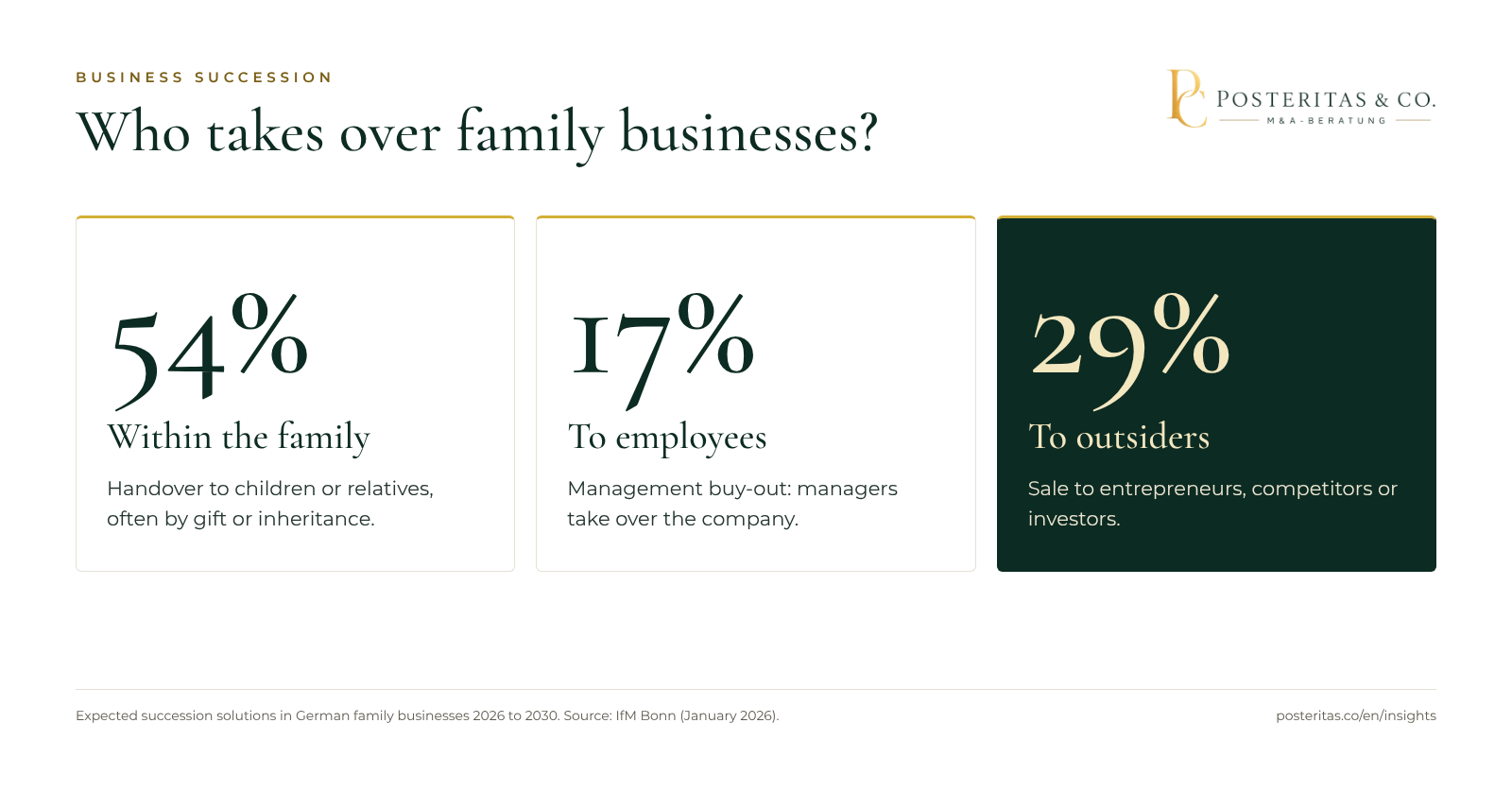
According to IfM Bonn, 54 percent of family businesses are handed over within the family, 17 percent to employees and 29 percent to external successors. The options compared:
| Option | Advantages | Challenges | Fits when |
|---|---|---|---|
| Family | Continuity, preservation of family wealth | Children’s suitability and willingness, fairness among siblings | A child wants to and is able to lead |
| Management buyout (MBO) | Knows the business, customers and employees | Limited own funds, financing | A strong second management level is in place |
| Management buy-in (MBI) | Fresh impetus, outside experience | Onboarding, acceptance within the team | External entrepreneur with industry knowledge |
| Sale to a strategic buyer | Often the highest price, synergies | Integration, changes to structures | Market position attractive to competitors |
| Sale to investors | Capital, professionalisation, rollover equity possible | Return expectations, later resale | Growth potential exists |
| Search fund | Entrepreneur takes over with investor capital | First experience as an entrepreneur | Solid, profitable company |
| Closure | Clear conclusion | Loss of value and jobs | No viable alternative |
A search fund is an entrepreneur who, with capital from investors, searches for, acquires and personally runs an owner-managed company. According to Unternehmeredition, typical target companies have EBITDA of around €1 million to €5 million. We describe external solutions in detail in our article Selling to investors.
What does a realistic timeline look like?
| Time before the handover | Task |
|---|---|
| 10 to 5 years | Fundamental decision: family, management or sale. Review tax structure, set up a holding company if appropriate |
| 5 to 3 years | Build a second management level, reduce dependence on the owner, normalise the figures |
| 3 to 2 years | Select a successor or prepare the sale process, business valuation |
| 2 to 1 year | Negotiation, financing for the successor, agreements |
| Handover | Notarial implementation, communication to employees and customers |
| 1 to 3 years afterwards | Transition period, advisory board or complete withdrawal |
A common mistake is planning succession and retirement at the same time. It is better to set up the company so that it also works without you. This increases its value and makes every succession solution easier.
Which taxes apply to a handover within the family?
The following rules apply under German law. Gift or inheritance tax is due on a gift or inheritance. For business assets, however, there are considerable reliefs.
| Rule | Content | Requirements |
|---|---|---|
| Personal allowance (§ 16 ErbStG, German Inheritance and Gift Tax Act) | Spouse €500,000, child €400,000, grandchild €200,000 | Per donor or testator, every ten years |
| Standard relief (Regelverschonung, § 13a ErbStG) | 85% of qualifying business assets tax-free | 5-year retention period, payroll total of 400% |
| Optional relief (Optionsverschonung, § 13a (10) ErbStG) | 100% tax-free | 7-year retention period, payroll total of 700%, non-operating assets max. 20% |
| Small businesses | Payroll rule does not apply | Up to 5 employees |
| Large acquisitions | Tapering of relief or relief needs assessment | Over €26 million in qualifying assets |
Sources: REB Steuerberatung, § 16 ErbStG. For 6 to 15 employees, staggered, lower payroll thresholds apply. If the conditions are breached, for example by a sale within the retention period, the relief is lost on a pro rata basis. So if you hand over to your children and do not rule out a later sale, you should calculate the tax consequences beforehand.
In a sale to outsiders, by contrast, income tax is due on the capital gain, see The business sale process.
How is the takeover financed?
In MBOs and MBIs in particular, the successor rarely has enough equity. Typical building blocks:
| Building block | How it works | Risk for the seller |
|---|---|---|
| Successor’s equity | Own funds as a basis, usually required by banks | Low |
| Bank loans and development loans | Financing via the house bank and public funding programmes | Low |
| Vendor loan | Owner defers part of the purchase price | Medium, depends on success |
| Earn-out | Part of the price depends on future results | Medium |
| Investor as partner | Financial investor takes the majority, management participates | Low to medium |
| Gradual takeover | Shares are transferred over several years | Medium, see Selling company shares |
Why does every company need an emergency plan?
Succession is not just a question of age. An accident or illness can take the owner out of action overnight. The IHK Braunschweig recommends an emergency kit containing:
- Arrangements for deputisation by a competent person
- Bank and other powers of attorney
- Articles of association and commercial register extract
- Credit and loan agreements as well as important customer and supplier agreements
- Access credentials, keys and storage locations of important documents
The emergency kit should be updated regularly, because personal and business circumstances change constantly.
Which mistakes should you avoid in succession?
| Mistake | Consequence | Better approach |
|---|---|---|
| Starting too late | No choice left, sale under time pressure | Allow five to ten years of lead time |
| Child designated as successor without being asked | Lack of motivation, conflicts | Open conversation, review alternatives |
| Siblings treated unequally | Family disputes | Arrange compensation via private assets or company shares |
| Company depends on the owner | Loss of value in every solution | Build a second management level |
| Taxes only reviewed at handover | Relief missed, high tax burden | Plan the tax structure years in advance |
| No emergency plan | Standstill if the owner is incapacitated | Create and maintain an emergency kit |
| Letting go not planned | Successor cannot lead | Clearly agree your role after the handover |
Conclusion
A good succession is no coincidence but the result of planning. If you decide early which route suits your family and company, make use of the tax rules and set up the company to be independent of its owner, you will have a choice in the end. If the solution is a sale, read on in our guide Selling a business.
Sources
- Unternehmensnachfolgen in Deutschland 2026 bis 2030 (IfM Bonn), IHK Dresden, January 2026
- Nachfolge-Monitoring Mittelstand 2025 (KfW Research Fokus Nr. 526), KfW Research, Dr. Michael Schwartz, January 2026
- DIHK-Report Unternehmensnachfolge 2025, Deutsche Industrie- und Handelskammer, July 2025
- Betriebsvermögen und Erbschaftsteuer: Verschonungsregelungen nach § 13a ErbStG, REB Steuerberatung
- § 16 ErbStG: Freibeträge, lxgesetze.de
- Unternehmensnachfolge: Vorbereitung für den Notfall, IHK Braunschweig
- Search Funds als Nachfolgelösung im Mittelstand, Unternehmeredition, January 2026
Frequently asked questions
When should I start succession planning?
Ideally five to ten years before your planned withdrawal. For preparing the company itself, for example building a second management level, you should allow at least two to three years. According to the DIHK, 38 percent of owners prepare the handover too late.
What is the difference between an MBO and an MBI?
In a management buyout (MBO), executives from within the company take over. In a management buy-in (MBI), an external manager buys the company and takes over its management. The MBO offers continuity; the MBI brings fresh impetus but less knowledge of the business.
How much inheritance tax is due when handing over to children?
Under German law, children have a personal allowance of €400,000 per parent. For qualifying business assets, a relief deduction of 85 percent (standard relief) or 100 percent (optional relief) also applies if the retention period and payroll requirements are met. The actual tax depends on the individual case.
What happens if no successor is found?
Then closure is often the only option left. According to KfW, around 569,000 owners are not aiming for continuation by the end of 2029. A sale to outsiders, including investors or search funds, is often the alternative if neither family nor management takes over.
How can a successor finance the purchase price?
The usual approach combines the successor's own equity, bank loans, development loans and a vendor loan, in which the owner defers part of the purchase price. An earn-out or a gradual takeover of the shares can also help.
What belongs in an emergency kit for business owners?
According to the IHK, among other things: arrangements for deputisation, bank and other powers of attorney, the articles of association, a commercial register extract, important loan, customer and supplier agreements, as well as access credentials and storage locations. The kit should be updated regularly.
Can I give away the company and still retain income?
Yes, for example via a usufruct (Nießbrauch) or maintenance payments agreed at the time of the handover. These arrangements are demanding from a tax perspective and should be planned with a tax advisor and a notary.
Is a search fund a succession solution?
Yes. A search fund is an entrepreneur who, with capital from investors, specifically searches for, buys and personally runs an owner-managed company. Typical targets are companies with EBITDA of around €1 million to €5 million.