
An earn-out in the purchase agreement links part of the purchase price to the future development of your company. For buyers it reduces risk; for sellers it opens the way to a higher total price. Yet the earn-out clause is one of the provisions in a company purchase agreement most prone to disputes. This guide shows how earn-outs work, how to structure them and how they are taxed in Germany.
What is an earn-out in the purchase agreement?
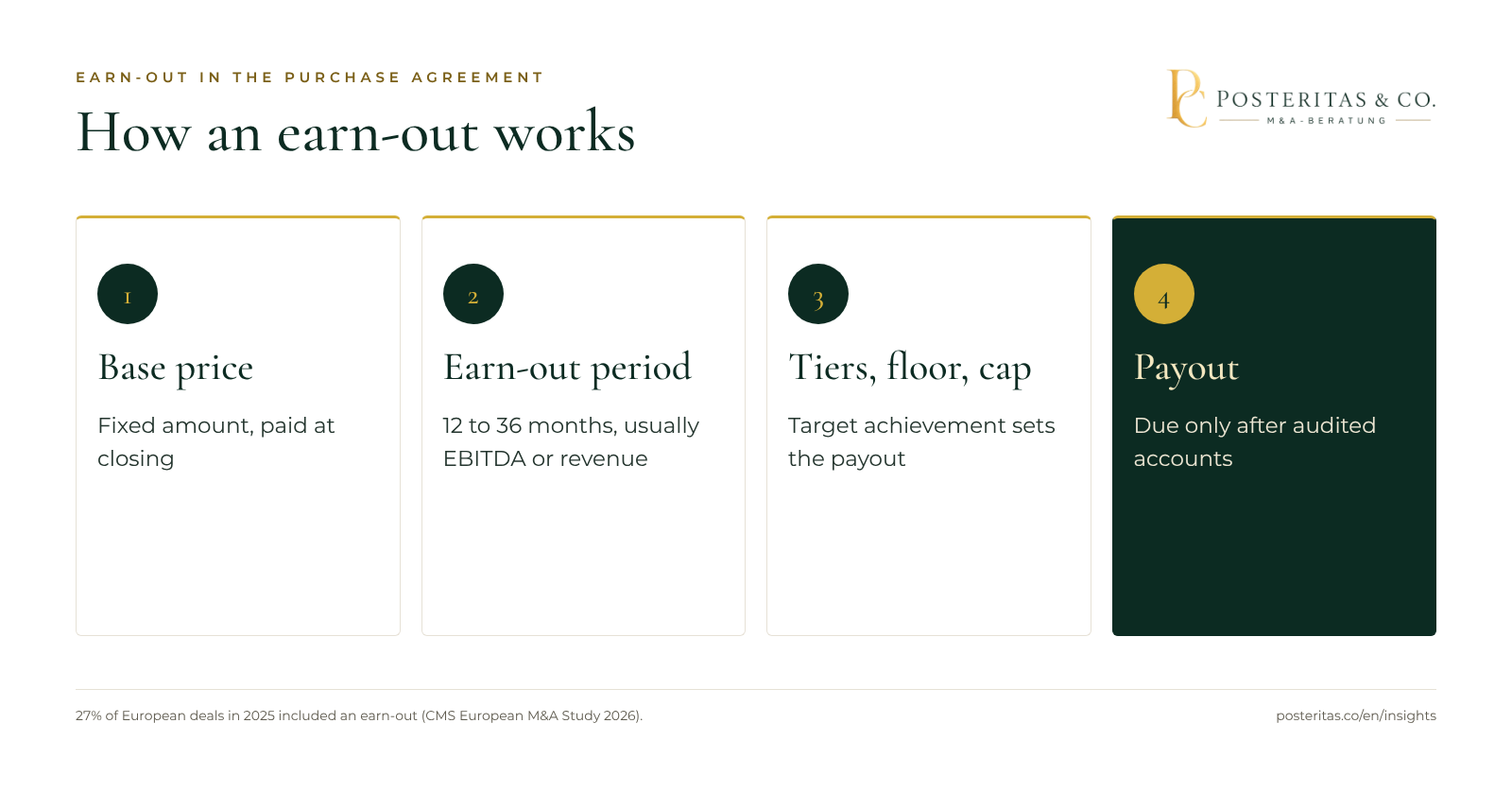
An earn-out is a conditional, variable portion of the purchase price that the buyer only pays if the company reaches agreed targets after closing. The purchase price is thus divided into two parts: a fixed base purchase price paid on completion, and a performance-related part that becomes due after the end of one or more measurement periods. The targets are usually financial metrics such as EBITDA or revenue, less often operational milestones.
Why do buyers and sellers agree an earn-out?
An earn-out bridges the valuation gap between buyer and seller. The seller values the company on the basis of its business plan, the buyer on the basis of its proven track record. If the two views diverge, the earn-out shifts part of the dispute into the future: if the plan is achieved, the seller receives the higher price. If the result fails to materialise, the buyer pays less.
Typical occasions are strong expected growth, a new product, a major customer being acquired or a business that depends heavily on the person of the owner. How price expectations form during the process is explained in our article on purchase price negotiation.
How common are earn-outs?
Earn-outs are more common in Europe than ever before. According to the CMS European M&A Study 2026, which analyses 601 transactions from 2025, 27 percent of deals included an earn-out. In 2024 the figure was 25 percent, and the average for the years 2015 to 2024 was around 23 percent. Earn-outs are most common in transactions below €25 million and in the technology, media and communications sector (44 percent).
The terms are also well documented:
| Term of the earn-out | Share in 2025 (Europe) |
|---|---|
| under 6 months | 7% |
| 6 to 12 months | 20% |
| 12 to 24 months | 33% |
| 24 to 36 months | 25% |
| over 36 months | 15% |
Source: CMS European M&A Study 2026.
There is hardly any public data for Europe on the share of the purchase price. For US deals outside life sciences, the median earn-out according to SRS Acquiom 2024 was 31 percent of the payments at closing, with an average term of 24 months. These figures can only be applied to the German Mittelstand (mid-sized, owner-managed companies) to a limited extent.
Which metrics are suitable for an earn-out?
The metric should be objectively measurable and as little open to influence by the buyer as possible. According to CMS, 55 percent of European earn-outs in 2025 used EBIT or EBITDA, and 21 percent revenue. Each metric has strengths and weaknesses:
| Metric | Advantages | Disadvantages |
|---|---|---|
| Revenue | easy to measure, little scope in cost allocation | says nothing about profitability, incentive for low-margin growth |
| EBITDA | reflects operating earning power, fits with EBITDA multiples | vulnerable to group charges, cost shifts and accounting options |
| EBIT | takes depreciation and investment into account | the buyer’s investment decisions directly affect the result |
| Milestones | clear, often binary (approval, contract signed, customer won) | all-or-nothing effect, disputes over whether the target was met |
The valuation basis and the metric should match. If the purchase price is derived using an EBITDA multiple, an EBITDA earn-out is the natural choice. You can find more on the derivation in our article on business valuation.
How is an earn-out calculated? A worked example
An earn-out is calculated using a formula set out in the contract, based on the metric and the degree of target achievement. The following example is hypothetical and has been recalculated using Python.
Assumptions: base purchase price €8.0 million. Earn-out over two financial years, with a maximum of €1.0 million per year, giving a total cap of €2.0 million. The metric is adjusted EBITDA. The scale per year:
- Floor (minimum threshold): no payment below €1.6 million EBITDA
- €1.6 million to under €1.8 million: 40 percent of the annual amount
- €1.8 million to under €2.0 million: 70 percent of the annual amount
- €2.0 million or more: 100 percent (cap per year)
| Scenario (hypothetical) | EBITDA year 1 | EBITDA year 2 | Total earn-out | Total purchase price |
|---|---|---|---|---|
| A: plan missed | €1.55m | €1.70m | €0.4m | €8.4m |
| B: plan narrowly missed | €1.85m | €1.95m | €1.4m | €9.4m |
| C: plan exceeded | €2.10m | €2.40m | €2.0m | €10.0m |
In scenario C the cap applies: exceeding the target does not increase the earn-out any further. In scenario A the floor applies in the first year. A scale prevents all-or-nothing effects, but at each step it creates an incentive to steer results to just above or just below the threshold.
What belongs in an earn-out clause?
A robust earn-out clause governs above all how the metric is determined and what the buyer may do during the term. CMS and Rödl & Partner identify unclear definitions and calculation bases as the main causes of later disputes. These points belong in the contract:
| Provision | Content |
|---|---|
| Definitions | exact formula for the metric, adjustments, treatment of one-off effects and group charges |
| Accounting principles | fix the accounting standard and valuation methods, require consistency |
| Conduct and continuation obligations | continuation in the ordinary course of business, prohibition of deliberate profit shifting, consent requirements |
| Information and audit rights | access to financial statements and the calculation, inspection by the seller’s auditor |
| Security | bank guarantee, escrow account or parent company guarantee for the earn-out amount |
| Dispute resolution | deadlines for objections, an expert for calculation issues, an arbitral tribunal for legal issues |
| Change of control | rule for resale, merger or integration of the company |
| Acceleration | immediate payment of the earn-out on breach of contract or change of control |
Acceleration clauses are widespread: according to SRS Acquiom, almost 25 percent of US deals outside life sciences between 2014 and 2023 included acceleration on a change of control. The clause should be negotiated early, ideally already in the letter of intent.
What risks does the seller bear with an earn-out?
The seller’s main risk: they give up control but remain economically exposed to the result. The buyer can allocate costs, bring investments forward or shift customers to other group companies. In addition, there are credit and dispute risks.
| Risk for the seller | Countermeasure |
|---|---|
| Profit shifting through group charges | Cap charges or exclude them from the metric |
| Change of accounting methods | Fix principles and consistency in the contract |
| Integration or resale | Change of control clause with acceleration |
| Lack of transparency | Information and audit rights, reporting deadlines |
| Buyer default | Bank guarantee, escrow account or parent company guarantee |
| Protracted dispute over the calculation | Expert determination with clear deadlines |
| Dependence on your own continued involvement | Link the earn-out to your managing director role and powers |
Check during due diligence how the buyer manages subsidiaries and allocates costs. This article does not replace legal or tax advice. Have the clause reviewed by specialist lawyers and tax advisors.
How is an earn-out taxed in Germany?
Under the established case law of the German Federal Fiscal Court (Bundesfinanzhof, BFH), an earn-out is only taxed in Germany when it is realised, not in the year of sale. In principle, the capital gain arises at the time of disposal. For profit- or revenue-linked purchase price claims, however, the BFH looks to the realisation of the consideration (BFH, judgment of 19 December 2018, I R 71/16). For a selling corporation, this means: the earn-out instalments are disregarded under § 8b (2) KStG in the year in which they are received, with 5 percent treated as non-deductible business expenses.
For the sale of a partnership interest, the BFH followed up in 2023 (judgment of 9 November 2023, IV R 9/21). Earn-out payments that are uncertain as to whether and how much will be paid do not increase the capital gain in the year of sale. They are to be recognised on receipt as subsequent business income. According to Deloitte, the preferential tax rate for capital gains does not apply to them.
For you as the seller, this means: allowances and reduced tax rates may in some circumstances only apply to the fixed portion of the purchase price. The structure of the earn-out therefore affects your net proceeds. Clarify the tax treatment with your tax advisor before the contract is finalised.
What alternatives are there to an earn-out?
The most important alternatives are the vendor loan and rollover equity. Both defer payment or share risk without linking the purchase price to a metric.
- Vendor loan: the seller defers part of the fixed purchase price in return for interest. The amount is fixed; the risk lies in the buyer’s creditworthiness.
- Rollover equity: the seller reinvests part of the proceeds in the acquiring company and benefits on a later exit. This is customary above all when selling to investors.
The instruments are often combined, for example a moderate earn-out with a vendor loan.
What should your next step be with an earn-out?
First clarify how large the valuation gap is and which metric you can realistically influence. Then run through scenarios and define your minimum requirements for security and control rights. If you are preparing the sale of your company, we will be glad to discuss your starting position in a confidential initial meeting. You can find more about how we support you under sell-side advisory.
Sources
- CMS European M&A Study 2026, CMS, 2026
- The Art and Science of Earn-Outs in M&A, Harvard Law School Forum on Corporate Governance (A&O Shearman), 2025
- Steuerfreistellung nach § 8b Abs. 2 KStG bei gewinn- und umsatzabhängigen Kaufpreisforderungen (BFH, Urteil vom 19.12.2018, I R 71/16), Verlag Dr. Otto Schmidt, 2019
- BFH: Gewinnrealisierung bei Earn-out-Zahlungen (BFH, Urteil vom 09.11.2023, IV R 9/21), Deloitte Tax News, 2024
- § 8b Körperschaftsteuergesetz: Beteiligung an anderen Körperschaften und Personenvereinigungen, Bundesministerium der Justiz (gesetze-im-internet.de)
- Earn-Out-Klauseln in Zeiten wirtschaftlicher Unsicherheit: Chance oder Risiko?, CMS Deutschland, 2025
- Earn-Out-Klauseln im Unternehmenskauf: Flexibilität für Käufer und Verkäufer, Rödl & Partner, 2026
Frequently asked questions
What is an earn-out in the purchase agreement?
An earn-out is a conditional, variable part of the purchase price. The buyer only pays it if the company sold reaches agreed metrics or milestones after closing. The rest of the purchase price is paid as the base purchase price on completion.
How common are earn-outs in Europe?
According to the CMS European M&A Study 2026, around 27 percent of the 601 European transactions analysed in 2025 included an earn-out. That is the highest figure since the study began. Earn-outs are most common in deals below €25 million and in the technology, media and communications sector.
Which metric is best for an earn-out?
That depends on the business model and the buyer's influence. EBITDA reflects earning power but is vulnerable to the buyer's cost allocations. Revenue is harder to manipulate but says little about profitability.
How long does an earn-out usually run?
According to CMS, 58 percent of earn-outs in Europe in 2025 ran for 12 to 36 months. Only 15 percent were longer than 36 months. The longer the term, the greater the buyer's influence on the result.
What share of the purchase price does the earn-out account for?
Reliable European figures on this are scarcely available publicly. For US deals outside life sciences, the median according to SRS Acquiom 2024 was 31 percent of the payments at closing. In each individual case, the share depends on the valuation gap and the risk of the business plan.
When must an earn-out be taxed in Germany?
Under BFH case law, profit- or revenue-linked purchase price components are only recognised at the time of their realisation (BFH, 19 December 2018, I R 71/16). For partnership interests, the BFH ruled in 2023 that earn-out payments are to be taxed as subsequent business income on receipt (IV R 9/21). Have the consequences for your case reviewed by a tax advisor.
How does the seller protect against manipulation of the earn-out?
Through precise definitions of the metrics, fixed accounting principles and obligations on the buyer to continue the business. These are supplemented by information and audit rights, an expert to determine disputes over the calculation and an acceleration clause in the event of a resale or integration.
What alternatives are there to an earn-out?
Common alternatives are a vendor loan and rollover equity for the seller. With a vendor loan, the amount is fixed and only the payment is deferred. With rollover equity, the seller benefits from the increase in value through a later exit.