
For many mid-sized companies in the German-speaking region, Central and Eastern Europe has long ceased to be an exotic market. Supply chains, subsidiaries and customers are located there. But if you want to make an acquisition, sell a subsidiary or win a buyer from the region, you need more than good contacts. This guide shows what matters in M&A advisory in Eastern Europe. It does not replace legal or tax advice; every transaction requires local lawyers and tax advisors.
Why is Central and Eastern Europe attractive for mid-sized companies in the DACH region?
Because the region is closely intertwined with the German economy, grows faster and continues to offer cost advantages. According to calculations by the German Eastern Business Association (Ost-Ausschuss) based on Destatis data, German trade with Poland reached around €180.4 billion in 2025, with the Czech Republic around €115.7 billion and with Hungary around €65.6 billion. Total trade with the East amounted to about €550 billion.
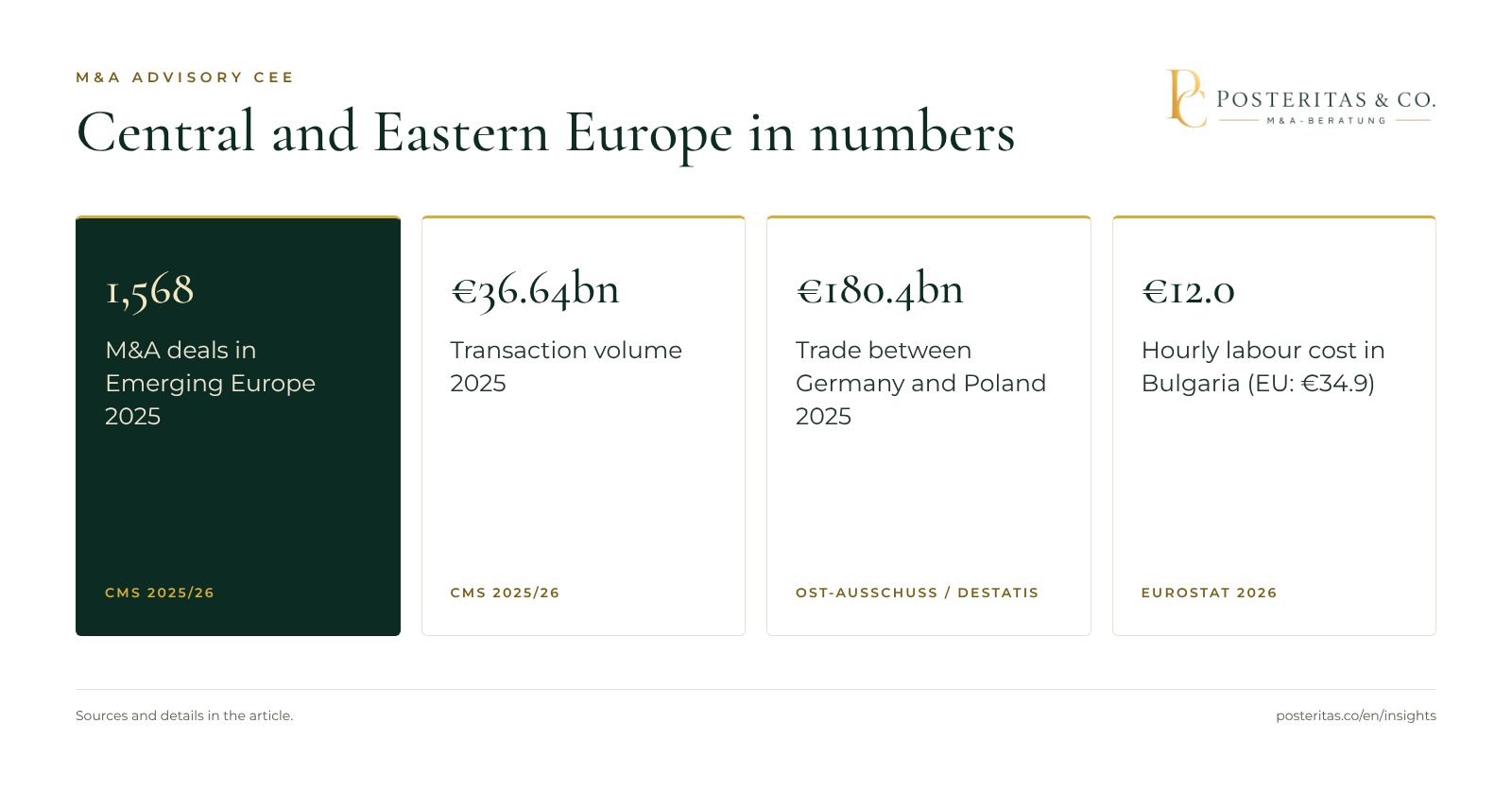
Nearshoring comes on top. Many companies are relocating production from Asia closer to their home market. Labour costs also remain a factor. Eurostat puts average hourly labour costs in 2025 at €34.9 in the EU, €12.0 in Bulgaria, €13.6 in Romania and €15.2 in Hungary. The gap is narrowing, however, because wages in the region are rising considerably faster.
What is the M&A market situation in Central and Eastern Europe in 2025 and 2026?
The market is livelier than ever. The CMS Emerging Europe M&A Report 2025/26 counts a total of 1,568 transactions for 2025, an increase of 22.4%. Volume rose by 42.5% to €36.64 billion. Poland led with 331 deals and €13.76 billion; Romania ranked second by number of deals and reached a record figure.
Three findings are important for mid-sized companies. First, 60.8% of the transactions were cross-border. Second, by number of deals, Germany ranked third among investor countries with 71 transactions, behind the USA and the United Kingdom. Third, private equity reached a peak of 330 deals. This means more competition for good targets, but also more potential buyers for your subsidiary.
Sentiment is not the same everywhere. According to the AHK business survey 2026, analysed by Germany Trade & Invest, 90% of the companies surveyed in the Czech Republic would choose the location again. In Slovakia, by contrast, only 4% rate the situation as good. The choice of country therefore remains a case-by-case decision.
Which legal and tax key figures apply in the focus countries?
Each country has its own equivalent of the German GmbH (limited liability company), its own formal requirements and its own screening regimes. The following table provides an initial overview. Formal requirements and investment controls change frequently; always check the current position with local lawyers.
| Country | GmbH equivalent | Share transfer (general rule) | Investment control | Corporate income tax 2026 |
|---|---|---|---|---|
| Poland | sp. z o.o. | Written form with notarially certified signatures | Yes, permanent since 2025, mainly investors outside the EU/EEA/OECD | 19% (9% for small taxpayers) |
| Czech Republic | s.r.o. | Written form with certified signatures | Yes, investors outside the EU | 21% |
| Slovakia | s.r.o. | Written form, entry in the commercial register | Yes, investors outside the EU | 10%, 21% or 24% depending on income |
| Hungary | Kft. | Written form, entry in the company register | Yes, in strategic sectors in some cases EU investors too | 9% (plus local business tax) |
| Romania | SRL | Written form, shareholder consent, entry in the trade register | Yes, broadly defined screening regime | 16% (micro-enterprises 1% up to €100,000 turnover) |
| Bulgaria | EOOD/OOD | Written form with notarial certification | Yes, since 2024 for investors outside the EU | 10% |
The tax rates are taken from the PwC Worldwide Tax Summaries, as of 2026. Since 2025, Slovakia has applied tiers based on income. In 2026, Romania lowered the turnover threshold for the micro-enterprise tax from €250,000 to €100,000. On investment control: Poland made its screening regime permanent in July 2025. Hungary applies an emergency regime that, in the case of an acquisition of control in strategic sectors, can also cover acquirers from the EU, EEA and Switzerland.
It is also worth looking at the Baltic states and Croatia. Estonia and Latvia only tax profits on distribution. Croatia provides a reduced rate of 10% for smaller companies.
Why is business succession becoming an issue in Eastern Europe?
Because the first generation of private entrepreneurs after 1990 is now reaching retirement age. Many companies in Poland, the Czech Republic or Romania were founded in the 1990s. Their owners are looking for successors but often cannot find any within the family.
For DACH buyers, this creates a supply of established, profitable mid-sized companies. These companies are frequently tailored heavily to the founder. You should therefore plan for a transition phase with the seller, for example through rollover equity or a consultancy agreement. Our guide on business valuation explains how to determine the value of such companies.
Who buys and who is bought?
Buyer and target profiles differ depending on the direction of the transaction. Three constellations are typical for mid-sized companies in the German-speaking region.
| Constellation | Typical buyer | Typical target | Main motive |
|---|---|---|---|
| Acquisition in CEE | DACH mid-sized companies, strategic buyers | Suppliers, service providers, sales companies | Capacity, costs, market access |
| Sale of a CEE subsidiary | Local strategic buyers, regional private equity firms, international groups | Production or sales subsidiary | Portfolio streamlining, freeing up capital |
| Buyers from CEE in the DACH region | Polish, Czech, Hungarian corporate groups | Technology or brand companies | Know-how, brands, access to Western Europe |
The third constellation is often underestimated. Corporate groups from the region have grown and are making targeted acquisitions in the West. For owners in the DACH region, they can be serious bidders. You can find more on this in our guides on selling to investors and on M&A advisory in Germany and in Austria.
What risks are there and how do you address them?
The greatest risks lie in data quality, legal enforcement, currency and compliance. A structured process can reduce them considerably.
| Risk | Manifestation | Countermeasure |
|---|---|---|
| Data quality | Financial statements driven by tax considerations, gaps in management reporting | Financial due diligence, quality of earnings analysis |
| Legal uncertainty | Lengthy court proceedings, changing legislation | Arbitration clause, warranties, consider W&I insurance |
| Currency | Zloty, koruna, forint and leu fluctuate against the euro | Purchase price in euros, hedging, earn-out in euros |
| Anti-corruption compliance | Informal arrangements with authorities or customers | Compliance due diligence, indemnities |
| Official procedures | Investment and merger control extend the timetable | Early review, closing conditions in the contract |
| Ownership and real estate | Unclear land register situation, restitution issues | Legal due diligence by a local law firm |
Bulgaria has been part of the eurozone since January 2026, so the currency risk there largely disappears. In Poland, the Czech Republic, Hungary and Romania, it remains.
How does a transaction work and how is it structured?
At its core, the process is the same as a domestic sale, but it requires more coordination. The typical stages are preparation, outreach, indicative offers, due diligence, negotiation, signing and closing. Our guide on the business sale process provides an overview.
Three questions arise regarding the structure. First: acquisition directly or through a holding company? An intermediate holding company can facilitate financing and later exits, but must have substance for tax purposes. Second: how will it be financed? Local banks finance in local currency, while German house banks often only do so with a parent company guarantee. Third: which purchase price mechanism fits? Earn-outs bridge valuation gaps when the data situation is uncertain. Our guide on purchase price negotiation shows how to arrive at a fair price.
What role does culture play in negotiations?
A bigger one than many buyers expect. In Poland and Romania, personal relationships and respect for the founder matter. In the Czech Republic and Hungary, negotiations are often more direct and numbers-driven. Everywhere, the same applies: a German buyer who works only with draft contracts loses trust.
Invest time in personal meetings on site, therefore. Translate key documents into the local language. And communicate early what will happen to management and employees after the acquisition.
What role does the M&A advisor play?
The advisor runs the process and holds everything together. The advisor prepares documents, approaches buyers or targets, manages due diligence and negotiates price and structure. Local lawyers, tax advisors and notaries are involved, but not replaced.
In Eastern Europe, there is an additional translation task: between legal systems, accounting practices and negotiating cultures. An advisor with a Europe-wide network can also approach buyers from several countries in parallel, including from the Benelux region.
What is your next step?
First clarify your goal: an acquisition, the sale of a subsidiary or approaching buyers from the region. Then check which countries come into question and which approvals are likely to be required. If you would like to think through your options in a structured way, Posteritas offers a confidential initial consultation. You then clarify legal and tax questions with licensed advisors in the respective country.
Sources
- CMS Emerging Europe M&A Report 2025/26, CMS, 2026-02-05
- Deutscher Osthandel 2025 (Berechnung auf Basis Destatis), Ost-Ausschuss der Deutschen Wirtschaft, 2026-02-23
- EU hourly labour costs ranged from €12 to €57 in 2025, Eurostat, 2026-03-31
- Tschechien, Slowakei: Stimmung unter Investoren (AHK-Konjunkturumfrage 2026), Germany Trade & Invest, 2026-05-13
- Corporate income tax (CIT) rates, PwC Worldwide Tax Summaries
- Romania: Corporate, Taxes on corporate income, PwC Worldwide Tax Summaries
- The Polish Parliament makes foreign direct investment screening permanent, Concurrences, 2025-07
- Hungary proposes elevating FDI regime adopted in state of emergency into law, CMS, 2025-05-14
Frequently asked questions
What does M&A advisory for Eastern Europe involve?
It identifies targets or buyers in the region, manages the process across national borders, coordinates local lawyers and tax advisors and negotiates purchase price and structure. Legal and tax advice is provided by licensed local advisors.
Which country in Central and Eastern Europe has the largest M&A market?
Poland. According to the CMS Emerging Europe M&A Report 2025/26, it accounted for 331 transactions with a volume of €13.76 billion in 2025. Romania ranked second by number of deals.
How high is corporate income tax in Eastern Europe in 2026?
According to PwC Tax Summaries: Hungary 9%, Bulgaria 10%, Romania 16%, Poland 19%, Czech Republic 21%. Slovakia applies tiers of 10, 21 and 24%. Special regimes such as the Romanian micro-enterprise tax come on top.
Do I need approval for a company acquisition in Poland or Hungary?
Depending on the sector and the investor, investment screening may be required. Poland made its screening regime permanent in 2025, and Hungary in some cases also covers EU investors in strategic sectors. Local lawyers check the current position.
How is a share in a Polish sp. z o.o. transferred?
As a rule, by written agreement with notarially certified signatures. Restrictions in the articles of association and registration must be observed. A Polish lawyer will clarify the specific form.
Are there buyers from Eastern Europe for German mid-sized companies?
Yes. Strategic buyers from Poland, the Czech Republic and Hungary as well as regional private equity firms are increasingly acquiring in the DACH region (Germany, Austria, Switzerland), for example for technology, brands or market access.
What risks are typical for M&A in Eastern Europe?
Variable data quality, currency risks outside the eurozone, informal side agreements, anti-corruption compliance and longer official procedures. In-depth due diligence and clear warranties in the contract reduce these risks.
How long does a transaction in Central and Eastern Europe take?
A structured process often takes six to twelve months. Investment screening, merger control or register entries can delay completion.