
For most owners, selling a company is a once-in-a-lifetime decision. Mistakes in valuation, buyer selection or contract drafting can hardly be corrected afterwards. This guide explains what M&A advisory in Germany involves, what the market looks like in 2025 and 2026, which legal and tax points you should know and how to choose a suitable advisor.
What does an M&A advisor actually do?
An M&A advisor manages the entire sale process for your company and represents your interests vis-à-vis buyers. The advisor is the project manager of the transaction. Lawyers, tax advisors and the notary remain independent, but are coordinated by the advisor.
Typical tasks include:
- Analysis of saleability and a well-founded business valuation
- Preparation of the teaser, information memorandum and data room
- Identification of suitable buyers and discreet approaches to them
- Management of offers, due diligence and negotiations
- Support through to signing and completion (closing)
The added value lies above all in competition. If you run several qualified bidders in parallel, you negotiate from a stronger position than in talks with a single buyer.
What does the German M&A market for mid-sized companies look like in 2025 and 2026?
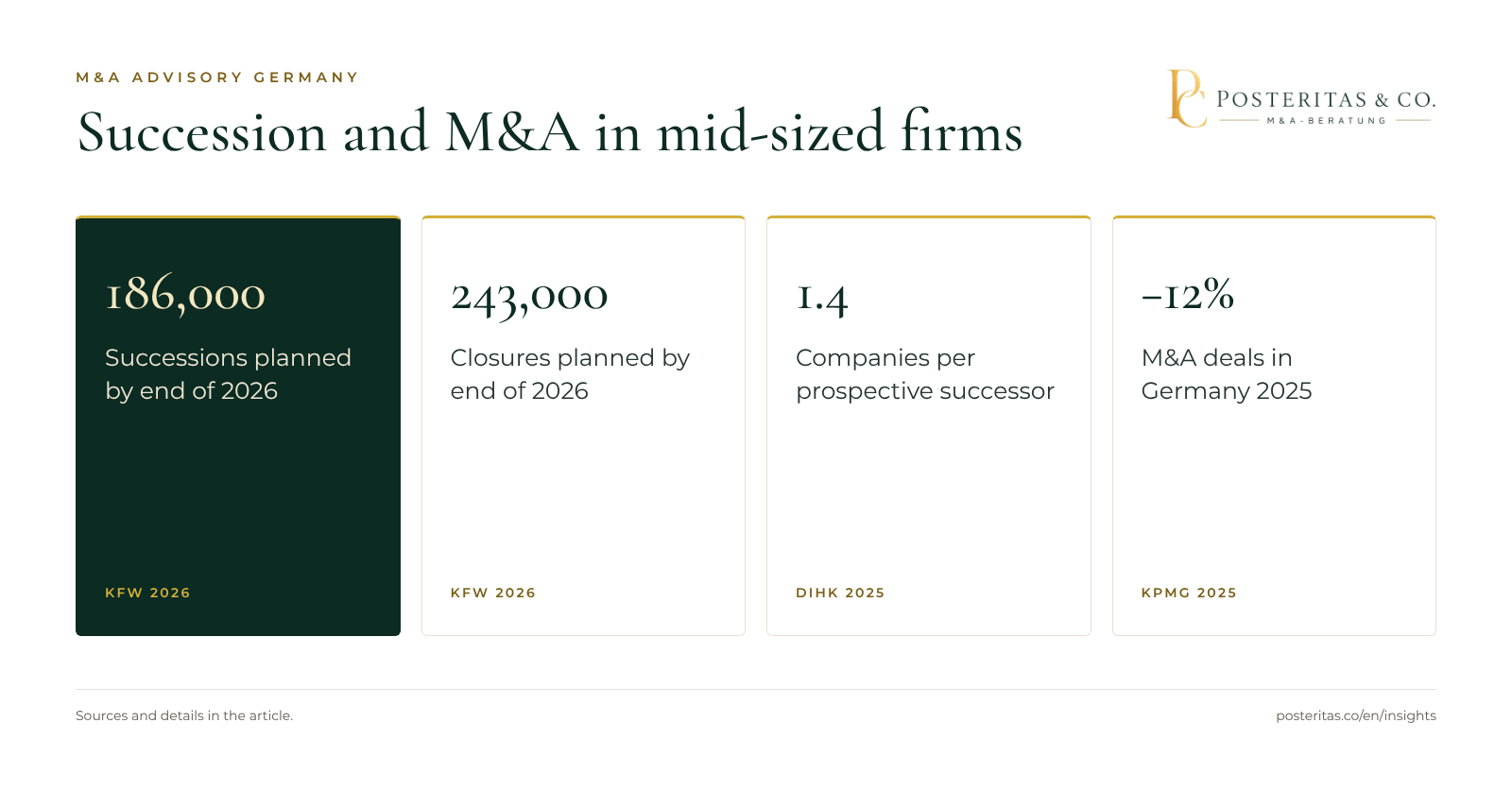
The market is characterised by fewer transactions but rising expectations. According to KPMG, the number of deals in Germany fell by 12 percent in the 2025 period under review, while volume rose by 30 percent. For 2026, 42 percent of the market participants surveyed expect more M&A activity.
For owners, this means: good companies still find buyers. But buyers scrutinise more closely, finance more cautiously and pay only for robust figures. KPMG cites geopolitical risks and high financing costs in particular as the main brakes.
How large is the succession gap in Germany?
The succession gap is considerable and growing. The KfW Nachfolge-Monitoring Mittelstand 2025 counts around 3.87 million small and medium-sized enterprises. By the end of 2026, around 186,000 owners plan a succession, but around 243,000 plan to close down. 57 percent of owners are 55 or older.
For 2026 to 2030, the IfM Bonn estimates around 186,000 family businesses ready for handover, or roughly 37,200 per year. The DIHK report 2025 arrives at around 1.4 businesses per prospective successor. In logistics and transport the figure is as high as four, in hospitality 3.5.
For sellers, this means that business succession does not happen by itself. Early planning and an active search for buyers determine success and price.
Which buyer groups are there in Germany?
In Germany, five buyer groups come into question for mid-sized companies. They differ in motive, holding period and the role of the previous owner.
| Buyer group | Motive | Typical holding period | Seller’s role afterwards |
|---|---|---|---|
| Strategic buyer | Market share, synergies, technology | Unlimited | Usually a short transition phase |
| Private equity | Value creation and resale | Roughly four to seven years | Often rollover equity, management stays |
| Family office | Long-term capital investment | Long-term | Flexible, continuity often desired |
| Search fund | Entrepreneurial career with investor capital | Several years | Support during the handover |
| MBI/MBO | Manager becoming an owner | Long-term | Often vendor loan or earn-out |
Which group fits depends on your goals: purchase price, continuation of the business, employees, your own role. You can find more on this in the guide on selling to investors.
What legal specifics apply when selling a company in Germany?
Four rules shape almost every German transaction. They concern form, foreign investment control, competition law and employment law.
| Topic | Provision | Key point |
|---|---|---|
| Notarial form | § 15(3) and (4) GmbHG | Assignment of, and obligation to assign, GmbH shares only by notarial deed |
| Foreign investment screening | AWG, §§ 55, 55a, 60 AWV | Non-EU acquirers: review from 25 percent; sensitive sectors 10 or 20 percent with notification requirement |
| Merger control | § 35 GWB | Notification above €500 million worldwide, €50 million and €17.5 million in Germany |
| Transfer of undertaking | § 613a BGB | In an asset deal, employment relationships transfer to the buyer |
On merger control: the government draft of the 12th GWB amendment from July 2026 provides for higher thresholds of €750 million, €75 million and €20 million. Until it enters into force, the previous values apply. Check the legal position at the time of your completion.
On foreign investment screening: in the defence sector, the sector-specific review under § 60 AWV (German Foreign Trade and Payments Ordinance) applies from 10 percent for every foreign acquirer, including those from the EU. The guide on selling a GmbH explains the details of a GmbH transaction.
Which tax points are important for sellers?
Taxation depends on who sells what. The decisive question is whether an individual, a holding company or a sole proprietor is selling.
| Constellation | Provision | Tax effect |
|---|---|---|
| Individual sells GmbH shares (holding of 1 percent or more) | § 17 EStG, § 3 No. 40 EStG | Partial income method: 60 percent of the gain is taxable |
| Holding company (corporation) sells shares | § 8b(2) and (3) KStG | Effectively around 95 percent tax-exempt |
| Sale of a business or partnership interest from age 55 | § 16(4) EStG | Allowance of €45,000, tapered from a gain of €136,000, once in a lifetime |
| Sale of a business or partnership interest from age 55 | § 34(3) EStG | 56 percent of the average tax rate, up to €5 million, once in a lifetime |
The reduced rate under § 34(3) EStG does not apply to gains subject to the partial income method. A holding structure is particularly worthwhile if you want to reinvest the proceeds. Restructuring shortly before a sale often triggers lock-up periods. You should therefore plan tax questions one to two years before the sale.
What does M&A advisory cost?
Most M&A advisors work with a combination of fixed and success-based fees. This way the advisor shares the risk while their basic costs are covered.
| Model | How it works | Advantage | Watch out for |
|---|---|---|---|
| Retainer | Monthly or one-off flat fee | Commitment on both sides | Crediting against the success fee |
| Success fee | Percentage of the purchase price on completion | Aligned interests | Definition of the fee basis |
| Minimum fee | Fixed minimum amount on success | Predictability for smaller deals | Ratio to the expected purchase price |
| Lehman scale | 5, 4, 3, 2 and 1 percent on the first five million euros, then 1 percent | Simple tiering | A model, not a market standard |
The Lehman scale originates from US investment banking and is named after the bank Lehman Brothers. Today it is mostly modified or replaced by individual tiers. Clarify in advance whether earn-outs, vendor loans or assumed debt fall within the fee basis. This question is directly linked to how the purchase price is determined.
How do you choose the right M&A advisor?
Choose an advisor who knows your size class, your sector and your buyer groups. A specialist in large-cap deals is often not the best partner for a family business.
Proven criteria:
- Verifiable experience: references you are allowed to contact yourself.
- Buyer access: how does the advisor identify strategic buyers, financial investors and family offices, including internationally?
- Process clarity: a written timetable with milestones.
- Honesty: an advisor who also tells you when your company is not yet ready for sale.
- Transparent terms: clear rules on fees, term, exclusivity and termination.
- Confidentiality: a plan for keeping employees, customers and competitors protected.
For cross-border questions, it is worth looking at neighbouring markets. You will find guidance in our guides on M&A advisory in Austria and M&A advisory in Switzerland.
How does a sale process work and how long does it take?
A structured sale process typically takes six to twelve months from the start of the mandate. The preparation beforehand can take several months, depending on the state of the data.
- Preparation: valuation, preparation of figures, equity story (two to three months)
- Outreach: teaser, non-disclosure agreement, information memorandum (one to two months)
- Offers: indicative offers, management presentations (one to two months)
- Due diligence: review by the buyer, binding offers (two to three months)
- Contract and completion: negotiation, notarisation, approvals, closing (one to three months)
Merger control or foreign investment screening can extend the time to completion. We describe the detailed business sale process in a separate guide.
What is your next step?
The best next step is a sober assessment: what is your company worth, who comes into question as a buyer and which structure suits your goals? The earlier you clarify these questions, the more options you have.
Posteritas & Co. supports owners of mid-sized companies across Europe with sales and succession. If you would like to put your situation into perspective, we offer a confidential, no-obligation initial consultation.
Note: This article is for general information only and does not replace legal or tax advice. For your specific situation, please consult a lawyer or tax advisor.
Sources
- Nachfolge-Monitoring Mittelstand 2025: Pläne für Geschäftsaufgaben wachsen erneut (Fokus Volkswirtschaft Nr. 526), KfW Research, 2026-01-09
- Unternehmensnachfolge-Report 2025, Deutsche Industrie- und Handelskammer (DIHK), 2025-07-21
- Unternehmensnachfolgen in Deutschland 2026 bis 2030 (Daten und Fakten Nr. 37), Institut für Mittelstandsforschung (IfM) Bonn, 2025-11
- M&A-Markt erwartet 2026 klaren Aufwärtstrend: Unternehmen rechnen mit mehr Dealaktivität, KPMG AG Wirtschaftsprüfungsgesellschaft, 2025-12-08
- FAQ Außenwirtschaftsrecht: Investitionsprüfung, Bundesministerium für Wirtschaft und Energie
- Mandanteninformation Kartellrecht: Regierungsentwurf zur 12. GWB-Novelle, SZA Schilling, Zutt & Anschütz, 2026-07-31
- Einkommensteuergesetz, § 34 Außerordentliche Einkünfte, Bundesministerium der Justiz
Frequently asked questions
What does M&A advisory cost in Germany?
The usual arrangement combines a monthly or one-off retainer with a success fee on completion. The success fee is often agreed as a percentage of the purchase price, sometimes tiered or with a minimum fee. The Lehman scale is a well-known calculation model, but in practice it is usually adapted.
How long does a business sale with an M&A advisor take?
A structured process typically takes six to twelve months from the start of the mandate. Preparation comes on top, and it can take considerably longer if the figures are disorganised or management succession is unresolved. Foreign investment screening or merger control can delay completion further.
Do I need a notary to sell a GmbH?
Yes. Under § 15(3) and (4) GmbHG, the assignment of shares in a German limited company (GmbH) and the obligation to assign them require notarial form. Without notarisation, the contract is void for lack of form. You should therefore include notary costs in your budget at an early stage.
When must a company acquisition be notified to the Bundeskartellamt?
Under the current § 35 GWB (German Act against Restraints of Competition), when the parties together achieve worldwide turnover of more than €500 million, one party achieves more than €50 million in Germany and another more than €17.5 million. The government draft of the 12th GWB amendment proposes raising these thresholds to €750 million, €75 million and €20 million. The law in force at the time of completion is decisive.
Can a buyer from the USA or China simply buy a German company?
In principle yes, but the Federal Ministry for Economic Affairs can review acquisitions by non-EU investors. The general review threshold is 25 percent of the voting rights; in sensitive sectors it is 10 or 20 percent, with a notification requirement. Until clearance is granted, completion of a notifiable acquisition is provisionally invalid (schwebend unwirksam).
What happens to the employees in an asset deal?
When a business or part of a business is sold, the employment relationships transfer to the acquirer with all rights and obligations under § 613a BGB (German Civil Code). Employees must be informed in writing and can object to the transfer within one month. In a share deal, by contrast, the employer stays the same.
Is it worth setting up a holding company before the sale?
If a corporation holds the shares, the capital gain is effectively around 95 percent tax-exempt under § 8b KStG (German Corporation Tax Act). This is particularly worthwhile if the proceeds are to be reinvested. Restructuring shortly before a sale, however, involves lock-up periods and risks; have this reviewed by a tax advisor.
How do I recognise a good M&A advisor?
Look for verifiable experience in your size class and sector, a clear process plan and access to suitable buyer groups. Ask for references you are allowed to contact yourself. A reputable advisor will also tell you if your company is not yet ready for sale.