
If you want to sell your company, you will hear one figure early on: the EBITDA multiple. It is the quickest route to a value indication. At the same time, it is one of the most common sources of misjudgement. In this guide you will learn how the multiple works, which values are currently customary for mid-sized companies and how to get from the multiple to the actual purchase price.
What is an EBITDA multiple?
An EBITDA multiple is the factor by which a company’s operating earnings are multiplied in order to estimate its total value. EBITDA stands for earnings before interest, taxes, depreciation and amortisation. The multiple is derived from the purchase prices of comparable transactions or from stock market valuations.
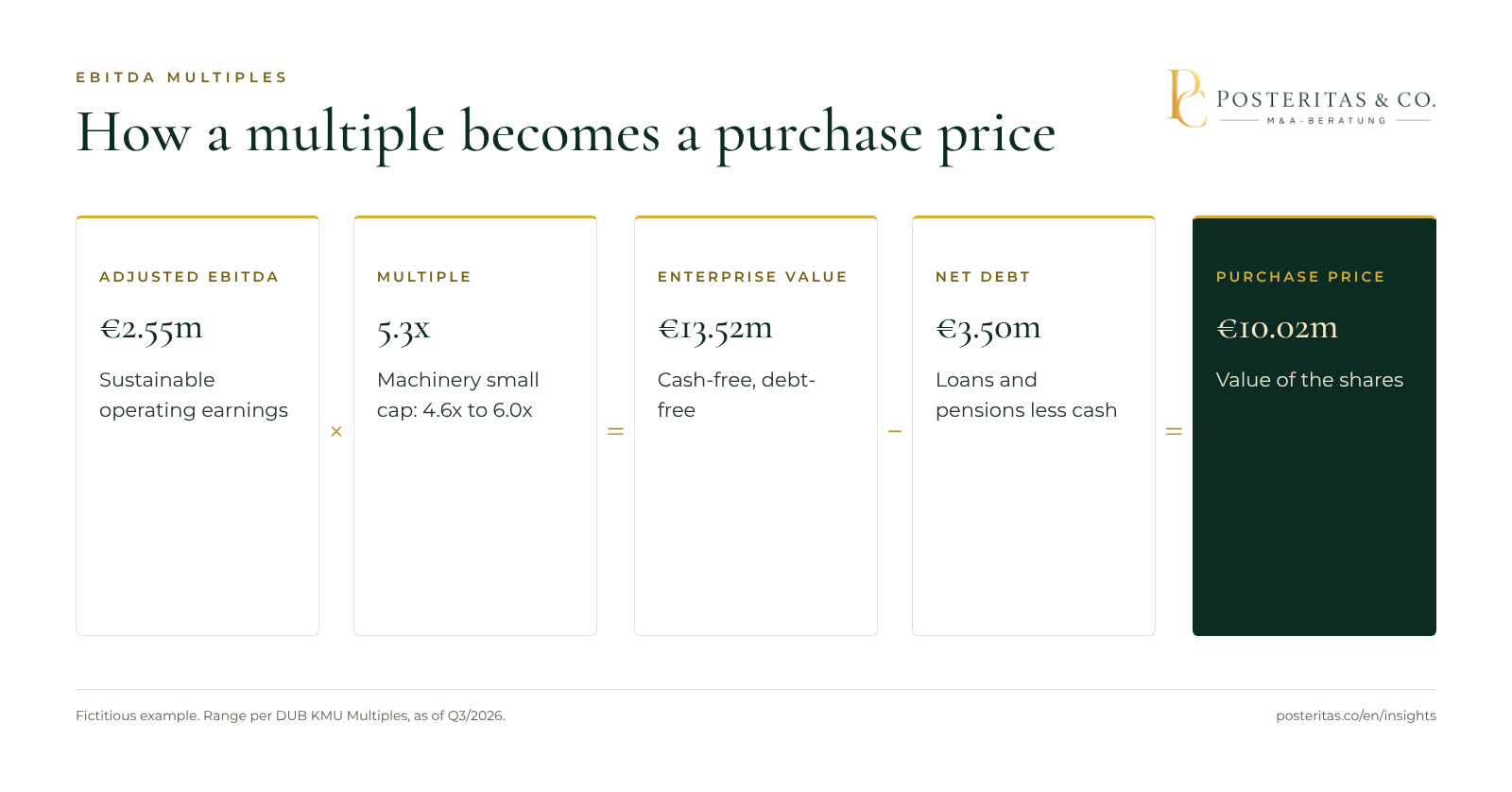
The formula is simple:
Enterprise value = adjusted EBITDA × EBITDA multiple
A multiple of 5.0x therefore means that a buyer pays five times the sustainable annual EBITDA for the operating business. The method is one of the market-based approaches to business valuation. It reflects what the market pays for comparable companies, not what a company should theoretically be worth.
Why EBITDA, and when is EBIT the better basis?
EBITDA is the usual reference figure for mid-sized companies because it makes companies comparable regardless of financing, tax burden and depreciation policy. Whether a machine was bought or leased, whether the GmbH carries high or low debt: EBITDA remains largely unaffected.
But this is precisely its weakness. In many industries, depreciation is not an accounting fiction but reflects real, recurring investment. A logistics company with a large vehicle fleet or a manufacturer with expensive machinery has to reinvest regularly. Here EBIT gives a more realistic picture. For companies without significant profit, for instance in early growth phases, revenue multiples are often used instead.
| Metric | Basis | Suitable for | Weakness |
|---|---|---|---|
| EBITDA multiple | Earnings before interest, taxes, depreciation and amortisation | Service providers, software, trade, companies with low investment needs | Ignores replacement investments |
| EBIT multiple | Earnings before interest and taxes | Manufacturing, logistics, capital-intensive business models | Depends on depreciation policy |
| Revenue multiple | Revenue | Growth companies without stable earnings, platforms | Completely ignores profitability |
Which EBITDA multiples currently apply to mid-sized companies?
For small and medium-sized companies in Germany, EBITDA multiples in the small-cap segment lie between 3.6x and 9.0x depending on the industry. The following selection is taken from the DUB SME Multiples (DUB KMU Multiples), which are based on the aggregated market assessments of more than 25 M&A advisors and financial institutions in the German-speaking region.
| Industry | Micro-cap | Small-cap | Mid-cap |
|---|---|---|---|
| Machinery and plant engineering | 3.6x to 5.1x | 4.6x to 6.0x | 5.6x to 7.3x |
| Metalworking & manufacturing technology | 3.4x to 4.2x | 4.1x to 5.5x | 5.0x to 7.2x |
| Electrical engineering & electronics | 4.2x to 6.0x | 5.7x to 7.6x | 6.8x to 8.5x |
| Medical technology & life sciences | 5.9x to 7.6x | 7.1x to 9.0x | 8.2x to 10.0x |
| Software & digital platforms | 5.6x to 7.6x | 7.2x to 9.0x | 8.3x to 10.6x |
| IT services & system integrators | 5.2x to 6.7x | 6.3x to 8.5x | 7.1x to 9.6x |
| Business services (B2B) | 3.8x to 5.7x | 5.0x to 7.2x | 6.4x to 8.0x |
| Construction & finishing trades (skilled trades) | 3.7x to 5.0x | 4.4x to 5.8x | 5.0x to 6.8x |
| Trade: wholesale & retail (bricks and mortar) | 3.4x to 4.5x | 4.4x to 5.4x | 5.2x to 6.7x |
| Transport, logistics & freight forwarding | 3.7x to 5.0x | 4.5x to 5.7x | 5.6x to 7.2x |
| Consumer goods (non-food) | 2.5x to 4.0x | 3.6x to 5.6x | 4.8x to 6.3x |
Source: DUB KMU Multiples, Deutsche Unternehmerbörse (dub.de/kmu-multiples), as of Q3/2026, selection of 11 out of 20 industries. EBITDA multiples shown as a “from to” range. Size classes according to DUB: micro-cap below €5 million revenue, small-cap €5 to 50 million, mid-cap above €50 million.
The DUB expressly points out that the majority of companies in an industry lie within the stated range, but that justified individual cases may also lie above or below it. The range is a frame of reference, not an entitlement.
What is the size discount (small cap discount)?
Smaller companies are valued at lower multiples than large ones. The DUB table shows this within each industry. It becomes even clearer in comparison with the stock market.
In its Valuation Insights 07|26, Grant Thornton Austria reports a median EV/EBITDA (trailing) of 13.0x for the mechanical engineering sector in the STOXX Europe 600, as of 30 June 2026. The DUB band for small-caps in machinery and plant engineering is 4.6x to 6.0x. Stock market values are therefore not a direct benchmark for mid-sized companies.
The reasons are understandable. Smaller companies depend more heavily on the owner, often have few major customers and less management depth. Their shares are not freely tradable. Buyers demand a higher return for this, and that lowers the factor. According to an analysis in Unternehmeredition (August 2026), the gap between micro-caps and mid-caps in mechanical engineering is around 60 percent, purely due to size.
Which factors drive the multiple up or down?
Where your company lands within the industry range is determined by qualitative factors. Buyers pay for predictability and transferable earnings.
| Value driver | Tends towards a higher multiple | Tends towards a lower multiple |
|---|---|---|
| Owner dependency | Second management level, documented processes | Customers and know-how depend on the owner |
| Customer structure | Broadly spread, no customer above 10 percent | One to three customers with a high share of revenue |
| Revenue quality | Recurring: maintenance, subscriptions, framework agreements | Project business, highly volatile |
| Growth | Demonstrably above the market, robust forecast | Stagnating or declining |
| Reporting | Monthly controlling, audited financial statements | Only annual financial statements, late figures |
| Market position | Niche, unique selling points | Interchangeable offering, price competition |
| Investment backlog | Modern equipment, well-maintained IT | Deferred investments |
Many of these levers cannot be moved in the short term. If you start two to three years before selling your business, you can noticeably improve your position within the band.
What is adjusted EBITDA?
Adjusted EBITDA is the sustainably achievable operating result, free of special effects. Buyers never apply the multiple to reported EBITDA, but always to adjusted EBITDA.
Typical adjustments for mid-sized companies:
- One-off costs: litigation costs, relocation and one-off consulting are added back.
- Private expenses: vehicles or travel with a private connection are added back.
- Owner’s salary: if it is below the market level for an external managing director, the difference is deducted.
- Rent paid to the owner: excessive rents for the owner’s own properties are corrected to market level.
Important: adjustments must be verifiable. In due diligence, the buyer examines every item. Aggressive adjustments cost credibility.
How do you get from enterprise value to the purchase price?
The purchase price for the shares is enterprise value less net financial debt. The multiple values the operating business free of debt and without excess cash (cash free, debt free).
Purchase price (equity value) = enterprise value − net financial debt
Net financial debt includes bank loans, shareholder loans and debt-like items such as pension provisions. Non-operating cash is deducted. In addition, a normalised working capital is often agreed. You can read details on the negotiation in the guide to purchase price negotiation.
What does a worked example look like?
A mechanical engineering company in the small-cap segment reports EBITDA of €2.40 million. This is how the purchase price is arrived at:
| Item | Amount |
|---|---|
| Reported EBITDA | €2.40 million |
| + one-off legal advice | €0.15 million |
| + private vehicle costs | €0.04 million |
| + rent adjustment for owner’s property to market level | €0.06 million |
| − adjustment of managing director salary to market level | €0.10 million |
| Adjusted EBITDA | €2.55 million |
| × multiple (middle of the DUB band 4.6x to 6.0x) | 5.3x |
| Enterprise value | €13.52 million |
| − bank loans | €4.20 million |
| − pension provisions | €0.80 million |
| + free cash | €1.50 million |
| = net financial debt | €3.50 million |
| Purchase price for the shares | €10.02 million |
The range is considerable. At the lower end (4.6x), enterprise value would be €11.73 million, and at the upper end (6.0x) €15.30 million. The purchase price therefore varies between €8.23 million and €11.80 million. Here, every tenth of a point in the multiple means around €0.26 million. How to estimate such values yourself is shown in the guide Calculating business value.
Where are the limits and typical mistakes?
A multiple is a market indication, not a complete valuation. It condenses many assumptions into a single figure. Typical mistakes:
- Adopting stock market multiples: values from share indices are far above what mid-sized companies achieve.
- Using unadjusted EBITDA: special effects distort the result upwards or downwards.
- Confusing enterprise value with the purchase price: without deducting net financial debt, expectations are too high.
- A single year instead of an average: a record year is not a sustainable basis. Buyers look at several years and the forecast.
- The top of the band as the standard: only companies with clear strengths reach the top.
- Ignoring investment needs: where replacement investments are high, EBITDA overstates earning power.
Multiple or capitalised earnings: which method is right?
The two methods complement each other. The multiple shows what the market is currently paying. The capitalised earnings value or a DCF method derives the value from the future earnings and the risk of the specific company.
The German valuation standard IDW S 1 puts present value methods at the centre. According to an assessment by Flick Gocke Schaumburg (June 2026), the revised version IDW S 1 as amended in 2026 expressly recognises market price-based methods as simplified methods for price-setting and plausibility checks. In practice, this means: for the initial indication and the negotiation, the multiple is indispensable. For robust values, you should cross-check it against a capitalised earnings value.
What is your next step?
First determine your adjusted EBITDA for the last three years and place your company honestly within the industry band. Then check which value drivers you can still strengthen before a sale. You will find an overview of the phases in the guide to the business sale process.
If you would like a well-founded assessment of where your company stands in the market, we would be happy to discuss it in a confidential introductory meeting. Without obligation and discreetly.
Sources
- DUB KMU Multiples: Unternehmensbewertung mit Multiples für KMU (Stand Q3/2026), Deutsche Unternehmerbörse DUB.de, 2026
- Valuation Insights 07|26: Bewertungsrelevante Kapitalmarktdaten zum 30. Juni 2026, Grant Thornton Austria, 2026
- Die Bewertungslücke im Mittelstand, Unternehmeredition (Kai Hesselmann), 2026
- IDW S 1 i.d.F. 2026: Neuerungen und Bedeutung für Verrechnungspreise, Flick Gocke Schaumburg, 2026
- Aktuelle und branchenspezifische Multiplikatoren, KPMG Deutschland
- Multiplikator-Bewertung: Alternatives Verfahren für eine erste Wertindikation, Rödl & Partner, 2014
Frequently asked questions
What is an EBITDA multiple?
An EBITDA multiple is the factor by which operating earnings before interest, taxes, depreciation and amortisation are multiplied in order to estimate enterprise value. A multiple of 5.0x means that enterprise value equals five times annual EBITDA.
Which EBITDA multiple is usual for mid-sized companies?
According to the DUB SME Multiples (as of Q3/2026), the ranges in the small-cap segment lie between 3.6x and 9.0x depending on the industry. Mechanical engineering, construction, logistics and bricks-and-mortar retail lie between 4.4x and 6.0x, while software, IT services and medical technology are significantly higher.
Why are multiples for small companies lower than on the stock market?
Smaller companies carry higher risks: dependency on the owner, customer concentration, less diversification and limited tradability of the shares. Buyers price this in through a size discount. Stock market multiples from indices such as the STOXX Europe 600 are therefore not a direct benchmark.
Is enterprise value the same as the purchase price?
No. The multiple gives enterprise value, meaning the value of the entire operating business. For the purchase price of the shares, you deduct net financial debt: interest-bearing debt and debt-like items less non-operating cash.
What does adjusted EBITDA mean?
Adjusted EBITDA is the result corrected for special effects. One-off costs, private expenses and owner salaries or rents that are not at market rates are removed or adjusted so that the sustainably achievable result becomes visible.
When is an EBIT multiple better than an EBITDA multiple?
The EBIT multiple is more meaningful when a company requires high and regular replacement investments, for example in machinery or a vehicle fleet. In that case, depreciation represents real recurring costs that EBITDA leaves out.
Is a multiple enough for a robust business valuation?
For an initial indication, yes; for negotiations or for tax and legal purposes, usually not. Professionally, a plausibility check with a present value method such as capitalised earnings or DCF is recommended.
How can I increase my company's multiple?
Typical levers are lower owner dependency, a broader customer base, recurring revenue, robust reporting and a traceable forecast. These measures take time, ideally two to three years before the sale.