
For many owners, an investor is the best answer to the succession question. An investor brings capital, often experience and sometimes the route to a second, larger sale. But not all investors are alike. This article compares the four most important buyer types, shows typical deal structures and explains how to find the right partner. You will find the general guide under Selling a business.
How active are investors in the German Mittelstand?
According to the BVK statistics, a total of €15.69 billion of private equity flowed into German companies in 2025, an increase of 4 percent on the previous year. Buy-outs, meaning majority acquisitions, accounted for €10.66 billion, as Unternehmeredition reports. At the same time, according to KfW, 42 percent of mid-sized companies (the German Mittelstand) with succession plans are considering a sale to external parties. Supply and demand are therefore meeting, but only well-prepared companies benefit.
Which investors come into question?
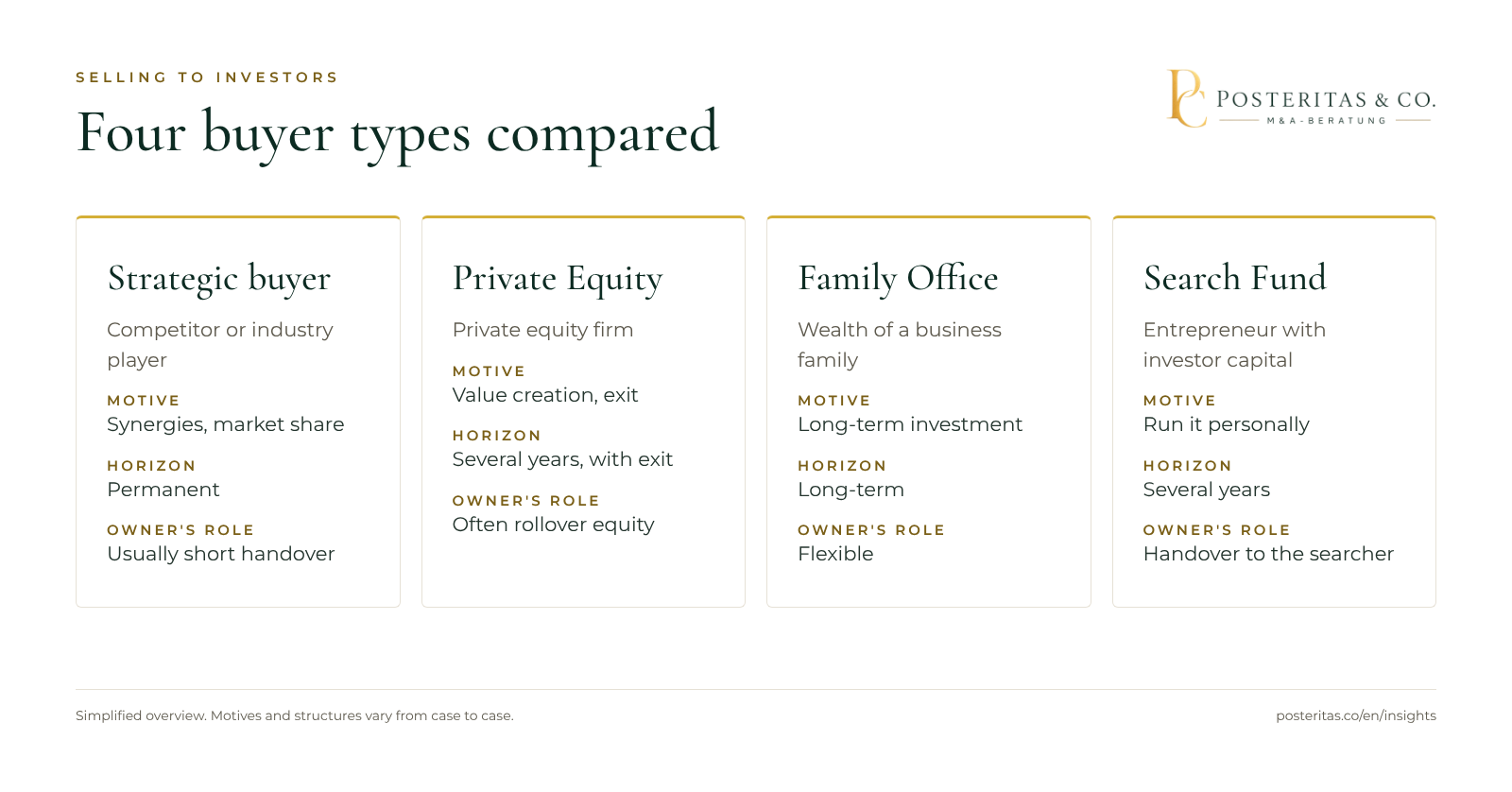
| Criterion | Strategic buyer | Private equity | Family office | Search fund |
|---|---|---|---|---|
| Who is it? | Competitor, supplier, customer | Investment firm with funds | Wealth of an entrepreneurial family | Entrepreneur with investor capital |
| Motive | Synergies, market share | Value creation, exit | Long-term investment | Running a company personally |
| Investment horizon | Permanent | Several years, followed by a resale | Long-term | Several years |
| Typical stake | 100% | Majority | Majority or minority | 100% or majority |
| Role of the owner | Short handover | Often rollover equity, management | Flexible | Handover to the searcher |
| Price | Often highest due to synergies | Competitive, structured | Solid | Depends on financing |
| Change in the company | Integration | Professionalisation, add-on acquisitions | Rather limited | New entrepreneur at the top |
Strategic buyers
Strategic buyers often pay the highest prices because they can realise synergies: joint purchasing, access to customers, new products. The price for this is usually integration. Name, location and structures are not always preserved.
Private equity
Financial investors usually acquire the majority and develop the company further over a number of years, for example through professionalisation or add-on acquisitions (buy-and-build). The owner frequently stays on board with rollover equity and benefits a second time from the later resale. For private equity, smaller companies are mainly of interest as add-ons for an existing platform.
Family offices
Family offices invest the wealth of entrepreneurial families. They usually have no fixed exit date and value continuity. For owners who care about name, location and employees, they are often a good partner.
Search funds
A search fund is an entrepreneur who, with capital from investors, looks for an owner-managed company, acquires it and then runs it personally. Typical target companies have EBITDA of roughly €1 to 5 million, and transaction values in the DACH region mostly range from €5 to 30 million. In Germany the model is still young, but it is gaining importance as a succession solution.
What do investors look for?
| Criterion | Why it matters | How you score |
|---|---|---|
| Sustainable earnings | Basis for valuation and financing | Adjusted, traceable figures |
| Recurring revenue | Predictability | Framework agreements, maintenance, subscriptions |
| Independence from the owner | Risk after the sale | Second management level, documented processes |
| Growth potential | Value lever for the investor | Clear strategy, untapped markets |
| Market position | Protection against competition | Specialisation, references |
| Clean structure | Fewer risks in due diligence | Complete data room, settled contracts |
Which deal structures are common?
| Structure | How it works | Advantage for the seller | What to watch |
|---|---|---|---|
| Full sale | 100% goes to the buyer | Immediate, full proceeds | Limit warranties and liability |
| Majority with rollover equity | Sale of e.g. 60 to 80%, the rest is retained | Second payout at the later exit | Minority rights, exit provisions |
| Earn-out | Part of the price depends on future results | Higher total price possible | Clear calculation, influence on results |
| Vendor loan | Part of the price is deferred | Enables the buyer’s financing | Ranking and collateral |
| Minority stake | Investor buys less than 50% | Capital without loss of control | Valuation discount, investor rights |
With rollover equity and minority stakes, the provisions in the shareholders’ agreement are decisive. According to Rödl & Partner, a tag-along right (Mitverkaufsrecht) secures participation in a later exit, while a drag-along obligation (Mitverkaufspflicht) enables the majority to sell the entire company. Find out more under Selling company shares.
What are the pros and cons of selling to investors?
| Advantages | Disadvantages |
|---|---|
| Capital for growth and acquisitions | Investor pursues its own return targets |
| Professional reporting and structures | More reporting obligations and control |
| Partial sale with rollover equity possible | With private equity, a later resale is predetermined |
| Second payout at the later exit | Debt can weigh on the company |
| Investor’s network and experience | Company culture may change |
| Succession even without family or management | Due diligence is demanding |
Whether the advantages outweigh the disadvantages depends on the investor and on the contracts. A family office with a long horizon feels different from a fund with a fixed exit date.
How does a sale to investors work?
The process follows the five phases of a business sale. With investors, a few particular features come into play:
| Phase | Particular feature with investors |
|---|---|
| Approach | Investors screen quickly against clear criteria, so a precise teaser is decisive |
| Offers | Indicative offers often already contain structure, rollover equity and financing |
| Due diligence | Often more extensive, with external advisers for finance, tax, legal and market |
| Financing | The purchase price is often partly financed with bank loans |
| Management | Meetings with the second management level and participation programmes |
A structured auction process with several investors generally improves price and terms. According to Unternehmeredition, competition also increases transaction certainty, because alternatives are available if a bidder drops out.
How do you find the right investor?
Ask every interested party these questions:
- How long do you intend to stay invested, and what happens afterwards?
- What role do you see for me and my management?
- What plans do you have for the location, brand and employees?
- How will you finance the acquisition, and how much debt will the company carry afterwards?
- Which entrepreneurs who have sold to you may I speak to?
The answers quickly show whether an investor fits your goals. The highest price is not always the best offer.
Conclusion
Selling to an investor can combine succession, growth and wealth preservation. The key is to choose the type of investor that fits your goals and to bring several interested parties into structured competition. If you negotiate rollover equity, minority rights and your own role clearly, you will sell on good terms and keep the future of your company in view.
Sources
- Beteiligungskapital wächst im Vorjahresvergleich um 4 % (BVK-Statistik 2025), Unternehmeredition, Eva Rathgeber, March 2026
- Search Funds als Nachfolgelösung im Mittelstand, Unternehmeredition, January 2026
- Strukturierter Bieterprozess versus bilaterale Verhandlung, Unternehmeredition, Boris Dürr (Heuking), October 2024
- Tag-along und Drag-along: Exit-Regelungen im Beteiligungsvertrag, Rödl & Partner, September 2019
- Nachfolge-Monitoring Mittelstand 2025 (KfW Research Fokus Nr. 526), KfW Research, Dr. Michael Schwartz, January 2026
Frequently asked questions
What is the difference between a strategic buyer and a financial investor?
A strategic buyer is usually a company from the same or a related industry that is looking for synergies and holds the business permanently. A financial investor such as a private equity firm wants to increase the value over a number of years and then sell the company on.
Do private equity investors also buy small mid-sized companies?
Yes, above all as add-on acquisitions for an existing platform (buy-and-build). For a stand-alone platform, many funds require a higher minimum level of earnings. For smaller companies, family offices, search funds and strategic buyers are often a better fit.
What is rollover equity?
The owner sells the majority to the investor and reinvests part of the proceeds in the company. When the investor later sells the business on, the owner benefits from the increase in value a second time.
Do I have to stay with the company after selling to an investor?
With financial investors, usually yes, for a certain period or until a successor in management has been brought up to speed. Strategic buyers integrate the company more often and only need the owner for a short transition phase.
What is a search fund?
An entrepreneur (the searcher) who, backed by investor capital, specifically looks for an owner-managed company, buys it and runs it personally as managing director. In the DACH region (Germany, Austria, Switzerland), transaction values typically range from €5 to 30 million.
How do I find the right investor?
First clarify your goals: price, your role after the sale, the future of employees and location. Then approach several suitable investors in parallel. Reference calls with entrepreneurs who have already sold to the investor provide valuable insights.
What should I pay particular attention to in the shareholders' agreement?
Above all your rights as a minority shareholder: consent requirements, information rights, the tag-along right and the conditions of the drag-along obligation, as well as leaver provisions and the valuation in a later exit.