
If you want to calculate the value of your business, you do not need a collection of formulas, but a clean sequence. First you adjust the figures, then you choose a method, and then you bridge from the value of the operating business to the value of your shares. This guide takes you through all the steps with one continuous worked example. It also shows where online calculators and rules of thumb reach their limits.
How does calculating business value work in practice?
The calculation follows six steps: collect the figures, adjust the result, choose a method, calculate enterprise value, bridge to equity value and check the result for plausibility. Each step builds on the previous one. An error in the adjustments is multiplied by the multiple and feeds through to the purchase price.
You will find an overview of all common methods in our guide to business valuation. This article is about the actual calculation.
Which figures do you need for the calculation?
You need the annual financial statements for the last three to five financial years, the current management accounts (in Germany, the betriebswirtschaftliche Auswertung, BWA) and a forecast for at least the next two to three years. In addition, you need loan agreements, pension commitments, rental and leasing contracts, and a list of receivables, inventories and liabilities.
Several years are important because a single year contains random effects. German tax law also works with an average: under § 201 BewG, the annual earnings are generally derived from the operating results of the last three completed financial years.
Example: The fictitious Muster Präzisionsteile GmbH, a supplier to the mechanical engineering industry, reports EBITDA of €1,420,000 (2023), €1,510,000 (2024) and €1,570,000 (2025). The average is €1,500,000.
How do you adjust EBIT and EBITDA correctly?
You adjust the result by correcting all items that a new owner would not have in that form. The aim is a sustainable result that can also be achieved without you. Four areas are almost always affected.
Imputed owner’s salary
Set your salary at the level of an employed external managing director. § 202 BewG describes the benchmark in exactly this way: the remuneration that a management without a shareholding would receive. Family members working without pay are also recognised at a notional salary. The IHK Schwaben (Swabian Chamber of Commerce and Industry) likewise names the imputed owner’s salary as a central correction in the multiples method.
Private costs, rent and one-off effects
Remove private costs run through the company (vehicles, travel, insurance). Set rent for properties that you own privately at market level. Also remove one-off expenses and income, such as a lawsuit or a sale of assets. § 202 BewG also provides for a correction of extraordinary expenses and income.
Example (average values per year):
| Item | Reported | Adjusted | Rationale |
|---|---|---|---|
| Owner’s managing director salary | €90,000 | €180,000 | Market-rate remuneration for an external managing director, result less €90,000 |
| Private vehicle and travel costs | €21,000 | €0 | Not business-related, result plus €21,000 |
| Rent for operating property (owned by the owner) | €60,000 | €96,000 | Market rent, result less €36,000 |
| Litigation costs 2024 (€120,000) | €40,000 | €0 | One-off effect, spread over three years, result plus €40,000 |
| Income from asset sale 2025 (€75,000) | €25,000 | €0 | One-off effect, spread over three years, result less €25,000 |
| EBITDA | €1,500,000 | €1,410,000 | Total of corrections: less €90,000 |
In the example, the adjustment reduces EBITDA by €90,000. With a multiple of 5.5, this corresponds to just under €500,000 of business value.
Which method should you choose?
For a market-oriented value indication for a mid-sized company, the multiples method is the usual starting point, supplemented by an earnings-based cross-check. Expert valuers work in accordance with IDW S 1, whose revised version (IDW S 1 as amended in 2026) was published on 8 April 2026, according to Forvis Mazars. For German inheritance and gift tax, there is the simplified capitalised earnings method under §§ 199 to 203 BewG.
Important: for tax purposes, § 11 (2) BewG sets net asset value as the floor. For price-setting between buyer and seller, on the other hand, what matters is which method an acquirer uses. You will find more detail in the guides on EBITDA multiples and the capitalised earnings method.
How do you calculate with the multiple?
You multiply adjusted EBITDA by a factor that is customary for the industry and size, and obtain enterprise value. The DUB SME Multiples, compiled from the assessments of more than 25 M&A advisors and financial institutions, give EBITDA ranges for Q3/2026 in machinery and plant engineering of 3.6 to 5.1 for the smallest size class and 4.6 to 6.0 for the medium size class.
Example: The company is well positioned, and the second management level works independently. We apply a multiple of 5.5.
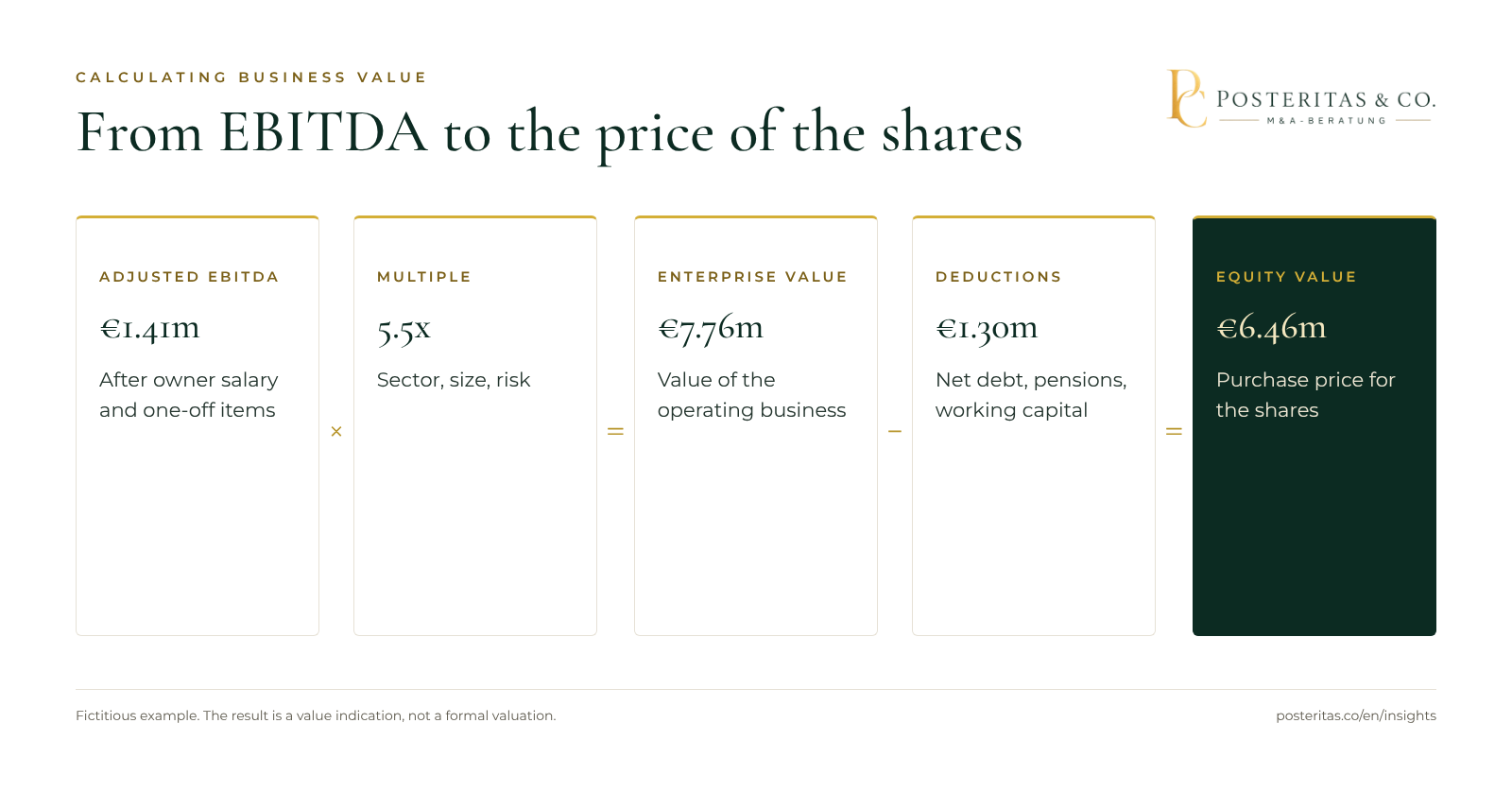
€1,410,000 × 5.5 = €7,755,000 enterprise value
At the lower and upper end of the range (4.6 to 6.0), enterprise value would be between €6,486,000 and €8,460,000. This shows how strongly the choice of factor affects the result.
How do you get from enterprise value to equity value?
From enterprise value, you deduct financial debt and debt-like items, add free cash and correct deviations in working capital. This logic is called cash-free/debt-free. Rödl & Partner counts among the debt-like items, for example, pension provisions, tax provisions, customer prepayments and overdue trade payables.
For working capital, a normal level is agreed. If it is below this level on the reference date, the difference reduces the purchase price, because the buyer would have to inject liquidity.
Example:
| Item | Amount | Effect |
|---|---|---|
| Enterprise value (€1,410,000 × 5.5) | €7,755,000 | Starting value |
| Net financial debt (bank loans €1,400,000 less cash €900,000) | €500,000 | less |
| Pension provisions | €650,000 | less |
| Working capital: actual €1,750,000, normal level €1,900,000 | €150,000 | less |
| Equity value (purchase price for the shares) | €6,455,000 | Result |
Of the €7,755,000 enterprise value, €6,455,000 remains for the shares. The deductions add up to €1,300,000. How these items are dealt with in the purchase agreement is explained in the guide to purchase price negotiation.
How does the cross-check with the simplified capitalised earnings method work?
With the simplified capitalised earnings method, you multiply the sustainable annual result after tax by the statutory factor of 13.75. Under § 202 BewG, the starting point is the taxable profit, adjusted for the owner’s salary and one-off effects. A positive operating result is reduced by a flat 30 percent for income taxes. The factor of 13.75 is set out in § 203 BewG and, under § 265 (11) BewG, applies to valuation dates after 31 December 2015.
Because interest is already included in the profit, the method directly produces a value of the equity. Under § 200 (2) BewG, non-operating assets are added separately.
| Calculation step | Multiple | Simplified capitalised earnings method |
|---|---|---|
| Adjusted EBITDA | €1,410,000 | €1,410,000 |
| Depreciation and amortisation | not applicable | less €310,000 |
| Interest expense | not applicable | less €70,000 |
| Operating result before tax | not applicable | €1,030,000 |
| Flat-rate tax 30 percent | not applicable | less €309,000 |
| Sustainable annual earnings | not applicable | €721,000 |
| Factor | 5.5 on EBITDA | 13.75 on annual earnings |
| Interim result | €7,755,000 (enterprise value) | €9,913,750 (equity value) |
| Bridge | less €1,300,000 | reflected in interest and result |
| Value of the shares | €6,455,000 | €9,913,750 |
In the example, the tax value is around 54 percent above the market value. The factor of 13.75 corresponds to a capitalisation rate of about 7.3 percent. Buyers of small and medium-sized companies usually demand a higher return because of owner dependency and size. The simplified method is therefore not a good benchmark for the sale price.
How do you check the result for plausibility?
You check the result for plausibility by examining it from a buyer’s perspective. Three questions help:
- Financeability: Can a buyer service the purchase price from free cash flow within a reasonable period?
- Comparison: Is the multiple within the industry range, and are there reasons for a position at the upper or lower end?
- Range: How does equity value change if you shift the multiple by 0.5?
In the example, the range of 4.6 to 6.0 results in an equity value between €5,186,000 and €7,160,000. A value indication should always be communicated as a range.
What can online calculators do, and where are their limits?
Online calculators provide a rough order of magnitude within a few minutes. No more than that. They mostly work with unadjusted inputs and flat-rate factors. They do not recognise owner dependency, customer concentration or an investment backlog. Above all, the bridge to equity value is almost always missing. In the example, this step alone accounts for €1,300,000.
Which mistakes happen most often in the calculation?
The most common mistakes arise in the adjustments and in the bridge:
- The multiple is applied to the unadjusted result.
- An owner’s salary that is too low is not corrected, so the result looks too high.
- Enterprise value and the purchase price for the shares are confused.
- Pension provisions and shareholder loans are overlooked.
- The tax value based on the factor of 13.75 is expected as the sale price.
- A single record year is used as the basis instead of an average.
If you are selling a GmbH (German limited liability company), you should also be aware of the particular features of selling GmbH shares.
What is your next step?
Your next step is an adjusted overview of results for the last three to five years and an honest list of all debt and debt-like items. With these, a robust range can be calculated. What happens after that is shown in the guide to the business sale process.
If you would like to have your figures reviewed from an independent perspective, we offer a confidential introductory meeting.
Note: This article does not replace tax or legal advice. All calculations are value indications based on a fictitious example and do not constitute a valuation report.
Get your business valued
You receive an initial, market-based valuation indication for your company. Prepared personally, without obligation and strictly confidential. We will get back to you within two business days.
Sources
- § 202 BewG: Betriebsergebnis, Bundesministerium der Justiz, Gesetze im Internet
- § 203 BewG: Kapitalisierungsfaktor, Bundesministerium der Justiz, Gesetze im Internet
- § 201 BewG: Ermittlung des Jahresertrags, Bundesministerium der Justiz, Gesetze im Internet
- § 11 BewG: Wertpapiere und Anteile, Bundesministerium der Justiz, Gesetze im Internet
- DUB KMU Multiples 2026: aktuelle Werte, Deutsche Unternehmerbörse (DUB), 2026
- M&A Vocabulary: Experten verstehen „Cash Free & Debt Free“, Rödl & Partner, 2026
- Neufassung des IDW S 1 i.d.F. 2026 veröffentlicht, Forvis Mazars, 2026
- Unternehmensbewertung, IHK Schwaben, 2026
Frequently asked questions
What is the simplest way to calculate the value of my company?
The simplest way is the multiples method: adjusted EBITDA times an industry-standard multiple gives you enterprise value. From this you deduct financial debt and debt-like items and add free cash. This gives you a value indication for your shares.
Which years are included in the calculation?
It is common to use the last three to five completed financial years, supplemented by the current year and a forecast. Under § 201 BewG, the simplified capitalised earnings method generally refers to the last three financial years. Buyers usually give greater weight to the most recent years and the forecast.
What is an appropriate owner's salary?
Appropriate is the remuneration that a managing director without a shareholding would receive for the same role. This is also how § 202 BewG puts it for the simplified capitalised earnings method. If your own salary is below that, the adjusted result falls; if it is above, the result rises.
Which multiple applies to my company?
That depends above all on industry, size, growth and dependency on the owner. The DUB SME Multiples for Q3/2026 show EBITDA ranges of roughly 2.5 to 10.6. Within the range, the quality and predictability of earnings determine the position.
What is the difference between enterprise value and equity value?
Enterprise value is the value of the entire operating business, regardless of how it is financed. Equity value is the value of the shares, in other words what the seller actually receives. In between are financial debt, cash, debt-like items and working capital adjustments.
Why is the value under the simplified capitalised earnings method often higher than the market price?
The fixed factor of 13.75 corresponds to a capitalisation rate of around 7.3 percent. Buyers of mid-sized companies usually expect higher returns because of owner dependency and size. This is why the tax value is often above what an acquirer pays.
How reliable are online calculators for business value?
Online calculators are useful for an initial order of magnitude. However, they know neither your adjustments nor your debt, pension commitments or working capital. The deviation from a realistic purchase price can therefore be considerable.
Do I need a formal valuation report for a sale?
A formal expert opinion is not required for a sale to third parties. The price emerges in negotiation. Nevertheless, a well-founded value indication with clean adjustments is the basis for being able to assess offers.