
The GmbH (the German limited liability company) is the most common legal form among Germany’s mid-sized companies. If you want to sell your GmbH, you need to observe a number of legal particularities in addition to price and buyer: the notarial form, possible consent requirements, the shareholder list and a tax burden that depends heavily on the structure. This article shows step by step what matters. The general sale process is described in our article The business sale process.
How does the sale of a GmbH work?
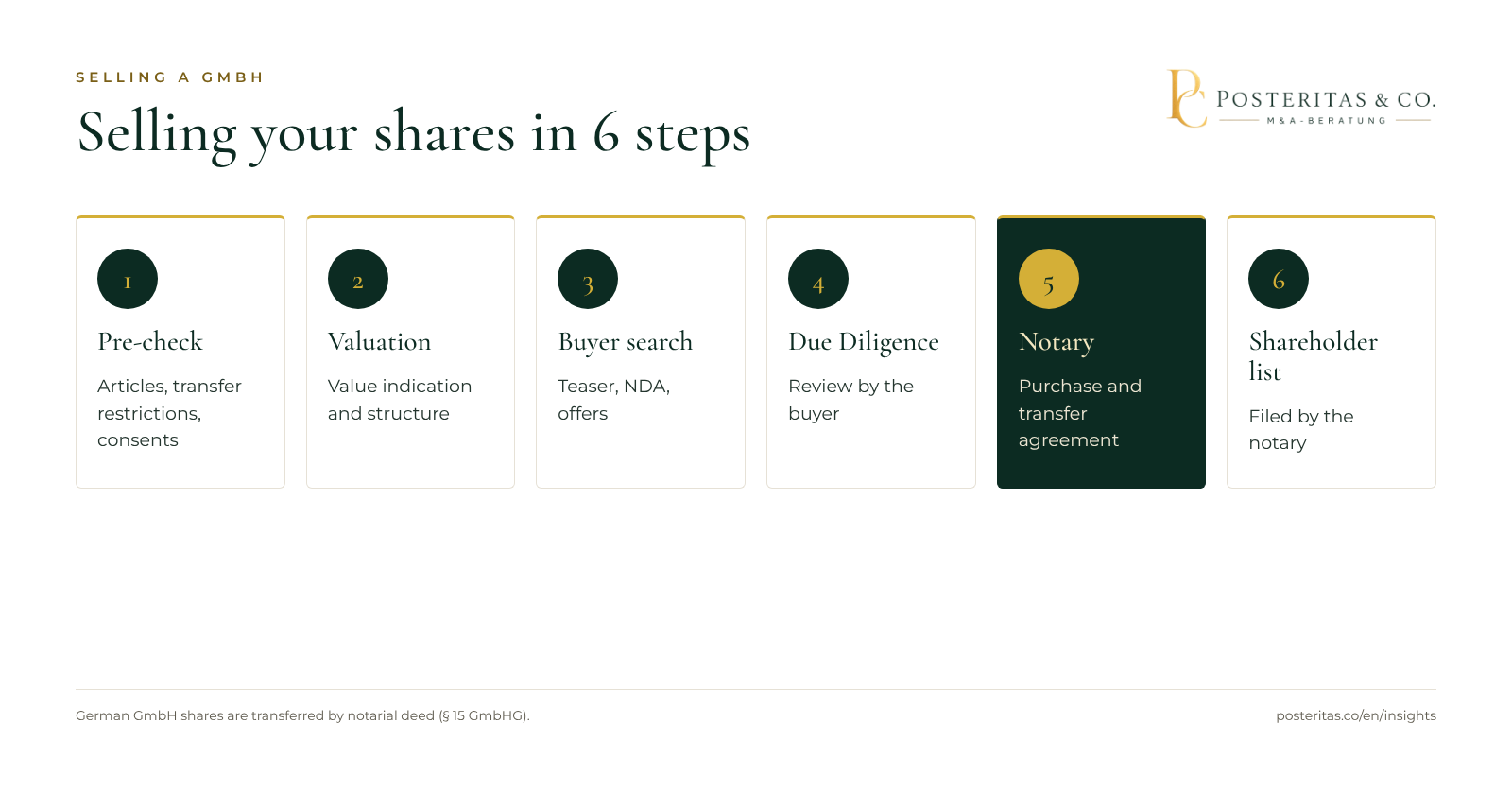
| Step | What happens | What to watch out for |
|---|---|---|
| 1. Preliminary review | Review articles of association, shareholder agreements, register | Transfer restrictions, pre-emption rights |
| 2. Valuation | Indication of value, normalisation of figures | Realistic price expectations |
| 3. Buyer search | Teaser, NDA, information memorandum | Confidentiality |
| 4. Due diligence | Buyer examines finance, tax, legal | Complete data room |
| 5. Notary appointment | Purchase and assignment agreement are notarised | Consents are in place |
| 6. Shareholder list | Notary files new list with the commercial register | Only then is the buyer legitimised vis-à-vis the GmbH |
Share deal or asset deal: what is being sold?
There are two routes for a GmbH. In a share deal, the shareholders sell their shares, and the GmbH itself remains unchanged. In an asset deal, the GmbH sells its business operations or individual assets.
| Criterion | Share deal | Asset deal |
|---|---|---|
| Seller | Shareholders | The GmbH itself |
| Subject of the sale | Shares | Machinery, contracts, trademarks, customers |
| The GmbH’s contracts | Remain in place | Transferred individually, often with consent |
| Employees | Remain with the GmbH | Transfer under § 613a BGB, right to object |
| Liability for legacy issues | Remains in the GmbH, i.e. with the buyer | Buyer can largely exclude it |
| Tax for the seller | § 17 EStG or § 8b KStG | Gain within the GmbH plus tax on distribution |
| Typical preference | Seller | Buyer |
In an asset deal, § 613a BGB (German Civil Code) applies: employment relationships transfer automatically to the buyer. Employees must be informed and can object within one month, as ROSE & PARTNER explains. For mid-sized companies, the share deal is therefore the normal case.
What form does the agreement require?
The German Limited Liability Companies Act (GmbHG) prescribes a strict form. Under § 15 GmbHG, both the obligation to transfer (the purchase agreement) and the assignment itself must be notarised. A privately written agreement is void. However, a purchase agreement that is invalid for lack of form can be cured by a validly notarised assignment, according to the material from the University of Erlangen-Nuremberg. In practice, the purchase and the assignment are combined in a single notarial deed.
Transfer restrictions and consents
Many articles of association contain a transfer restriction (Vinkulierung): shares may only be assigned with the consent of the company or the shareholders’ meeting (§ 15 (5) GmbHG). If consent is missing, the assignment is invalid. Also check pre-emption rights, tag-along rights and drag-along obligations in shareholder agreements, see Selling company shares.
The shareholder list
After notarisation, the notary files an updated shareholder list (Gesellschafterliste) with the commercial register (§ 40 GmbHG), as Captain.Legal describes. Vis-à-vis the company, the buyer is only treated as a shareholder once listed in it (§ 16 GmbHG).
What belongs in the purchase agreement?
| Provision | Content | Why it matters |
|---|---|---|
| Purchase price and mechanism | Fixed price (locked box) or adjustment at closing | Determines what is ultimately paid |
| Warranties | Assurances on financial statements, contracts, taxes, litigation | Basis for the seller’s liability |
| Indemnities | Assumption of known risks, e.g. taxes up to the reference date | Limits disputes over legacy issues |
| Liability limits | Cap, thresholds, limitation periods | Protects the seller |
| Earn-out | Part of the price depends on future results | Bridges price gaps |
| Non-compete | Seller refrains from competing for a limited period | Protects the value for the buyer |
| Shareholder loans, guarantees | Repayment or assumption | Releases the seller from liability |
| Closing conditions | Consents, clearances, financing | Defines the path to closing |
How is the sale of a GmbH taxed?
What matters is who holds the shares. The following rules apply in Germany.
| Shareholder | Rule | Taxable portion of the gain |
|---|---|---|
| Private individual with at least 1% | § 17 EStG, partial income method | 60% at the personal tax rate |
| Private individual with less than 1% | Flat-rate withholding tax (Abgeltungsteuer) | Full gain at 25% plus solidarity surcharge |
| Holding GmbH | § 8b KStG | 5%, effective tax burden of around 1.5% |
Sources: Lohnsteuer kompakt, REB Steuerberatung. A holding company is worthwhile above all for larger gains, but because of possible holding periods it usually has to be set up years before the sale. Be sure to review this with your tax advisor.
Caution with loss carryforwards
If the GmbH has tax loss carryforwards, a sale can wipe them out. Under § 8c KStG, unused losses are generally forfeited if more than 50 percent of the shares are transferred within five years. Exceptions apply, among others, to intra-group restructurings and up to the amount of existing hidden reserves, according to DATEV magazin. For buyers, this reduces the value; for sellers, it is a point of negotiation.
What does the buyer look at particularly closely in a GmbH?
Besides the business itself, the buyer looks closely at the company as a legal entity. You should check these points yourself before the sale:
| Checkpoint | Typical buyer question | Preparation |
|---|---|---|
| Share capital | Has the share capital been paid in full? | Have proof of payment ready |
| Shareholder list | Does the list match all past assignments? | Document the history without gaps |
| Shareholder loans | Which loans exist, and on what terms? | Schedule with agreements |
| Managing director’s contract | Which notice periods, severance payments, pensions apply? | Disclose the contract and commitments |
| Hidden profit distributions | Are there benefits to shareholders on terms not in line with the market? | Clean up before the sale |
| Shareholdings | Does the GmbH hold shares in other companies? | Present the structure as an organisation chart |
Hidden profit distributions (verdeckte Gewinnausschüttungen) and pension commitments to shareholder-managing directors in particular often lead to purchase price reductions in due diligence. If you identify them early, you can resolve them with your tax advisor before the sale.
What liability traps are there?
| Risk | Consequence | Solution |
|---|---|---|
| Missing consent under a transfer restriction | Assignment invalid | Obtain consent before the notary appointment |
| Warranties that are too broad | Subsequent purchase price reduction | Liability cap, disclosure in the data room |
| Personal guarantees | Liability after the sale | Agree release at closing |
| Open tax risks | Back payments after a tax audit | Clearly limit the tax indemnity |
| Unclear shareholder list | Dispute over legitimation | Review and correct the list before the sale |
Conclusion
Selling a GmbH is clearly regulated by law, but it does not forgive formal errors. If you review the articles of association and consents early, plan the tax structure in good time and negotiate warranties carefully, you will sell securely and at a fair price. More on the overall process in our guide Selling a business.
Sources
- Veräußerung und Vinkulierung von Gesellschaftsanteilen (Lehrmaterial Aktien- und GmbH-Recht), Friedrich-Alexander-Universität Erlangen-Nürnberg, 2026
- Geschäftsanteilsabtretung GmbH nach § 15 GmbHG, Captain.Legal
- Veräußerungsgewinn: Freibetrag und Teileinkünfteverfahren, Lohnsteuer kompakt, 2025
- § 8b KStG in der Holding: Schachtelprivileg und steuerbegünstigter Exit, REB Steuerberatung
- Wie ein Gesellschafterwechsel teuer werden kann (§ 8c KStG), DATEV magazin
- Arbeitsrecht beim Unternehmenskauf durch Asset Deal, ROSE & PARTNER
Frequently asked questions
Does the sale of GmbH shares have to be notarised?
Yes. Under § 15 GmbHG, both the purchase agreement (the obligation) and the assignment of the shares require notarial form. A privately written agreement is invalid. However, a purchase agreement that is invalid for lack of form is cured by a validly notarised assignment.
When does the buyer become a shareholder of the GmbH?
Legally, upon the valid assignment. Vis-à-vis the company, however, under § 16 GmbHG the buyer is only treated as a shareholder once entered in the shareholder list filed with the commercial register. The notary submits the new list.
What does Vinkulierung (transfer restriction) mean?
The articles of association can stipulate that shares may only be assigned with the consent of the company or the other shareholders. If this consent is missing, the assignment is invalid. This is why reviewing the articles of association belongs at the start of every sale.
How is the sale of GmbH shares taxed?
If a private individual holds at least 1 percent, § 17 EStG applies with the partial income method: 60 percent of the gain is taxable. If a corporation (holding company) holds the shares, 95 percent is tax-exempt under § 8b KStG. Your tax advisor should review the details.
What happens to the GmbH's loss carryforwards?
If more than 50 percent of the shares change owner within five years, unused losses are generally forfeited under § 8c KStG. Exceptions exist, for example, for intra-group restructurings or up to the amount of hidden reserves.
Can I also sell a GmbH via an asset deal?
Yes, in that case the GmbH itself sells its business operations. The gain is first taxed within the GmbH, and a distribution to the shareholders is taxed again. Employees transfer to the buyer under § 613a BGB. For sellers, the share deal is therefore usually more favourable.
What about my personal guarantees and shareholder loans?
Personal guarantees given to banks and shareholder loans should be dealt with in the purchase agreement: the buyer repays or assumes the loans, and guarantees are released at closing or replaced by security provided by the buyer.
How high are the notary fees?
They are governed by the German Court and Notary Fees Act (GNotKG) and the transaction value, which essentially means the purchase price. The buyer usually bears the costs, but this is a matter for negotiation.