
What is your company worth? The capitalized earnings method (Ertragswertverfahren) gives a clear answer: as much as its future profits are worth today. In Germany it is the classic method for valuation reports under IDW S 1, and in a simplified form it is the basis for inheritance and gift tax. This guide explains the logic, the current interest rate parameters and two worked examples. You will also learn when the method helps in a sale and where its limits lie.
How does the capitalized earnings method work?
The capitalized earnings method determines the value of a company as the present value of all future, sustainably achievable earnings that flow to its owners. One euro of profit in five years is worth less today than one euro today. The expected earnings are therefore discounted using a capitalization rate.
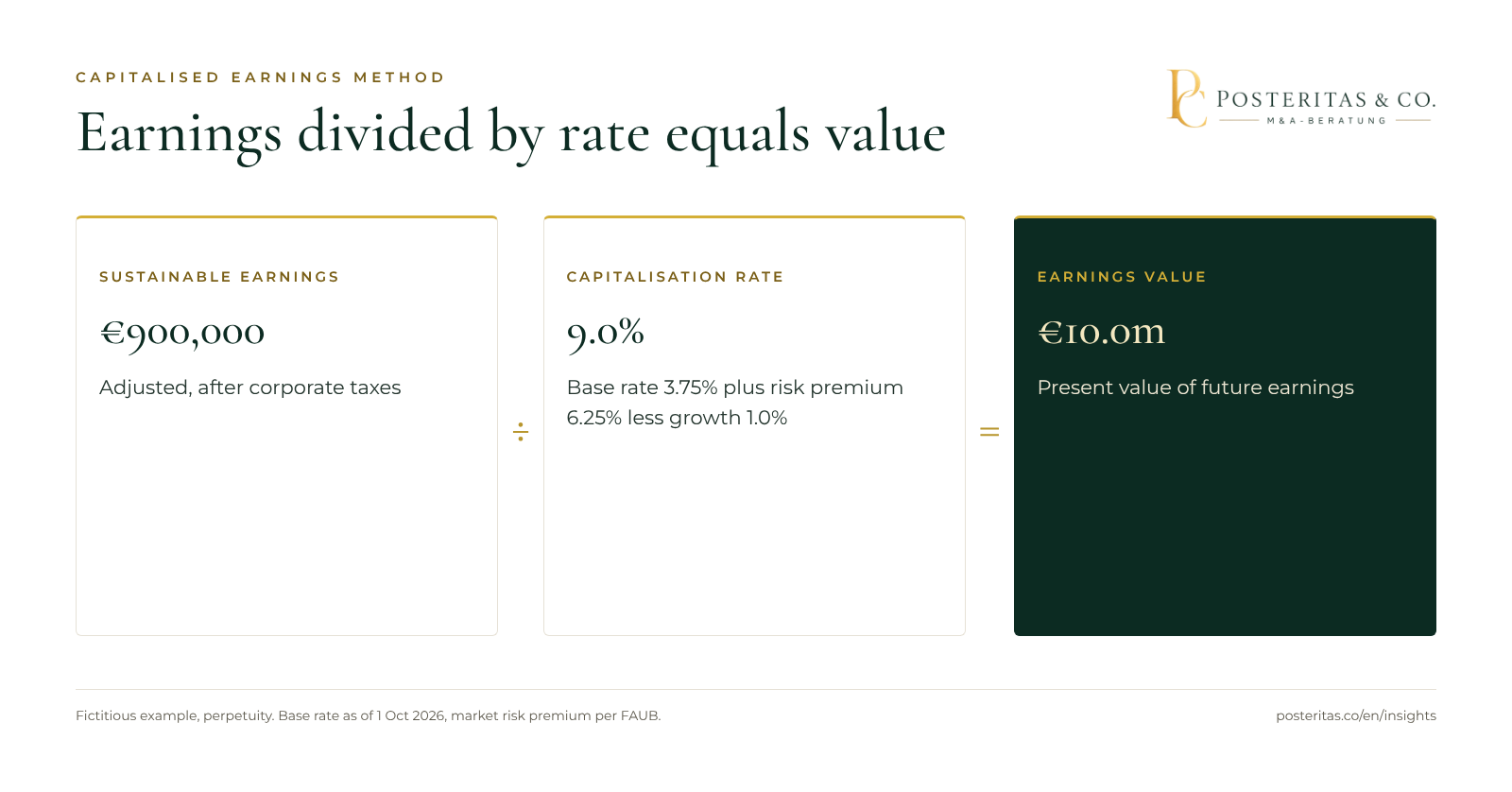
The interest rate reflects the return on an equivalent alternative investment. The riskier the earnings, the higher the rate and the lower the value. In the simplest case of constant earnings:
Capitalized earnings value = sustainable annual earnings ÷ capitalization rate
You will find an overview of all common methods in our guide to business valuation.
What does IDW S 1 govern?
IDW S 1 is the business valuation standard of the Institute of Public Auditors in Germany (Institut der Wirtschaftsprüfer, IDW). For many years the 2008 version applied. On 8 April 2026 the IDW published a revised version (IDW S 1 as amended in 2026). It applies to valuation dates after its publication and replaces the 2008 version. The present value logic of the capitalized earnings method is retained.
Key principles:
- Future orientation: future earnings are valued. Historical figures serve only as a plausibility check.
- Reporting date principle: what counts is the information available on the valuation date.
- Valuation of earning power: non-operating assets are recognised separately at their liquidation value.
- Objectified value: a standardised value from the perspective of a neutral valuer, without buyer-specific synergies.
- Subjective value: the decision value for a specific buyer or seller. The revised version refers here to the plausibility-checked decision value.
Income taxes are standardised. Corporate taxes such as corporation tax and trade tax always reduce earnings. The personal taxes of the owners are taken into account on a standardised basis in reports on objectified values. In transactions, a calculation before personal taxes is customary.
How is the capitalization rate made up?
The capitalization rate consists of the base interest rate plus a risk premium. In the terminal value, a growth discount is also deducted. Under the CAPM, the risk premium is the market risk premium multiplied by the beta factor.
The base interest rate is derived from the Deutsche Bundesbank yield curve for German federal securities. As of 1 October 2026 it is 3.75% rounded (3.74% unrounded). The market risk premium is recommended by the IDW’s expert committee for business valuation (FAUB). Since 22 September 2025 a range of 5.25 to 6.75% before personal taxes has applied. After personal taxes the range is 4.50 to 5.75%.
| Component | Value in the example | Source |
|---|---|---|
| Base interest rate | 3.75% | Yield curve, as of 1 October 2026 |
| Market risk premium | 6.25% | FAUB range 5.25 to 6.75% (before personal taxes) |
| Beta factor | 1.0 | Peer group, here the market average |
| Risk premium | 6.25% | 6.25% × 1.0 |
| Capitalization rate, detailed phase | 10.00% | 3.75% + 6.25% |
| Growth discount | 1.00% | Assumption for the terminal value |
| Capitalization rate, terminal value | 9.00% | 10.00% minus 1.00% |
The beta factor measures how strongly a company fluctuates compared with the overall market. For mid-sized companies it is derived from listed peer companies. A value above 1.0 indicates higher risk.
How does the phase model work?
The phase model divides the future into a detailed planning phase and a terminal value. For the first three to five years, earnings are planned and discounted individually. After that, a steady state with constant growth is assumed.
Capitalized earnings value = sum of the present values of the detailed phase + present value of the terminal value
Terminal value = earnings in the first year thereafter ÷ (capitalization rate minus growth discount)
Worked example following IDW logic (simplified, before personal taxes): A company plans earnings after corporate taxes of €800,000, €850,000 and €880,000. From year 4 it expects sustainable earnings of €900,000 with 1% growth.
| Item | Calculation | Present value |
|---|---|---|
| Year 1 | €800,000 ÷ 1.10 | €727,273 |
| Year 2 | €850,000 ÷ 1.10² | €702,479 |
| Year 3 | €880,000 ÷ 1.10³ | €661,157 |
| Terminal value | €900,000 ÷ 9% = €10,000,000, discounted ÷ 1.10³ | €7,513,148 |
| Capitalized earnings value | €9,604,057 |
Around 78% of the value comes from the terminal value. This shows how strongly assumptions about sustainability and growth affect the result. In short form: €900,000 of sustainable earnings ÷ 9% gives €10.0 million. How to adjust the earnings base properly is explained in our guide to calculating business value.
What is the simplified capitalized earnings method under the BewG?
The simplified capitalized earnings method under §§ 199 to 203 of the German Valuation Act (Bewertungsgesetz, BewG) is a flat-rate tax method. It is used mainly for German inheritance and gift tax. Its basis is the average operating result of the last three financial years (§ 201 BewG).
The operating result is adjusted in accordance with § 202 BewG. Items added back include, for example, special depreciation, extraordinary expenses and income tax expense. Extraordinary income and an appropriate owner’s salary are deducted. The result is then reduced by a flat 30%. Under § 203 BewG the capitalization factor is 13.75. It applies to valuation dates after 31 December 2015 and corresponds to an interest rate of around 7.27%.
Worked example under the BewG: Adjusted operating results of €1,100,000, €1,250,000 and €1,150,000 give an average of €1,166,667. After the 30% deduction, €816,667 remains. Multiplied by 13.75, this gives a capitalized earnings value of €11,229,167.
Limits and exclusions:
- The method must not lead to obviously incorrect results (§ 199 BewG).
- Sales between unrelated third parties within one year before the valuation date take precedence (§ 11 (2) BewG).
- The net asset value is the lower limit.
- Non-operating assets, shareholdings and recently contributed assets (contributed within two years) are recognised separately (§ 200 BewG).
| Feature | IDW S 1 | Simplified BewG method |
|---|---|---|
| Purpose | Valuation reports, transactions, compensation payments | Inheritance and gift tax |
| Earnings base | Future planning | Average of the last three years |
| Taxes | Actual corporate taxes, standardised | Flat 30% |
| Interest rate | Base rate plus individual risk premium | Fixed factor of 13.75 (around 7.27%) |
| Growth | Growth discount possible | Not provided for |
| Prepared by | Certified public auditor | Taxpayer or tax advisor, reviewed by the tax office |
Because the factor is fixed, at today’s interest rates the BewG often produces higher values than a valuation under IDW S 1. In that case a valuation report showing a lower value can make sense for tax purposes. This is not tax advice. Have your individual case reviewed by your tax advisor.
How does the capitalized earnings value differ from DCF and multiples?
The capitalized earnings method and DCF are both present value methods and lead to the same result under consistent assumptions. Multiples, by contrast, derive the value from the market prices of comparable transactions.
| Criterion | Capitalized earnings method | DCF | Multiple |
|---|---|---|---|
| Metric | Distributable earnings | Free cash flows | Historical EBITDA or EBIT |
| Discounting | Cost of equity | Usually WACC | None, market factor |
| Prevalence | German valuation practice, tax | International, investors | M&A practice, plausibility check |
| Effort | High | High | Low |
| Proximity to the market | Medium | Medium | High |
In sale processes, buyers often work with multiples. You can read how these work in our guide to EBITDA multiples.
What are the strengths and weaknesses of the method?
Its greatest strength is its transparent, forward-looking logic. Its greatest weakness is its high sensitivity to planning assumptions and the interest rate.
Strengths:
- Recognised by the courts, the tax authorities and auditors
- Reflects the company’s individual earning power
- Makes value drivers and risks transparent
Weaknesses:
- Small changes in the interest rate shift the value considerably. If the rate in the terminal value falls from 9% to 8%, the value rises from €10.0 million to €11.25 million.
- Owners’ plans are often too optimistic or too cautious.
- Dependence on the owner is difficult to capture in the interest rate.
When is the capitalized earnings method useful in a sale?
In a sale, the capitalized earnings value is useful above all as a well-founded value basis and a negotiating anchor. The actual price, however, is set by the market. It depends on the type of buyer, synergies and competition.
The method is particularly useful:
- where earnings are stable and easy to plan
- in business succession within the family and in inheritance matters
- for checking the plausibility of offers based on multiples
- when a strategic buyer derives its willingness to pay
How value turns into price is described in our guide to purchase price negotiation.
What is your next step?
The best next step is an initial, realistic indication of your company’s value based on several methods. This will show you whether your price expectations match the market. Valuation reports under IDW S 1 are prepared by certified public auditors. Your tax advisor is responsible for tax questions. If you are considering a sale, we will be glad to discuss your situation in a confidential initial meeting. You can read more about the process in our guide to selling a business.
Sources
- Bewertungsgesetz (BewG) § 203 Kapitalisierungsfaktor, Bundesministerium der Justiz, gesetze-im-internet.de
- Bewertungsgesetz (BewG) § 202 Betriebsergebnis, Bundesministerium der Justiz, gesetze-im-internet.de
- Bewertungsgesetz (BewG) § 11 Wertpapiere und Anteile, Bundesministerium der Justiz, gesetze-im-internet.de
- Basiszinssatz nach IDW S 1 bleibt zum 01.10.2026 gerundet bei 3,75 %, Kleeberg, 2026
- FAUB veröffentlicht angepasste Empfehlung zur Höhe der Marktrisikoprämie, Grant Thornton, 2025
- Neufassung des IDW S 1 2026: Neuer Standard für Bewertungen, Forvis Mazars, 2026
- Zinsstruktur am Rentenmarkt: Börsennotierte Bundeswertpapiere, Deutsche Bundesbank
- Billigkeitserlass bei Kapitalisierungsfaktor im vereinfachten Ertragswertverfahren, IWW Institut, ErbBstg
Frequently asked questions
What is the capitalized earnings method in simple terms?
The capitalized earnings method asks what a company's future profits are worth today. To answer this, the expected, sustainably achievable earnings are discounted to the valuation date using a risk-adjusted interest rate. The sum of these present values is the capitalized earnings value.
What is the current base interest rate for business valuations?
As of 1 October 2026 the base interest rate under the IDW methodology is 3.75% rounded (3.74% unrounded). It is derived from the Deutsche Bundesbank yield curve for German federal securities and changes monthly.
What market risk premium does the FAUB recommend?
Since 22 September 2025 the FAUB of the IDW has recommended a market risk premium of 5.25 to 6.75% before personal taxes and 4.50 to 5.75% after personal taxes. Previously, from 2019, the ranges were 6.0 to 8.0% and 5.0 to 6.5% respectively.
Since when has the capitalization factor of 13.75 applied?
The fixed capitalization factor of 13.75 under § 203 BewG applies to valuation dates after 31 December 2015. It corresponds to a capitalization rate of around 7.27% and is independent of the current interest rate level.
When may the simplified capitalized earnings method be used?
It is used mainly for valuations for German inheritance and gift tax. It is only permitted if it does not lead to obviously incorrect results. If there have been recent sales between unrelated third parties, these take precedence. The net asset value always forms the lower limit.
What is the difference between the capitalized earnings method and DCF?
Both are present value methods and lead to the same results under the same assumptions. The capitalized earnings method discounts the earnings distributable to the owners at the cost of equity. DCF works with cash flows and often with the weighted average cost of capital (WACC) for equity and debt.
Is the capitalized earnings value also the sale price of my company?
No. The capitalized earnings value is a value, not a price. The purchase price emerges in negotiation and depends on the type of buyer, synergies, competition between bidders and the structure of the contract. The capitalized earnings value does, however, provide a robust basis for argument.
Who prepares a valuation report under IDW S 1?
Reports under IDW S 1 are prepared by certified public auditors (Wirtschaftsprüfer). For sale processes, a well-founded indicative valuation by an M&A advisor that follows the same logic is often sufficient. Clarify tax questions with your tax advisor.