
For most owners, selling a company is a once-in-a-lifetime event. It concerns their life’s work, their employees and often a large part of their personal wealth. This article describes the five phases we use to structure sell-side mandates for mid-sized companies and shows what matters in each phase.
How does a business sale work? The 5 phases at a glance
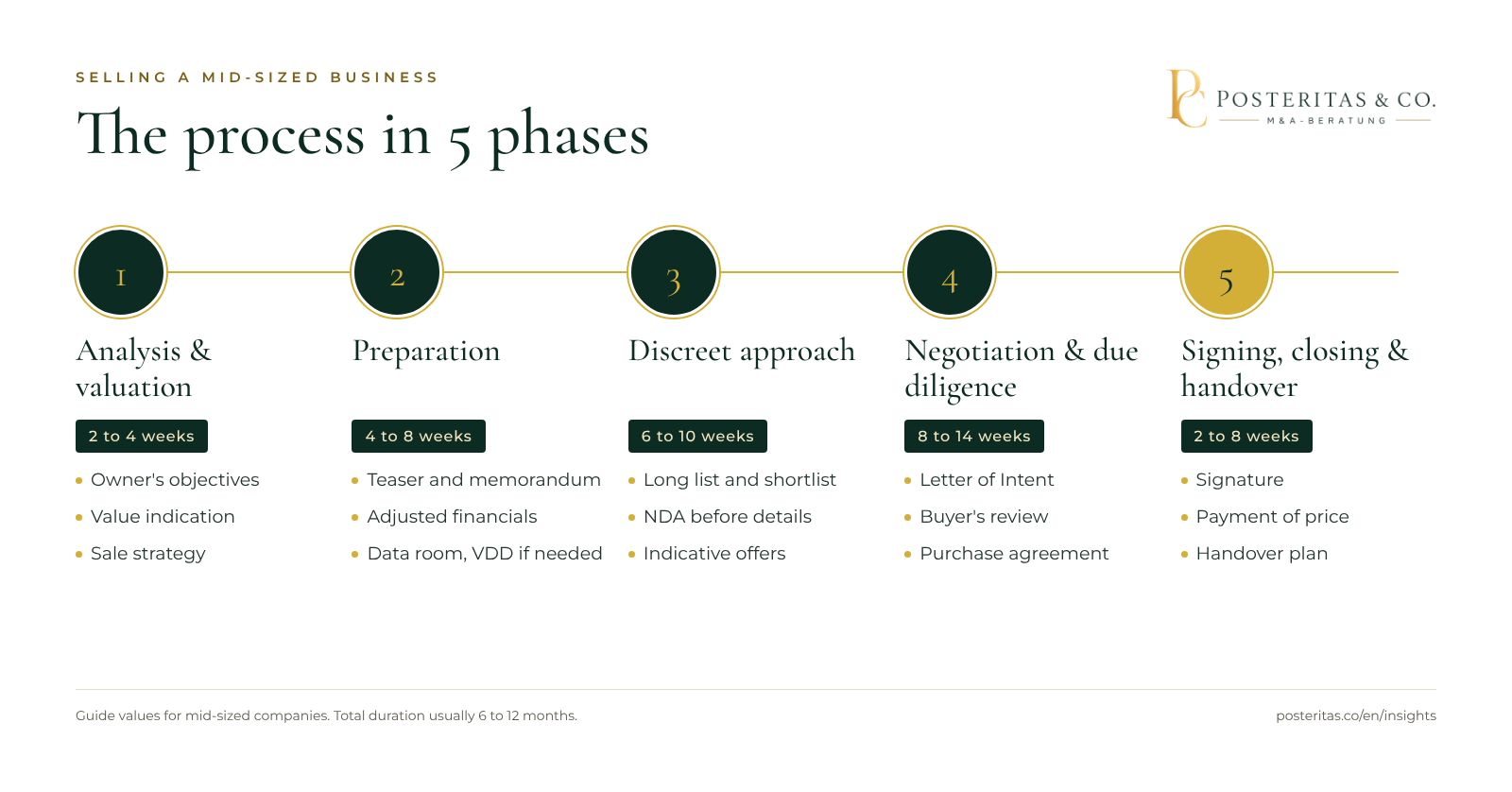
| Phase | Goal | Key outcomes | Guide duration |
|---|---|---|---|
| 1. Analysis and valuation | Clarify goals, assess value | Target picture, indication of value, strategy | 2 to 4 weeks |
| 2. Preparation | Present the company in a saleable form | Teaser, memorandum, business plan, data room | 4 to 8 weeks |
| 3. Discreet approach | Find suitable buyers | Buyer list, NDAs, indicative offers | 6 to 10 weeks |
| 4. Negotiation and due diligence | Secure the best offer | Letter of intent, due diligence, purchase agreement | 8 to 14 weeks |
| 5. Signing, closing, handover | Complete the transaction | Agreement, payment of purchase price, handover plan | 2 to 8 weeks |
These values apply to companies with €1 million to €20 million in revenue and can differ considerably in individual cases.
Why the topic is pressing: succession in figures
Germany’s Mittelstand, its backbone of mid-sized, often family-owned companies, is facing a major wave of handovers. According to the KfW succession monitoring, around 545,000 of the 3.87 million mid-sized companies are aiming for a succession by the end of 2029. Among all mid-sized companies with succession plans, 42 percent are considering a sale to external buyers. At the same time, around 569,000 owners intend to close their business by then without a successor.
| Metric | Value | Source |
|---|---|---|
| Companies ready for handover in Germany 2026 to 2030 | around 186,000 | IfM Bonn |
| Share of external successors in family businesses | 29% | IfM Bonn |
| Planned successions in the Mittelstand by the end of 2029 | around 545,000 | KfW |
| Mid-sized companies with succession plans considering a sale to outsiders | 42% | KfW |
| Owners who prepare the handover too late | 38% | DIHK |
| Outgoing owners with excessive price expectations | 36% | DIHK |
The figures from IfM Bonn and the DIHK report point to two typical weaknesses: preparation that starts too late and price expectations that are too high. This is exactly where a structured process comes in.
Phase 1: Analysis and valuation
The starting point is your goals, not the figures:
- Scope: A full sale, a majority sale or only part of the shares?
- Your role afterwards: An immediate exit or a transition period?
- Priorities: Highest price, location, security for employees, preserving the name?
- Timeframe: Are there personal or tax reasons for a particular point in time?
In parallel, we analyse the business model, customer structure, margins and dependencies. This results in a realistic indication of value, which for mid-sized companies is usually based on multiples from comparable transactions. More on this in our article on business valuation.
Phase 2: Preparation of the documents
Buyers buy the future, but they examine the past. This phase produces the documents for the market.
| Document | Content | Who receives it? |
|---|---|---|
| Teaser | Anonymous short profile of one to two pages | All interested parties approached |
| Information memorandum | Market, business model, team, customers, figures | Only after a signed NDA |
| Financial plan | Plan for three to five years | Together with the memorandum |
| Data room | Contracts, financial statements, HR, taxes, IT | Selected bidders during due diligence |
Normalising the figures is particularly important. One-off effects, private expenses or a managing director’s salary that is not in line with the market distort the result. An adjusted EBITDA shows the true earning power, see EBITDA multiples for mid-sized companies.
Is vendor due diligence worthwhile?
In a vendor due diligence (VDD), the seller has advisors examine the company before the sale. According to Rödl & Partner, this creates a knowledge advantage, shortens the process and reduces liability risks, because weaknesses are fixed or disclosed. If the advisors assume liability via a reliance letter, the buyer can partly dispense with its own review.
| With VDD | Without VDD | |
|---|---|---|
| Knowledge of weaknesses | Before the negotiation | Only through the buyer |
| Negotiating position | Stronger | Reactive |
| Upfront costs | Higher | Lower |
| Useful for | Auction process, complex structures | Small, straightforward companies |
Phase 3: Discreet approach to buyers
We draw up a longlist of potential interested parties, narrow it down with you to a shortlist and approach them anonymously. Only after signing a non-disclosure agreement (NDA) does an interested party learn which company is involved.
| Buyer type | Typical motive | Advantages | Possible disadvantages |
|---|---|---|---|
| Strategic buyer | Market share, synergies | Often higher prices due to synergies | Integration changes structures |
| Financial investor | Value creation, later exit | Professional process, rollover equity | Limited investment horizon |
| Family office | Long-term investment | Patient capital, continuity | Sometimes lower valuation |
| Entrepreneur, MBI | Own active role | Personal succession | Financing often tight |
| Management (MBO) | Taking over their own business | Knows the business and customers | Vendor loan usually required |
Auction process or exclusive negotiation?
There are basically two routes: a structured auction process with several interested parties or an exclusive negotiation with a single buyer.
| Criterion | Auction process | Exclusive negotiation |
|---|---|---|
| Purchase price | Competition drives the price | Dependent on one buyer |
| Deal certainty | Alternatives if a bidder drops out | Termination means starting over |
| Effort and duration | Higher | Lower, faster |
| Confidentiality | More parties involved | Easier to protect |
As Unternehmeredition summarises, the auction process is suited to achieving the best possible price, while bilateral negotiation suits confidentiality and speed. For mid-sized companies, a limited auction process with three to eight selected interested parties often proves effective. Details on investors in our article Selling to investors.
Phase 4: Negotiation and due diligence
A letter of intent (LOI) is negotiated with the preferred bidder: purchase price, structure, timetable and usually an exclusivity period. As a rule, only clauses such as confidentiality and exclusivity are binding, see The letter of intent explained. The buyer then examines the company in due diligence: finance, tax, legal, HR, market and IT. Our due diligence checklist provides an overview. The findings feed into warranties, indemnities and the purchase price mechanism.
Share deal or asset deal?
| Criterion | Share deal | Asset deal |
|---|---|---|
| Subject of the sale | Shares in the company, e.g. GmbH shares | Individual assets and contracts |
| Contracts | Generally remain in place | Must be transferred individually, often with consent |
| Liability for legacy issues | Remains with the company | Buyer can exclude risks |
| Typical preference | Seller | Buyer |
More on share sales under Selling a GmbH.
How is the purchase price determined?
| Mechanism | How it works | Benefits |
|---|---|---|
| Locked box | Fixed price based on a reference date balance sheet | Seller (price certainty) |
| Closing accounts | Adjustment for debt and working capital at closing | Buyer (accuracy) |
| Earn-out | Part of the price depends on future results | Bridges price gaps |
| Vendor loan | Part of the price is deferred | Buyer’s financing |
An earn-out carries potential for conflict if the calculation is not precisely defined, see Earn-outs in the purchase agreement.
Which taxes apply when selling a business?
The tax burden depends on who is selling and what is being sold. The following overview shows the basic rules in Germany. It does not replace tax advice.
| Seller and subject of sale | Basic rule | Special feature |
|---|---|---|
| Sole proprietorship or partnership | Capital gain under § 16 EStG (German Income Tax Act) | From age 55, a one-off allowance of €45,000, reduced from €136,000 of gain, and a reduced tax rate of 56% under § 34 (3) EStG |
| GmbH shares held as private assets (from 1%) | § 17 EStG, partial income method (Teileinkünfteverfahren) | 60% of the gain is taxable |
| GmbH shares held via a holding GmbH | § 8b KStG (German Corporate Income Tax Act) | 95% tax-exempt, effective tax burden of around 1.5%, observe holding periods |
Sources: Lohnsteuer kompakt, REB Steuerberatung. Anyone wishing to use a holding company usually has to set it up years before the sale because of the holding periods. For cross-border structures, the rules of the countries involved also apply.
Phase 5: Signing, closing and handover
At signing, the purchase agreement is signed, which for GmbH shares in Germany requires notarisation. Closing follows as soon as all conditions are met, such as merger control clearance or financing. The purchase price is then paid and the company passes to the buyer.
- Communication: Employees, customers and suppliers are informed in a coordinated sequence.
- Transition period: If agreed, the previous owner remains on board in an advisory or operational role.
- After closing: Document purchase price adjustments, earn-out calculations and warranty periods carefully. Clear rules in the agreement prevent later disputes.
A good sale process does not end with the signature, but with a company that continues to run well in new hands.
Which mistakes should you avoid?
| Mistake | Consequence | Countermeasure |
|---|---|---|
| Starting too late | Selling under time pressure | Begin preparation two to three years in advance |
| Excessive price expectations | Termination, burnt market | Well-founded indication of value before launch |
| Only one interested party | Buyer dictates the terms | Limited auction process |
| Incomplete documents | Price reductions in due diligence | Build the data room before the approach |
| Strong dependence on the owner | Lower value | Build a second management level |
| Tax structure reviewed too late | Avoidable tax burden | Plan early with your tax advisor |
Conclusion: a business sale can be planned
If you start preparing early, normalise the figures, bring several buyers into a structured process and choose the contractual and tax structure carefully, you significantly increase the chances of a fair price and a good solution for your life’s work. The five phases provide orientation, but they do not replace a close look at your company. In a confidential initial conversation, we clarify where you stand and which route fits your goals.
Sources
- Nachfolge-Monitoring Mittelstand 2025: Pläne für Geschäftsaufgaben wachsen erneut (KfW Research Fokus Nr. 526), KfW Research, Dr. Michael Schwartz, January 2026
- Unternehmensnachfolgen in Deutschland 2026 bis 2030 (IfM Bonn), IHK Dresden, January 2026
- DIHK-Report Unternehmensnachfolge 2025, Deutsche Industrie- und Handelskammer, July 2025
- Strukturierter Bieterprozess versus bilaterale Verhandlung, Unternehmeredition, Boris Dürr (Heuking), October 2024
- Vendor Due Diligence: Prüfung durch den Verkäufer, Reliance Letter und Haftung, Rödl & Partner, July 2021
- Veräußerungsgewinn: Freibetrag nach § 16 Abs. 4 und Tarifermäßigung nach § 34 Abs. 3 EStG, Lohnsteuer kompakt, 2025
- § 8b KStG in der Holding: Schachtelprivileg und steuerbegünstigter Exit, REB Steuerberatung
Frequently asked questions
How long does it take to sell a business?
A structured sale process for a mid-sized company usually takes six to twelve months until closing. Complex structures, regulatory approvals or a difficult market environment extend this period. Preparing the company itself, for example building a second management level, should ideally begin two to three years in advance.
What does an M&A advisor cost when selling a business?
The usual model combines a base fee with a success fee that is only payable on completion and is usually based on the transaction value. The exact amount depends on the size, complexity and scope of the mandate and is set out in the engagement agreement.
When do employees, customers and suppliers learn about the sale?
Usually only shortly before or after signing. Until then, the process works with anonymised documents and non-disclosure agreements. Key people are often involved earlier in agreement with the buyer, for example for management meetings during due diligence.
What is the difference between signing and closing?
At signing, the purchase agreement is signed. At closing, the company actually passes to the buyer once all agreed conditions have been met, such as approvals, third-party consents or payment of the purchase price. The gap between the two ranges from a few days to several weeks.
Do I need a business valuation before the sale?
Yes, a well-founded indication of value is strongly recommended. According to the DIHK, 36 percent of outgoing owners expect excessive prices. A realistic valuation protects against failed negotiations. In the end, the actual price is determined by the market, meaning the buyers' offers.
Which is better: a share deal or an asset deal?
Sellers usually prefer a share deal because the company passes as a whole and liability risks lie with the buyer. Buyers often prefer an asset deal because they can leave legacy liabilities behind. Which structure makes sense depends heavily on taxes and legal form and should be reviewed with a tax advisor and a lawyer.
Can I stay in the company after the sale?
Yes, and this is often even desired. Many buyers agree a transition period ranging from a few months to several years. Part of the purchase price is often linked to performance during this period through an earn-out.
Is vendor due diligence worthwhile for a mid-sized company?
For more complex companies and in auction processes, often yes. The seller identifies weaknesses earlier, can fix or disclose them and negotiates from a stronger position. For small, straightforward companies, thorough internal preparation of the data room is often sufficient.
What are the most common reasons business sales fail?
Unrealistic price expectations, incomplete documents, surprises in due diligence, strong dependence on the owner and a process with only one interested party. Most of these risks can be reduced considerably through early preparation.