
Roughly one in seven Swiss SMEs is looking for a successor. At the same time, 2025 was an active M&A year. For owners, this means: there are buyers, but the path to completion follows its own rules. Swiss contract law (the Code of Obligations), cantonal tax practice and restraint in handling sensitive information shape every sale. This guide shows what M&A advisory in Switzerland involves, which legal and tax points matter and what German buyers and sellers should bear in mind.
What does M&A advisory in Switzerland involve?
M&A advisory guides you as the owner through the entire sale in a structured way, from preparation to completion.
Typical tasks include:
- Preparation: analysis of the company, removal of dependencies, proposal for the transaction structure.
- Valuation: a realistic value range instead of a wish price, see our guide on business valuation.
- Documents: anonymous teaser, information memorandum, data room.
- Buyer outreach: confidential, targeted and under a non-disclosure agreement.
- Negotiation and completion: letter of intent, due diligence, purchase agreement, closing.
We describe the general process in our article on the business sale process. In Switzerland, discretion is particularly important, as many owners are closely tied to their region and canton.
What is the state of succession and M&A in Switzerland in 2025/2026?
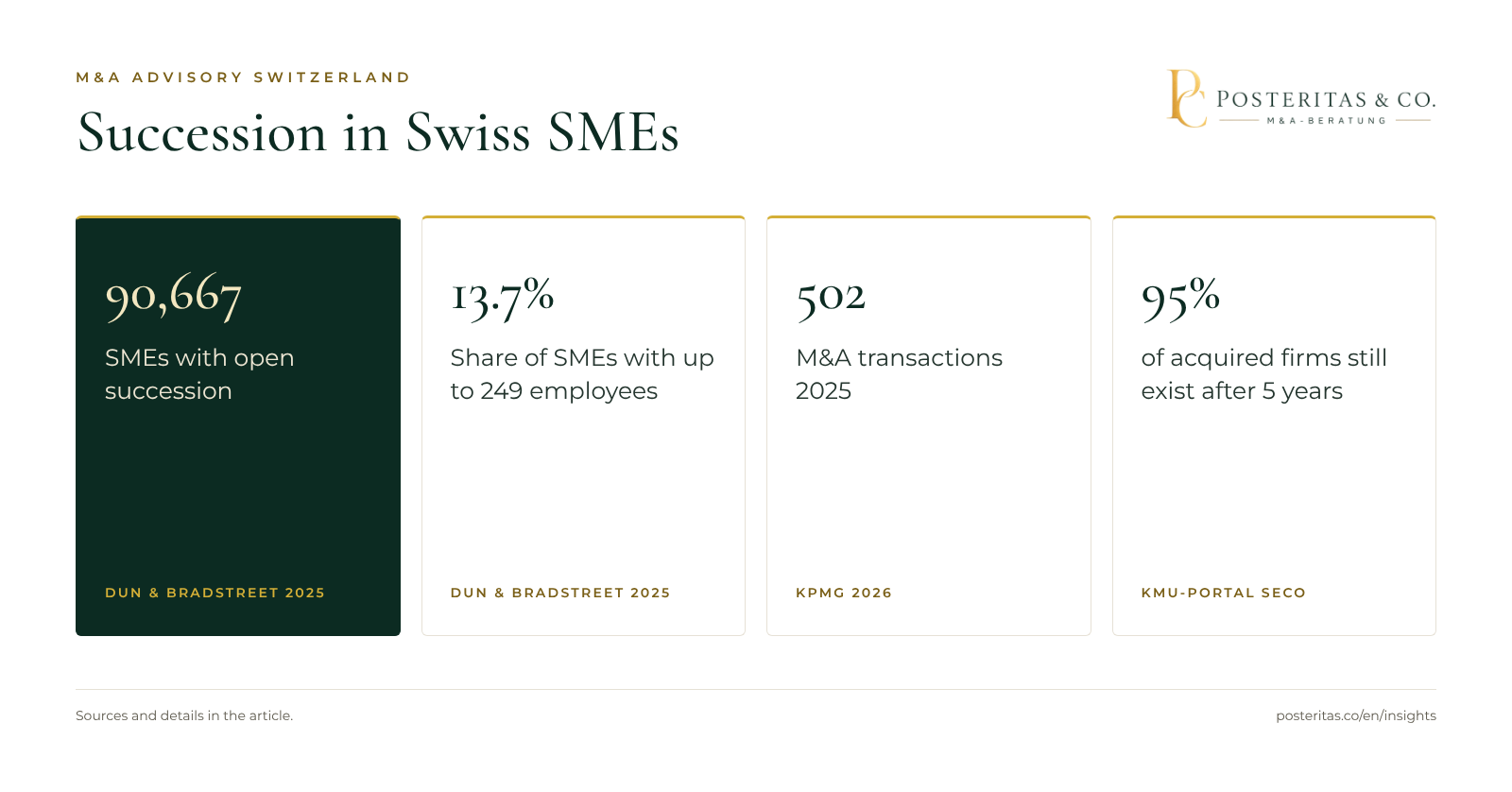
Succession pressure is high and the transaction market is active. According to the Dun & Bradstreet succession study of March 2025, 90,667 Swiss SMEs have an open succession. That is 13.7 percent of all companies with up to 249 employees. Sole proprietorships are most affected at 19.3 percent, followed by stock corporations (AG) at 14.0 percent and limited liability companies (GmbH) at 9.6 percent. Regionally, Northwestern Switzerland, Eastern Switzerland and Espace Mittelland lead.
Based on a Credit Suisse survey, the SECO SME portal cites further figures: around 42 percent of SMEs are transferred within the direct family line, 11 percent to other relatives and 23 percent to employees or partners. According to a study by the KMU Next foundation, almost one in three SMEs disappears because no successor is found. Companies that are taken over, by contrast, have a survival rate of 95 percent after five years.
On the buyer side, KPMG counted a total of 502 transactions with Swiss involvement in 2025, after 464 in the previous year. Private equity was involved in 142 transactions.
Which buyer groups come into question for a Swiss SME?
For a Swiss SME, four buyer groups generally come into question, differing in motive, pace and purchase price logic. Which one fits depends on your goals: price, continuity, jobs or your own role after the sale.
| Buyer group | Typical motive | Strengths | What to watch |
|---|---|---|---|
| Family | Continuation, preserving wealth | Continuity, trust | Financing, equal treatment of heirs |
| Management (MBO) | Entrepreneurial opportunity | Knows customers and processes | Equity often scarce, vendor loans common |
| Strategic buyer | Market share, know-how, synergies | Often higher willingness to pay | Integration, loss of independence |
| Financial investor | Return, growth, add-on acquisitions | Capital, professionalism | Rollover equity, exit horizon |
We cover family solutions in our guide on business succession. If you are considering private equity or family offices, read our article on selling to investors.
Which legal rules apply when selling a company in Switzerland?
The main framework is the Swiss Code of Obligations (Obligationenrecht, OR; referred to here as CO), supplemented by the Cartel Act and, in future, the Investment Screening Act. The form depends on whether you sell shares (share deal) or individual assets (asset deal).
GmbH capital contributions: under Art. 785 CO, the assignment requires written form. Notarisation as in Germany is not necessary. Under Art. 786 CO, the consent of the shareholders’ meeting is generally required, although the articles of association may provide otherwise. Since the shareholders of a GmbH are entered in the commercial register, the change must be registered there.
Shares in an AG: registered shares are transferred by handing over the share certificates or by assignment. They are often subject to transfer restrictions (vinkuliert), in which case the board of directors must consent. Shareholders are not listed in the commercial register but in the company’s share register.
Asset deal and employees: if a business or part of a business is transferred, the employment relationships pass to the acquirer with all rights and obligations under Art. 333 CO. Employees may refuse the transfer. The employee representatives or the employees must be informed in good time (Art. 333a CO).
Merger control: a concentration must be notified to the Competition Commission (WEKO) if the companies involved together achieve turnover of at least CHF 2 billion worldwide or CHF 500 million in Switzerland, and at least two of the parties each achieve at least CHF 100 million in Switzerland (Art. 9 Cartel Act). Most SME sales are well below these thresholds. On 19 December 2025, Parliament adopted a partial revision of the Cartel Act. It introduces the SIEC test; according to CMS, the thresholds remain unchanged, and entry into force is expected in 2027.
Investment screening: the Investment Screening Act (IPG) was also adopted on 19 December 2025. According to SECO, it is scheduled to enter into force in 2027. Approval will then be required for takeovers of companies in particularly critical sectors by state-controlled foreign investors. Private buyers from Germany are generally not covered.
How are sale proceeds taxed in Switzerland?
In Switzerland, the gain from selling privately held shares is generally tax-free (Art. 16(3) DBG). This is a key difference from Germany. However, there are important exceptions that affect the purchase price or the structure.
| Constellation | Basic rule | Provision |
|---|---|---|
| Sale of privately held shares | Capital gain generally tax-free | Art. 16(3) DBG |
| Indirect partial liquidation | Part of the proceeds is taxed as investment income | Art. 20a(1)(a) DBG |
| Transposition | Transfer to your own company can trigger investment income | Art. 20a(1)(b) DBG |
| Sole proprietorship, cessation from age 55 | Liquidation gain taxed separately and at a reduced rate | Art. 37b DBG |
| Shares held as business assets | Gain is taxable income or profit | Art. 18 DBG |
Indirect partial liquidation: this applies if you sell a stake of at least 20 percent from your private assets into the business assets of a buyer and, within five years and with your involvement, non-operating assets are distributed that already existed and were distributable at the time of the sale. A typical case is a buyer financing the purchase price from the target company’s reserves.
Transposition: if you sell shares to a company in which you hold at least 50 percent after the transfer, you can trigger taxable investment income to the extent that the consideration exceeds the nominal value and reserves from capital contributions.
Sole proprietorship: if you definitively give up your self-employed activity after reaching the age of 55 or because of disability, the realised hidden reserves are taxed separately from your other income. According to the Federal Tax Administration (ESTV), one fifth of the applicable rate applies to the notional purchase into the pension scheme.
Clarify the tax consequences before the first buyer meeting, not afterwards.
What does M&A advisory cost in Switzerland?
The usual arrangement combines a fixed base fee (retainer) with a success fee on completion. The base fee covers analysis, documents and the buyer search. The success fee is usually agreed as a percentage of the transaction value, sometimes with a minimum amount or in tiers.
Pay attention to these points in the engagement agreement:
- A clear definition of the transaction value, for example including assumed debt or earn-outs.
- Term, exclusivity and termination rights.
- Tail clause: for which buyers is a fee still payable after the mandate ends?
How do you recognise the right M&A advisor?
The right advisor knows companies of your size, has access to relevant buyers and works independently of individual buyer groups. Ask specific questions in the first meeting.
- Focus: does the advisor regularly handle sales of your size and in your sector?
- Buyer access: can they approach buyers in Switzerland and abroad, for example in Germany and Austria?
- Independence: do they receive commissions from the buyer side? If so, there is a conflict of interest.
- Network: do they work with Swiss fiduciaries, lawyers and tax experts?
To compare markets, see also our articles on M&A advisory in Germany and M&A advisory in Austria.
What should German buyers and sellers bear in mind in Switzerland?
German parties often underestimate the differences in form, tax, currency and negotiating culture.
| Topic | Switzerland | Germany |
|---|---|---|
| Assignment of GmbH shares | Written form (Art. 785 CO) | Notarial recording (§ 15 GmbHG) |
| Private gain from a share sale | Generally tax-free | Generally taxable (§ 17 or § 20 EStG) |
| Currency | CHF | Euro |
| Register | Commercial register, kept by the cantons | Commercial register, local courts |
| Investment screening | IPG expected from 2027 | AWG/AWV already in force |
Currency: purchase prices are usually agreed in CHF. Earn-outs, vendor loans or financing in euros create an exchange rate risk. Set out the currency and payment date expressly in the contract.
Culture: Swiss owners often negotiate in a reserved, consensus-oriented way. Offers that are too aggressive or tight time pressure quickly put them off.
Procedure: real estate is transferred by notarial deed, and the rules are cantonal. If the target company holds residential property, the Lex Koller on acquisitions by persons abroad may also be relevant. If you are an owner resident in Germany selling Swiss shares, German tax rules apply in addition. Have both sides reviewed early.
How do you take the next step?
The next step is a sober assessment: goals, time frame, a realistic value range and possible buyer groups. The earlier you clarify structure and tax consequences, the more options remain open. Our guide on selling a business provides an overview.
Posteritas & Co. supports owners of mid-sized companies across Europe with sales and succession. If you would like to put your situation into perspective, we offer a confidential initial consultation, without obligation and with full discretion.
Note: This article is for general information only and does not replace legal or tax advice. For your individual case, please consult specialists in Swiss law and tax.
Sources
- Dringender Handlungsbedarf bei KMU-Nachfolge, Dun & Bradstreet Schweiz, 2025-03-19
- KMU in Zahlen: Nachfolgeregelungen, KMU-Portal des SECO
- Schweizer M&A-Markt 2025: Solides M&A-Jahr in einem wirtschaftlich anspruchsvollen Umfeld, KPMG Schweiz, 2026-01-14
- Investitionsprüfung, Staatssekretariat für Wirtschaft SECO
- Revision des Schweizer Kartellgesetzes: Parlament verabschiedet Teilrevision, CMS Schweiz
- Einkommenssteuer: Liquidationsgewinne bei definitiver Aufgabe der selbstständigen Erwerbstätigkeit (Steuermäppchen), Eidgenössische Steuerverwaltung ESTV, 2025-12-02
- Obligationenrecht (OR), SR 220, Fedlex, Bundesrecht der Schweiz
- Bundesgesetz über die direkte Bundessteuer (DBG), SR 642.11, Fedlex, Bundesrecht der Schweiz
Frequently asked questions
What does M&A advisory in Switzerland involve?
The advisor prepares the sale, produces documents such as the teaser and information memorandum, approaches buyers confidentially, conducts the negotiations and coordinates fiduciaries, lawyers and tax advisors through to completion.
Is the gain from selling my company in Switzerland tax-free?
Gains from selling privately held shares are generally tax-free (Art. 16(3) DBG, Swiss Federal Direct Tax Act). The exceptions are indirect partial liquidation and transposition under Art. 20a DBG. For sole proprietorships, by contrast, the liquidation gain counts as taxable income.
Does selling GmbH shares in Switzerland require a notary?
No. Art. 785 CO requires written form for the assignment of capital contributions (Stammanteile). As a rule, the consent of the shareholders' meeting is also required (Art. 786 CO); the new shareholder is then entered in the commercial register.
How many Swiss SMEs are looking for a successor?
According to Dun & Bradstreet, there were around 90,667 SMEs in March 2025, which corresponds to 13.7 percent of companies with up to 249 employees.
When must a concentration be notified to the WEKO?
A concentration must be notified if the companies involved together achieve turnover of at least CHF 2 billion worldwide or CHF 500 million in Switzerland, and at least two of them each achieve CHF 100 million in Switzerland. Most SME transactions fall below these thresholds.
Is the new Investment Screening Act already in force?
No. Parliament adopted the act on 19 December 2025; according to SECO, it is scheduled to enter into force in 2027. It targets state-controlled foreign investors in critical sectors.
What does M&A advisory cost in Switzerland?
The usual arrangement combines a fixed base fee with a success fee on completion. The amount depends on size, complexity and scope of services and should be agreed in writing in advance.
What is particularly important for German buyers of a Swiss SME?
Important points are the currency risk between CHF and euro, the different formal requirements, the tax consequences on both sides of the border and a calm, consensus-oriented approach to negotiations.