
Anyone who wants to sell their company asks early on what an M&A advisor will cost. There is no fixed fee schedule; remuneration is freely negotiated in the engagement letter (Mandatsvertrag). In practice it is made up of a few components: base fee, success fee, minimum fee and expenses. This guide shows how the models work, what ranges an industry survey for the DACH region (Germany, Austria, Switzerland) documents and what you should look out for in the contract.
What are the components of an M&A advisor’s fee?
An M&A advisor’s fee usually consists of an ongoing base fee (retainer) and a success fee that only becomes due when the sale is completed. It is often supplemented by a minimum success fee and reimbursement of expenses. The retainer covers the preparatory work; the success fee rewards the closing.
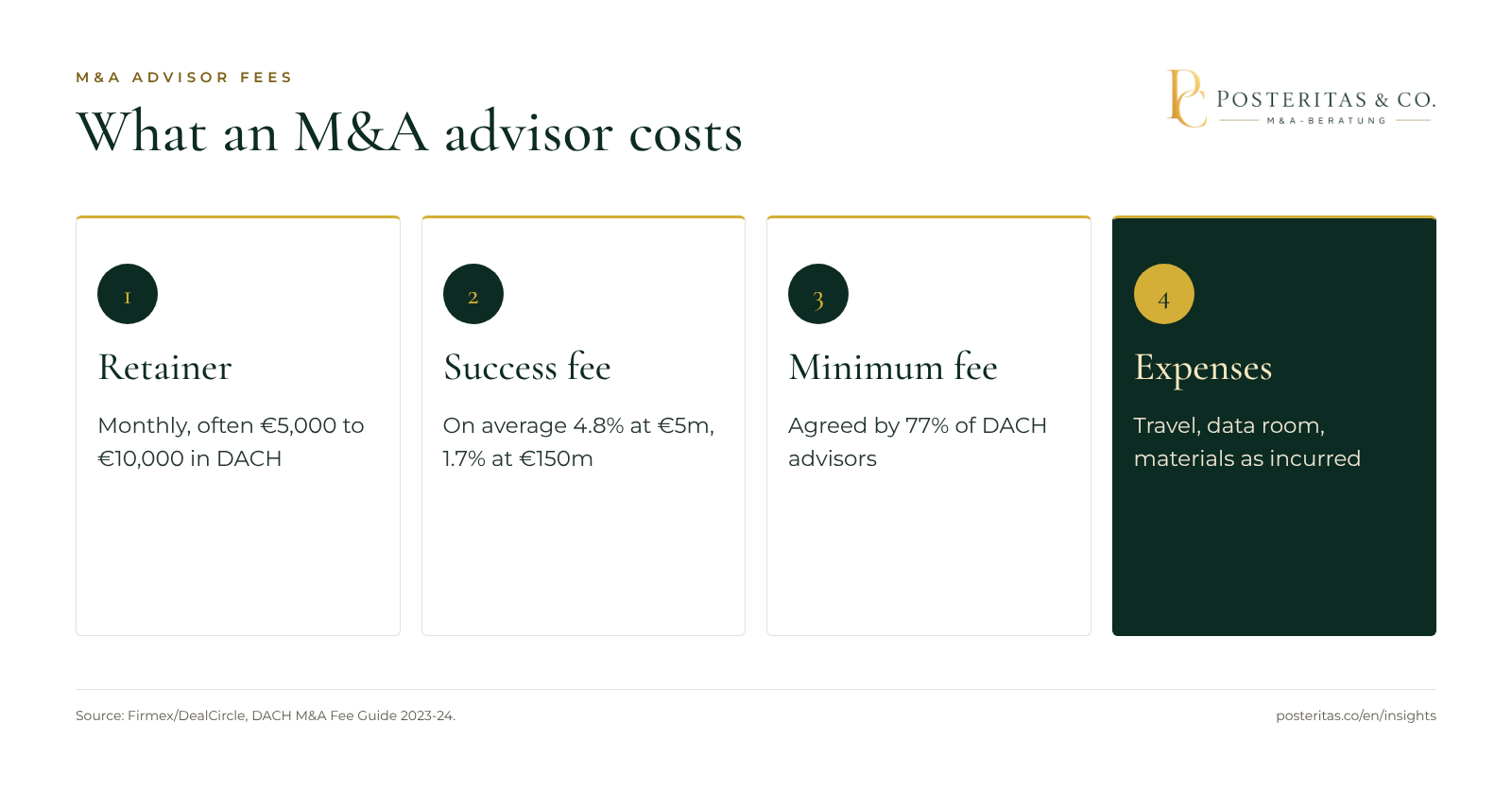
According to Firmex’s DACH M&A Fee Guide 2023-24, a survey of 141 advisors from Germany, Austria and Switzerland, around 89 percent charge a work fee. The most common is a monthly retainer (49 percent), followed by hourly fees (16 percent), one-off flat fees (12 percent) and milestone payments (11 percent). Only 11 percent work purely on a success basis.
| Component | Due | Purpose | Negotiating point |
|---|---|---|---|
| Retainer (monthly or flat) | ongoing or upfront | Covers analysis, documents, approaching buyers | Term, cap, credit against success fee |
| Milestone fee | at defined stages, such as the LOI | Ties payment to progress | Clear definition of milestones |
| Success fee | on completion (closing) | Rewards the closing | Rate, scale, basis of calculation |
| Minimum fee | on completion | Secures the effort where the purchase price is small | Amount relative to the expected price |
| Expenses | as incurred | Travel, data room, materials | Cap, approval above amount X |
What does an M&A advisor cost according to current market data?
The Firmex survey is the main source of reliable market data for the DACH region. According to it, the most common monthly retainer was between €5,000 and €10,000 (46 percent of responses), followed by €11,000 to €15,000 (25 percent). The average success fee fell as transaction size grew, from 4.8 percent at €5 million to 1.7 percent at €150 million.
| Metric (Firmex DACH 2023-24) | Value |
|---|---|
| Advisors charging a work fee | around 89 percent |
| Most common monthly retainer | €5,000 to €10,000 |
| Most common one-off flat fee | €16,000 to €25,000 |
| Average success fee at €5 million | 4.8 percent |
| Average success fee at €150 million | 1.7 percent |
| Advisors with a minimum success fee | 77 percent |
| Advisors with a Lehman scale | 50 percent |
The spread is wide. At a transaction value of €20 million, three fifths of responses were between 2.0 and 4.0 percent. The follow-up 2024-2025 edition reports that average work fees have risen and success fees have fallen significantly, especially for smaller transactions. The figures are a guide, not a price list.
How do the Lehman formula and Double Lehman work?
The Lehman formula is a declining scale: the percentage falls the higher the purchase price. Classically, 5 percent applies to the first million, 4 percent to the second, 3 to the third, 2 to the fourth and 1 percent to every further euro. Under the Double Lehman the rates double to 10, 8, 6, 4 and 2 percent. According to Firmex, 50 percent of DACH advisors use such a scale, 29 percent a fixed rate and 21 percent a progressive scale (accelerator) that rises above a target price.
Hypothetical worked example: A company is sold for €8 million.
| Tranche | Lehman | Double Lehman |
|---|---|---|
| 1st million | €50,000 | €100,000 |
| 2nd million | €40,000 | €80,000 |
| 3rd million | €30,000 | €60,000 |
| 4th million | €20,000 | €40,000 |
| Remaining 4 million | €40,000 | €80,000 |
| Total | €180,000 (2.25 percent) | €360,000 (4.5 percent) |
A fixed rate of 3 percent would give €240,000. The choice of scale therefore changes the fee by six-figure amounts.
How do retainer credits and minimum fees work?
With a credit, the retainer already paid is deducted from the success fee, so you only pay once. In the hypothetical example, you pay €8,000 a month for six months, a total of €48,000. With a credit, €360,000 less €48,000, i.e. €312,000, remains payable at closing; the total cost is €360,000. Without a credit, it rises to €408,000.
According to Firmex DACH 2023-24, just under half of advisors credit the work fee, while around 40 percent insist on both payments. In some cases only a portion is credited, or only from a certain month onwards.
The minimum fee applies if the scale produces too low an amount. At a hypothetical purchase price of €1.5 million, the Double Lehman gives €140,000. If a minimum fee of €150,000 has been agreed, that is what you pay. Check, therefore, up to which purchase price the minimum fee exceeds the scale, and compare this figure with your realistic price expectation from the business valuation.
On what value is the success fee calculated?
The basis of calculation is set out in the engagement letter, and it is often more important than the percentage. The enterprise value is the value of the company before deduction of net financial debt; the equity value is the purchase price for the shares. In the hypothetical example with an enterprise value of €8 million and net financial debt of €1.5 million, the equity value is €6.5 million. On that basis the Double Lehman gives €330,000 instead of €360,000.
| Purchase price component | Question for the contract |
|---|---|
| Enterprise value or equity value | Which value is the fee calculated on? |
| Assumed financial debt | Is it included in the basis of calculation? |
| Earn-out | Is the expected or the actually paid amount used? |
| Vendor loan | Is the fee due at closing or on repayment? |
| Consulting agreements and salaries after the sale | Are they included or excluded? |
For earn-outs and vendor loans, timing is decisive. Agree that the fee on these parts only becomes due when you receive the money. According to Firmex DACH 2024-2025, some advisors accept such deferred payment. You can read more about pricing in our guide to purchase price negotiation.
What additional costs arise in the sale process?
In addition to the M&A advisor, there are costs for other specialists. The purchase agreement is usually negotiated by a lawyer, and a tax advisor reviews the tax structure. When selling shares in a German GmbH, the assignment must be notarised under § 15 (3) GmbHG, which gives rise to notary costs. Depending on the process, a virtual data room and a vendor due diligence are added.
| Cost item | For what | Cost driver |
|---|---|---|
| Lawyer | Purchase agreement, warranties, negotiation | Complexity, hourly rate, duration |
| Tax advisor | Structure, tax burden, financial statements | Restructuring before the sale |
| Notary | Notarisation for GmbH shares | Transaction value |
| Virtual data room | Provision of documents | Duration, data volume, users |
| Vendor due diligence | Advance review by third parties | Scope (financial, tax, legal) |
Good preparation reduces these costs. The due diligence checklist helps you prepare your documents.
How are M&A advisor costs treated for tax purposes?
Under German tax law, fees for the sale are costs of disposal and reduce the taxable capital gain. For the sale of a business or a partnership interest, this is governed by § 16 (2) EStG; for the sale of shares in a corporation held as private assets, by § 17 (2) EStG. Where the partial income method (Teileinkünfteverfahren) applies, costs of disposal are only 60 percent deductible under § 3c (2) EStG. If a holding GmbH sells, the costs reduce the capital gain within the meaning of § 8b (2) of the German Corporation Tax Act (KStG).
This guide does not replace legal or tax advice. Have your specific structure reviewed before signing the contract.
Is an M&A advisor worth it despite the costs?
An M&A advisor is worth it if, through competition between buyers, they achieve a higher price or better terms than you would achieve on your own. A structured process with several interested parties produces comparable offers and negotiating pressure. In addition, the advisor relieves you operationally, so that the business runs smoothly during the sale.
A price premium of just a few percent can already cover the fee. There are also factors that do not show up in the price: warranties, liability caps, payment terms and your role after the sale. How such a process works is described in our guide to the business sale process.
Which clauses in the engagement letter should you review?
Above all, review exclusivity, term, termination and the tail clause. Exclusive mandates are customary but should be limited in time. The tail clause secures the advisor’s fee if the sale takes place after the end of the engagement. In a partial judgment of 23 October 2023 that is not yet final, the Frankfurt am Main Regional Court (LG Frankfurt am Main, 3-02 O 56/22) held a clause with a one-year tail to be valid, even without the advice having caused the sale.
| Clause | What to look out for |
|---|---|
| Exclusivity | Limited duration, clear rules for direct enquiries |
| Term | Fixed term with an option to extend rather than open-ended |
| Termination | Ordinary right of termination, consequences for the retainer |
| Tail clause | Limit the duration, only to buyers approached by the advisor |
| Break fee | Payment on rejection of an offer only under narrow conditions |
| Expenses | Cap and approval requirement |
How can you spot dubious providers?
A warning sign is high upfront fees that are not matched by any concrete service. Reputable advisors describe what they deliver for the retainer: analysis, teaser, buyer list, outreach and process management. Caution is also advisable if an inflated valuation is promised in order to win the mandate, or if references cannot be verified. Further warning signs are open-ended exclusivity and reference to a generic buyer database instead of a reasoned, individual buyer list.
How do you choose the right M&A advisor?
Choose your advisor based on experience with comparable transactions, access to suitable buyers and transparency of fees. Obtain several proposals and compare the total costs for the same hypothetical purchase price. Ask who will actually work on your mandate. An advisor who also handles sales to investors knows financial investors as a buyer group.
How do you take the next step?
First clarify your goals, your timeframe and a realistic price expectation. Then ask two or three advisors for a written proposal with all fee components and calculate it for your expected purchase price. If you would like to assess your situation, Posteritas offers a confidential initial meeting on selling your business.
Sources
- DACH M&A Fee Guide 2023-24, Firmex in Kooperation mit DealCircle, 2024
- M&A Fee Guide 2024-2025, DACH Edition, Firmex, 2025
- § 16 EStG Veräußerung des Betriebs, Bundesministerium der Justiz, gesetze-im-internet.de
- § 17 EStG Veräußerung von Anteilen an Kapitalgesellschaften, Bundesministerium der Justiz, gesetze-im-internet.de
- § 3c EStG Anteilige Abzüge, Bundesministerium der Justiz, gesetze-im-internet.de
- § 8b KStG Beteiligung an anderen Körperschaften und Personenvereinigungen, Bundesministerium der Justiz, gesetze-im-internet.de
- § 15 GmbHG Übertragung von Geschäftsanteilen, Bundesministerium der Justiz, gesetze-im-internet.de
- Unternehmensverkauf: M&A-Beraterin klagte erfolgreich auf Zahlung ihres Beraterhonorars (LG Frankfurt am Main, 3-02 O 56/22), ETL Rechtsanwälte, 2023
Frequently asked questions
What does an M&A advisor cost in a business sale?
The costs usually consist of a monthly retainer and a success fee. According to the Firmex DACH M&A Fee Guide 2023-24, the average success fee was 4.8 percent for a transaction value of €5 million and 1.7 percent for €150 million. The most common monthly retainer was between €5,000 and €10,000.
What is the Lehman formula?
The Lehman formula is a declining scale for the success fee. In its classic form, 5 percent is charged on the first million, 4 percent on the second, 3 percent on the third, 2 percent on the fourth and 1 percent on everything above that. Under the Double Lehman, the rates double to 10 down to 2 percent.
Is the retainer credited against the success fee?
That is a matter for negotiation. According to Firmex DACH 2023-24, just under half of advisors credit the work fee against the success fee, while around 40 percent insist on both. The 2024-2025 DACH edition reports that fewer advisors are agreeing to such a credit.
Is an M&A advisor without an upfront fee more reputable or cheaper?
Not necessarily. A pure success fee lowers your risk, but it can lead the advisor to invest little effort in preparation and approaching buyers. What matters is whether the payments are matched by clearly defined services.
On what value is the success fee calculated?
This is set out in the engagement letter. It is often the enterprise value, that is the value of the company before deduction of net financial debt, or the equity value, that is the purchase price for the shares. Also clarify whether earn-outs, vendor loans and assumed debt are included and when the fee on these becomes due.
Can I deduct M&A advisor costs for tax purposes?
Yes. Under German tax law, advisory fees for the sale count as costs of disposal and reduce the capital gain under § 16 (2) and § 17 (2) EStG. Under the partial income method (Teileinkünfteverfahren), they are only 60 percent deductible under § 3c (2) EStG. You should clarify the specific effect with your tax advisor.
What is a tail clause in an M&A engagement letter?
A tail clause secures the advisor's success fee if the sale is completed within a certain period after the end of the engagement. In a partial judgment that is not yet final, the Frankfurt am Main Regional Court held such a clause with a one-year tail to be valid. Limit the tail in time and to buyers the advisor can demonstrably show it approached.
What costs arise in addition to the M&A advisor?
Typical items are fees for lawyers and tax advisors, notary costs, a virtual data room and, where applicable, a vendor due diligence. For a German GmbH, the assignment of shares must be notarised under § 15 (3) GmbHG. The amount depends heavily on the structure and complexity of the transaction.