
The Netherlands, Belgium and Luxembourg are right on the doorstep. Nevertheless, many owners underestimate how differently the three countries work when it comes to selling or acquiring a company. Formal requirements, investment screening and employee participation follow their own rules. This guide shows what M&A advisory for the Benelux region must deliver and what you should look out for as a seller or buyer.
Why is the Benelux region relevant for mid-sized companies in the German-speaking region?
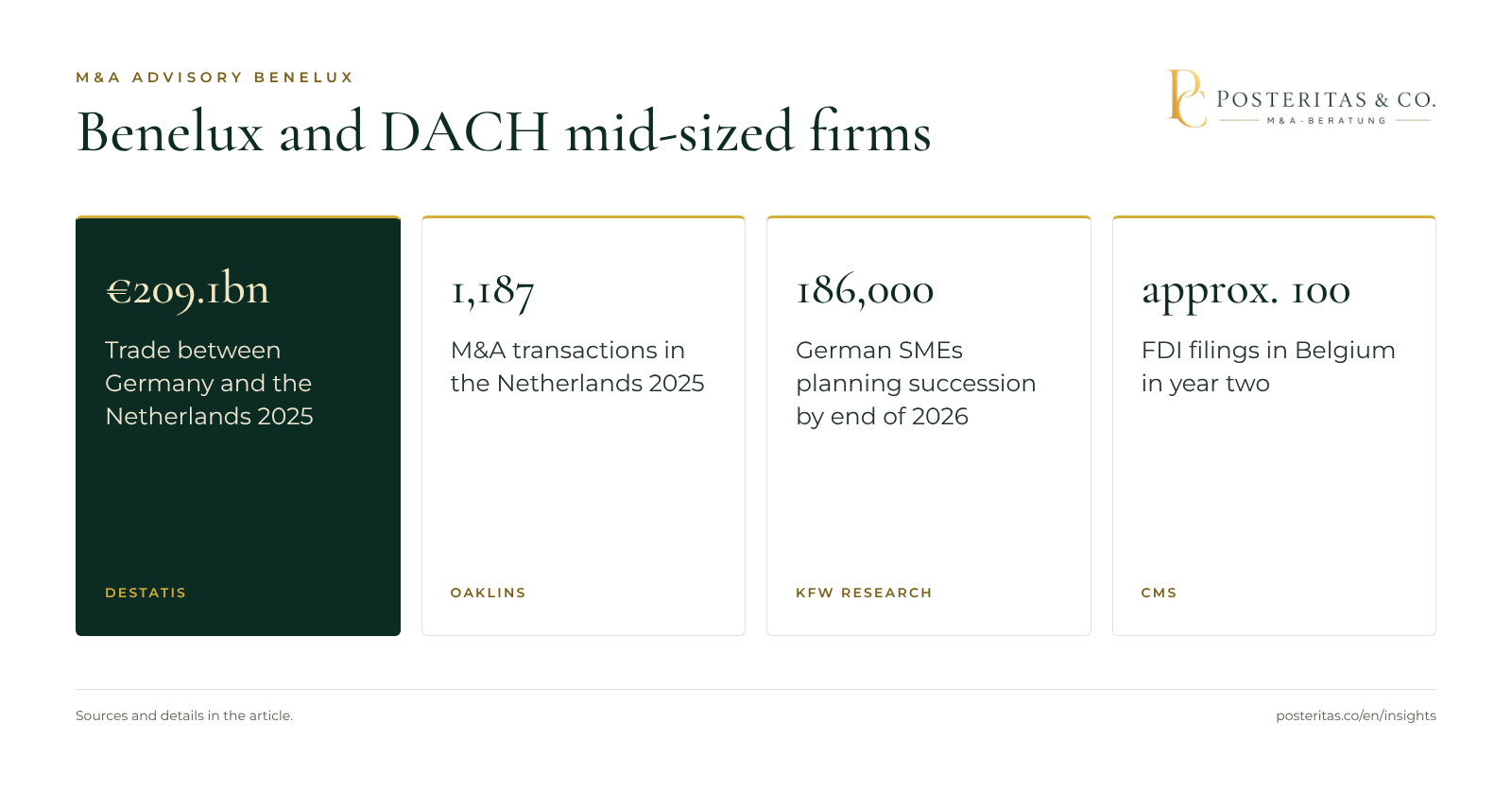
The Benelux region is one of Germany’s closest economic partners and an important source of buyers. According to the Federal Statistical Office (Destatis), the Netherlands was Germany’s third-largest trading partner in 2025, after China and the USA, with foreign trade turnover of €209.1 billion. Germany exported goods worth €112.5 billion there.
These trade relationships give rise to acquisitions. Dutch and Belgian companies buy suppliers, distribution partners and competitors in the German-speaking region. In addition, there are private equity firms and family offices from the region building platforms in Germany, Austria or Switzerland. You can read more about approaching financial investors in the guide on selling to investors.
At the same time, pressure is growing on the German side. According to KfW Research, around 186,000 owners of mid-sized companies (the German “Mittelstand”) plan to step back with a succession arrangement by the end of 2026. 42% of those planning a succession are considering an external handover or a sale to outsiders. Buyers from neighbouring countries are an obvious option.
What is the M&A market situation in the Benelux region in 2025/2026?
The Dutch M&A market grew significantly in 2025. An analysis by Oaklins, reported by Consultancy.eu in February 2026, counts 1,187 transactions. That is almost 14% more than in 2024. In the fourth quarter alone, 319 deals were completed, the most active quarter in three years.
Private equity remained active. According to the same analysis, financial investors were involved in 212 transactions in 2025, after 221 in the previous year. Valuation gaps between buyers and sellers have narrowed but still exist.
For you, this means: buyers are there, but they scrutinise closely. A robust business valuation and clean documentation help determine whether a prospective buyer makes a serious bid.
What legal differences are there between the Netherlands, Belgium and Luxembourg?
The three countries differ above all in the form of share transfer. In the Netherlands, a BV share only passes by notarial deed. In Belgium, the transfer must be entered in the share register. In Luxembourg, for a SARL you need the consent of the other shareholders when shares go to third parties.
| Feature | Netherlands | Belgium | Luxembourg |
|---|---|---|---|
| Typical legal form for mid-sized companies | BV (besloten vennootschap) | BV/SRL (since the 2019 Companies and Associations Code) | SARL (Sàrl) or SA |
| Share transfer | Notarial deed before a Dutch notary | Entry in the company’s share register, so that the transfer is effective vis-à-vis the company and third parties | SARL: consent of shareholders holding 75% of the capital for a transfer to non-shareholders, reducible to 50% by the articles |
| Investment control | Vifo Act since 1 June 2023, for all investors | Interfederal screening since 1 July 2023, for non-EU investors | Law of 14 July 2023, in force since 1 September 2023, for non-EEA investors |
| National merger control | Yes, notification to the ACM | Yes, notification to the Belgian Competition Authority | Currently none |
| Employee participation in a sale | Right of the Ondernemingsraad to be consulted (Art. 25 WOR) | Information and in some cases consultation of the works council | Information of employee representatives |
| Language of negotiation and deeds | English, deeds in Dutch | English, deeds in Dutch, French or German | English, deeds mostly in French or German |
The table does not replace a review of the individual case. Articles of association and shareholder agreements often contain additional pre-emption rights or consent requirements. The guide on selling company shares shows how to clarify such clauses in advance.
Which investment controls apply to Benelux transactions?
All three countries introduced general investment screening in 2023, but the scope differs. The most important difference for German buyers: the Dutch Vifo Act applies regardless of the investor’s origin. In Belgium and Luxembourg, investors from the EU or the EEA respectively are generally not covered.
| Country | Legal basis | Investors covered | Focus |
|---|---|---|---|
| Netherlands | Wet Vifo, in force since 1 June 2023, authority BTI | All investors, including Dutch and German ones | Vital providers, sensitive technologies, business campuses |
| Belgium | Interfederal screening, in force since 1 July 2023 | Investors from outside the EU | From 25% of the voting rights in sensitive sectors, from 10% for targets with annual turnover of at least €100 million in certain sectors such as defence or energy |
| Luxembourg | Law of 14 July 2023, in force since 1 September 2023, Ministry of the Economy | Investors from outside the EEA | Acquisition of control from 25% of the voting rights in critical activities |
Belgium shows how often screening takes place. According to the second annual report, analysed by CMS in 2025, around 100 notifications were received in the second reporting year, about 30% more than in the first year. Around 5% went into an in-depth review. In the Netherlands, according to Stibbe, more than 50 notifications were filed in the first year of the Vifo Act, predominantly from the technology sector.
Merger control applies in addition. In the Netherlands, notification to the ACM is required if all parties together achieve worldwide turnover of at least €150 million and at least two of them each achieve at least €30 million in the Netherlands. A bill introduced in April 2026 is intended to additionally allow the ACM to call in deals below these thresholds. In Belgium, the thresholds are combined domestic turnover of more than €100 million and at least €40 million for at least two of the parties. Luxembourg has no national merger control so far.
What role does the Dutch Ondernemingsraad play?
The Ondernemingsraad, the Dutch works council, has a formal right to be consulted in the event of a change of control. Under Art. 25 WOR, it must be consulted if a decision may lead to a transfer of control over the company or part of it. The consultation must take place early enough for its opinion to still influence the decision.
If the procedure is bypassed, the Ondernemingsraad can challenge the decision in court. For your timetable, this means: in the Netherlands, the signing of the purchase agreement often only follows the works council’s opinion. Many buyers therefore first sign a letter of intent and only afterwards the final agreement.
In Belgium and Luxembourg, there are information and in some cases consultation obligations towards employee representatives. They are less formalised than in the Netherlands, but should also be planned early.
What applies broadly in terms of tax for Benelux transactions?
All three countries have a participation exemption for dividends and capital gains from qualifying shareholdings. However, the minimum shareholding, holding period and exceptions differ.
As a seller from the German-speaking region, your own tax law is what counts first. Whether you sell as an individual or through a holding company has a considerable impact on the net proceeds. Have the structure reviewed by a tax advisor before the first buyer meeting.
How do negotiating style and culture differ?
Dutch negotiating partners are regarded as direct, pragmatic and well prepared. Criticism is voiced openly, and decisions are often made by consensus. In Belgium, regional differences shape the talks. Flanders is Dutch-speaking, Wallonia French-speaking and East Belgium German-speaking. Luxembourg is multilingual and strongly shaped by the financial sector.
English is the usual contract language for cross-border deals. Notarial deeds and register entries, however, follow the respective national language.
How does a cross-border deal with a Benelux connection work?
At its core, the process corresponds to a domestic sale, but it includes additional review and formal steps. The following overview shows the typical phases. The basics are described in the guide on the business sale process.
| Phase | Content | Benelux specifics |
|---|---|---|
| Preparation | Valuation, documents, buyer list | Define target groups in NL, BE and LU, documents in English |
| Outreach | Teaser, non-disclosure agreement | Approach strategic buyers, private equity and family offices separately |
| Offers | Indicative offers, letter of intent | Factor the consultation of the Ondernemingsraad into the timetable |
| Due diligence | Finance, legal, tax, HR | Involve local lawyers for the law governing the target company |
| Approvals | Investment screening, merger control | Vifo review possible even for EU buyers, check thresholds per country |
| Signing and closing | Purchase agreement, completion | NL: notarial deed; BE: entry in the share register; LU: shareholder consents |
The sequence is important. Approvals and employee participation often determine when signing and completion can take place.
What does an M&A advisor do in Benelux transactions?
The M&A advisor manages the entire process and brings together the work of the specialists. The advisor prepares the documents, identifies suitable buyers or target companies and conducts the negotiations, coordinating lawyers, notaries and tax advisors in several countries along the way.
Posteritas & Co. is an M&A boutique active across Europe and supports cross-border transactions. For every mandate, we involve licensed lawyers and tax advisors in the respective country. The guide on M&A advisory in Germany describes how we work in our home market.
Note: This article is not legal or tax advice. The legal situation in the Netherlands, Belgium and Luxembourg changes, and every transaction has its own specifics. For binding advice, you need local lawyers and tax advisors.
What is the next step if you want to approach Benelux buyers or acquire there?
The first step is a sober assessment: where does your company stand, and which buyers or targets realistically come into question? Clarify valuation, structure and time frame before you talk to prospective buyers. The guide on selling a business provides an overview of the entire journey.
If you would like to assess your options in the Benelux region, we offer a confidential initial consultation. In it, we clarify whether and how a cross-border process makes sense for you.
Sources
- China im Jahr 2025 wieder wichtigster Handelspartner Deutschlands, Statistisches Bundesamt (Destatis), 2026-02-20
- Nachfolge-Monitoring Mittelstand 2025: Pläne für Geschäftsaufgaben wachsen erneut, Kaufpreisvorstellungen deutlich gestiegen, KfW Research, 2026-01-09
- Dutch M&A market enters 2026 with renewed momentum, Consultancy.eu (analysis by Oaklins), 2026-02-17
- Global Private M&A Guide: Netherlands, Common deal structures, Baker McKenzie, 2026-01
- Lenders & borrowers beware when Dutch works council advice enters the deal, Loyens & Loeff, 2026-09-29
- Call-in powers for Dutch competition watchdog come yet one step closer after publication of revised bill, Loyens & Loeff, 2026-05-07
- Happy first anniversary! One year of the Vifo Act: an update, Stibbe, 2024-06-04
- Second annual report on Belgian foreign direct investment screening, CMS, 2025-09
Frequently asked questions
Why should I approach buyers from the Benelux region?
In 2025, the Netherlands was Germany's third-largest trading partner. Many Dutch and Belgian companies, private equity firms and family offices know the German-speaking market and use acquisitions to grow there. For sellers, this widens the circle of bidders.
Do I need a notary to buy a Dutch BV?
Yes. The transfer of shares in a BV requires a notarial deed executed before a Dutch notary. The purchase agreement itself can be concluded as a private written contract, but legal title only passes with the deed.
Does a German buyer have to go through investment screening in Belgium or Luxembourg?
As a rule, no. The Belgian and Luxembourg screening regimes cover investors from outside the EU or the EEA respectively. The Netherlands is different: the Vifo Act applies to all investors if the target company falls within a covered sector.
What role does the works council play in the Netherlands?
Under Art. 25 WOR, the Ondernemingsraad has a right to be consulted on decisions that may lead to a change of control. It must be involved early enough for its opinion to still influence the decision. Otherwise, it can challenge the decision in court.
Is there merger control in Luxembourg?
Luxembourg currently has no national merger control with notification thresholds. A draft bill was criticised by the Council of State in 2025 and is to be revised. EU merger control remains unaffected.
In which language are Benelux deals negotiated?
Cross-border transactions are usually conducted in English. Notarial and register documents, however, follow the respective national language: Dutch in the Netherlands, Dutch, French or German in Belgium, and mostly French or German in Luxembourg.
How long does a cross-border sale to the Benelux region take?
As with a domestic sale, plan for several months. Depending on the case, the consultation of the Ondernemingsraad, investment screening and merger control procedures come on top. These steps should be built into the timetable early.
Does an M&A advisor replace local lawyers?
No. The M&A advisor manages the process, buyer outreach and negotiation. For contracts, notary appointments, tax questions and approvals, you need licensed lawyers and tax advisors in the respective country.