
Austria’s mid-sized companies are facing a change of generation. Many owners want to hand over in the coming years, often without a successor in the family. A sale to third parties is therefore becoming more common. This guide explains what M&A advisory in Austria involves, what the market looks like and which legal and tax points you should know. It does not replace legal or tax advice.
What does M&A advisory in Austria involve?
M&A advisory guides you as the seller through the entire process in a structured way, from preparation to closing. The advisor acts as project manager, negotiating partner and interface to the notary, lawyer and tax advisor.
Typical tasks include:
- Analysis of readiness for sale and preparation of the figures
- Assessment of value, see also our guide on business valuation
- Preparation of the teaser and information memorandum
- Identification of suitable buyers and confidential approaches to them
- Management of due diligence, letter of intent and purchase agreement
- Negotiation of price and terms
Our guide to the business sale process describes the steps in detail. The core is simple: an advisor creates competition among buyers and protects your confidentiality.
How are the market and succession developing in Austria in 2025 and 2026?
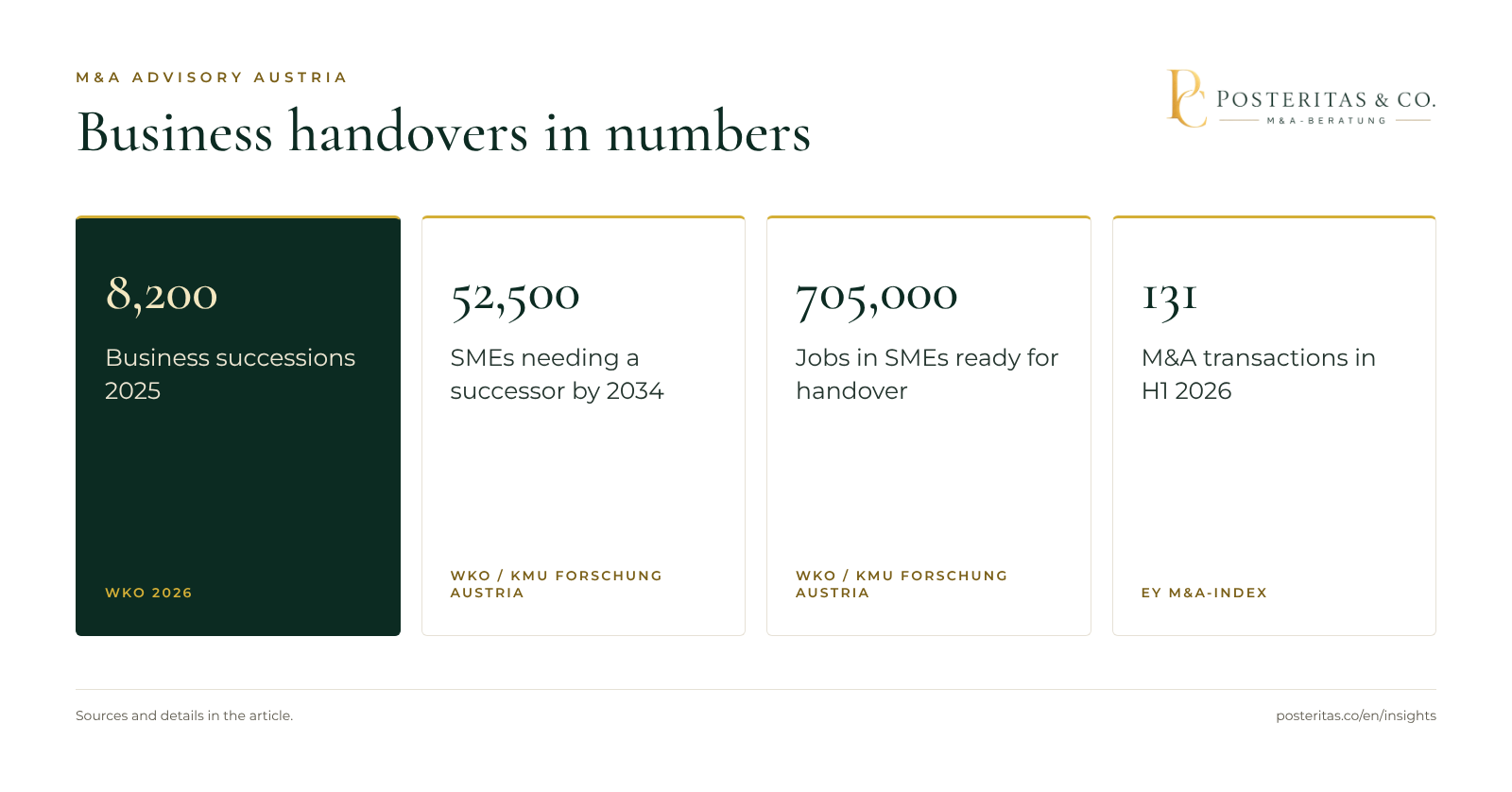
Succession pressure is rising and the M&A market is active. According to the Austrian Economic Chamber (WKO), there were around 8,200 business successions in Austria in 2025. Businesses are taken over by family members, former employees or third parties, usually through a sale.
The outlook is clear. According to the WKO factsheet based on KMU Forschung Austria, 52,500 SMEs (excluding one-person businesses) face the challenge of finding a successor by 2034. Around 705,000 jobs depend on them. About 55% of takeovers take place within the family, with a downward trend. For many owners, a sale to third parties is therefore becoming a realistic option.
The classic M&A market is also picking up. The EY M&A-Index counts 131 transactions with Austrian involvement in the first half of 2026, 11% more than in the same period of the previous year. Volume fell to €5.6 billion because individual large deals had driven the value in 2025. Many smaller handovers are not made public and do not appear in such indices.
| Indicator | Value | Source |
|---|---|---|
| Business successions 2025 | around 8,200 | WKO |
| SMEs needing a successor by 2034 | 52,500 | WKO, KMU Forschung Austria |
| Jobs affected | around 705,000 | WKO, KMU Forschung Austria |
| Share of takeovers within the family | approx. 55% | WKO, KMU Forschung Austria |
| M&A transactions H1 2026 | 131 | EY |
Which buyer groups come into question for Austrian companies?
Strategic buyers are currently the most important group. According to EY, strategic investors accounted for 124 of 131 transactions in the first half of 2026, and only 7 for private equity or venture capital. Of the 55 inbound deals, 21 buyers came from Germany.
| Buyer group | Typical motive | What you should bear in mind |
|---|---|---|
| Strategic buyers from Austria | Market share, customers, locations | High synergies, but competitors see sensitive data |
| Strategic buyers from Germany and the EU | Access to the Austrian and CEE markets | No InvKG procedure, close in language and law |
| Buyers from third countries | Technology, access to the EU market | Possible approval under the InvKG |
| Private equity and family offices | Platform or add-on acquisition | Often rollover equity and earn-out |
| Management (MBO) or employees | Continuity | Financing is often the bottleneck |
| Family | Preserving a life’s work | Tax and inheritance planning required |
Which group fits depends on your goals. You can read more in our guide on selling to investors. For financing, the aws guarantee can help; according to aws (Austria Wirtschaftsservice), it is also aimed at company buyers.
Which legal rules apply when selling a company in Austria?
The most important formal requirement concerns the GmbH (limited liability company). Under § 76(2) of the Austrian GmbHG, the transfer of shares between living persons requires a notarial deed (Notariatsakt). This also applies to preliminary agreements that create an obligation to assign shares in the future. An informal preliminary agreement can therefore be invalid. The change of shareholder is then entered in the commercial register (Firmenbuch).
Further points at a glance:
| Topic | Rule | Practical consequence |
|---|---|---|
| Form in a share deal | Notarial deed under § 76(2) GmbHG | Plan for the notary early, including for options |
| Investment control | InvKG: approval required for acquisitions by third-country nationals from 10%, 25% or 50% of the voting rights, depending on the sector | Review by the Ministry of Economic Affairs, phase 1 one month, phase 2 two further months |
| Merger control | Notification to the BWB (Federal Competition Authority), among other cases from €300 million worldwide turnover and €30 million domestic turnover, plus a transaction value above €200 million | Not relevant for most mid-market deals, but check |
| Transfer of undertaking | § 3 AVRAG: in an asset deal, employment relationships transfer to the acquirer | The workforce is part of the transaction |
| Liability on acquisition | § 38 UGB: the acquirer generally takes over legal relationships and is liable for business-related liabilities | Agree deviations contractually and publish them properly |
Under the Investment Control Act, micro-enterprises with fewer than 10 employees and less than €2 million in turnover or total assets are exempt. Buyers from the EU, EEA and Switzerland are not covered. A reform of the InvKG is under discussion. Check the current position before signing.
How is a business sale taxed in Austria?
Taxation depends on whether you sell shares or a business. When individuals sell GmbH shares held as private assets, the special tax rate of 27.5% under § 27a EStG generally applies. It applies regardless of holding period and size of the shareholding.
When selling a sole proprietorship or a partnership interest, § 24 EStG applies. It provides for an allowance of €7,300. The allowance is lost if you use the relief under § 37. On application, the half-rate under § 37(5) EStG halves the average tax rate. The prerequisite is death, incapacity for work or reaching the age of 60 combined with ceasing gainful activity. In addition, seven years must have passed since the business was opened or last acquired for consideration.
| Constellation | Basic tax rule | Note |
|---|---|---|
| Sale of GmbH shares (private assets) | 27.5% special tax rate | Option for standard taxation possible |
| Sale of a business | Standard rate, allowance of €7,300 | Allowance lost if § 37 relief is used |
| Sale of a business from age 60 with cessation of activity | Half-rate under § 37(5) | Seven years since opening or acquisition |
| Share deal involving real estate | Real estate transfer tax from 75% share consolidation | Since 1 July 2025, 0.5% of the property value, 3.5% for real estate companies |
Real estate transfer tax (Grunderwerbsteuer) was tightened by the 2025 Budget Accompanying Act (Budgetbegleitgesetz 2025). The threshold for share consolidation fell from 95% to 75%. For corporations, a change of 75% of the shareholders within seven years also counts. Indirect acquisitions are covered as well. If your GmbH owns real estate, you should review the structure with your tax advisor early.
What does M&A advisory cost in Austria?
The costs usually consist of a fixed component and a success fee. A retainer covers the preparation and the ongoing process. The success fee is only payable on completion and is based on the purchase price.
Pay attention to these points:
- Is the retainer credited against the success fee?
- How is the fee basis defined, for example for earn-outs or assumed debt?
- How long does exclusivity run, and what applies afterwards?
- Which costs for the notary, lawyer and tax advisor come on top?
A good advisor pays for themselves through the price achieved and the terms secured. You will find more on pricing in the guide on purchase price negotiation.
How do you choose the right M&A advisor in Austria?
Choose an advisor who knows your sector, your size class and the relevant buyer groups. For Austrian companies, buyers from Germany and the EU are particularly common. A cross-border network is therefore an advantage.
Check in the conversation:
- References you can verify yourself
- Who will actually handle your mandate?
- How is confidentiality ensured?
- What does the buyer list look like, nationally and internationally?
- Does the advisor work with notaries and tax advisors in Austria?
Be sceptical of value promises without analysis. Reputable advisors give ranges and explain them.
How does M&A advisory in Austria differ from Germany?
The basic logic is the same, the details differ. Form, register, taxes and liability rules follow their own law.
| Topic | Austria | Germany |
|---|---|---|
| Form of GmbH share transfer | Notarial deed, § 76(2) GmbHG | Notarial recording, § 15 GmbHG |
| Register | Firmenbuch | Handelsregister |
| Share sale by an individual | 27.5% special tax rate | Partial income method |
| Sale of a business in later life | Half-rate from 60, § 37(5) EStG | Allowance and reduced rate from 55, §§ 16, 34 EStG |
| Liability on acquisition | § 38 UGB | § 25 HGB where the trade name is continued |
| Transfer of undertaking | § 3 AVRAG | § 613a BGB |
| Investment screening | Investment Control Act | Foreign Trade and Payments Act and Ordinance |
If you own companies in several countries, it is worth reading our guides on M&A advisory in Germany and M&A advisory in Switzerland.
How do you take the next step?
Start early, ideally several years before the planned handover. That leaves time to prepare the figures, reduce dependencies and clarify the tax structure. Review your options between family, management and an external sale. Our guide on business succession helps you put this into context.
Posteritas & Co. supports owners across Europe with sales and succession. If you would like to put your situation into perspective, we offer a confidential initial consultation. This article is for general information only and does not replace legal or tax advice in individual cases.
Sources
- Unternehmensübernahmen 2010 bis 2025, Wirtschaftskammer Österreich, 2026-08
- Factsheet Betriebsnachfolge, Wirtschaftskammer Österreich, 2026-07
- EY M&A-Index Österreich H1 2026, EY Österreich, 2026-08
- § 76 GmbHG, Rechtsinformationssystem des Bundes (RIS)
- Zusammenschlüsse, Unternehmensserviceportal (USP)
- Investitionskontrollgesetz, Wirtschaftskammer Österreich, 2025-04
- § 37 EStG 1988, Rechtsinformationssystem des Bundes (RIS)
- Grunderwerbsteuer, Wirtschaftskammer Österreich, 2026-02
Frequently asked questions
What does an M&A advisor do in Austria?
The advisor prepares the sale, produces the documents, approaches suitable buyers confidentially, coordinates due diligence and negotiates through to signing and closing. Lawyers, the notary and tax advisors are brought in along the way.
Do I need a notary to sell GmbH shares in Austria?
Yes. Under § 76(2) of the Austrian GmbHG, the transfer of shares between living persons requires a notarial deed (Notariatsakt). This also applies to agreements creating an obligation to assign shares in the future.
How is the sale of GmbH shares taxed in Austria?
For individuals holding the shares as private assets, the special tax rate of 27.5% for income from capital assets (§ 27a EStG) generally applies. An option for standard taxation is possible. Clarify the specific solution with your tax advisor.
When does the half-rate apply to the sale of a business?
Under § 37(5) of the Austrian EStG, on application in the event of death, incapacity for work or if you have reached the age of 60 and cease your gainful activity. In addition, seven years must have passed since the business was opened or last acquired for consideration.
Does a sale to a foreign buyer require approval?
For buyers from countries outside the EU, EEA and Switzerland, the Investment Control Act (InvKG) may require approval. The thresholds are 10%, 25% and 50% of the voting rights, depending on the sector. Micro-enterprises are exempt.
When must a company acquisition be notified to the competition authority?
Concentrations must be notified, among other cases, when the parties achieve worldwide turnover of more than €300 million and domestic turnover of more than €30 million. Further conditions and a transaction value threshold also apply.
What does M&A advisory cost in Austria?
The usual arrangement combines a fixed monthly fee with a success fee on completion. The amount depends on size, complexity and scope of services. Ask for the fee structure in writing in advance.
How does selling a company in Austria differ from Germany?
There are differences in form (notarial deed instead of notarial recording), the register (Firmenbuch instead of Handelsregister), taxes on share sales and the rules on real estate transfer tax. Liability when acquiring a business also follows its own provisions.