
An M&A advisor supports owners when they sell a company and buyers when they acquire one. For most owners of mid-sized companies, selling is a once-in-a-lifetime decision, and mistakes in choosing a buyer or drafting the contract can hardly be corrected afterwards. According to the KfW SME Succession Monitor 2025, around 545,000 owners in Germany want to hand over their business by the end of 2029, and 42 percent of them are considering outside successors. This guide explains what M&A advisory involves, how it differs from brokers, business marketplaces, lawyers and tax advisors, how to find the right advisor and what to look for in the engagement letter. It focuses on companies in Germany, so German legal terms apply where relevant; the same questions arise for international and cross-border buyers. Fees are covered separately in our article on M&A advisor fees.
What does an M&A advisor do?
An M&A advisor is the project lead of a transaction. The advisor prepares the company, finds the right counterparty, organises competition and leads the negotiation up to signing. Depending on the mandate, the advisor works for the seller (sell side), for the buyer (buy side) or supports a succession within the family or management.
| Mandate type | Client | Core tasks |
|---|---|---|
| Sell side (“sell my company”) | Owners, shareholders, heirs | Indication of value, teaser, information memorandum, buyer list, approach, comparison of offers, negotiation |
| Buy side | Entrepreneurs, successors, family offices, investors | Search profile, target search, first approach to owners, valuation, managing due diligence, negotiation |
| Succession advisory | Owner family | Comparing options (family, management, sale), roadmap, structuring a handover to employees or children |
| Valuation and exit preparation | Owners before a sale | Adjusted figures, indication of value, fixing weaknesses, equity story |
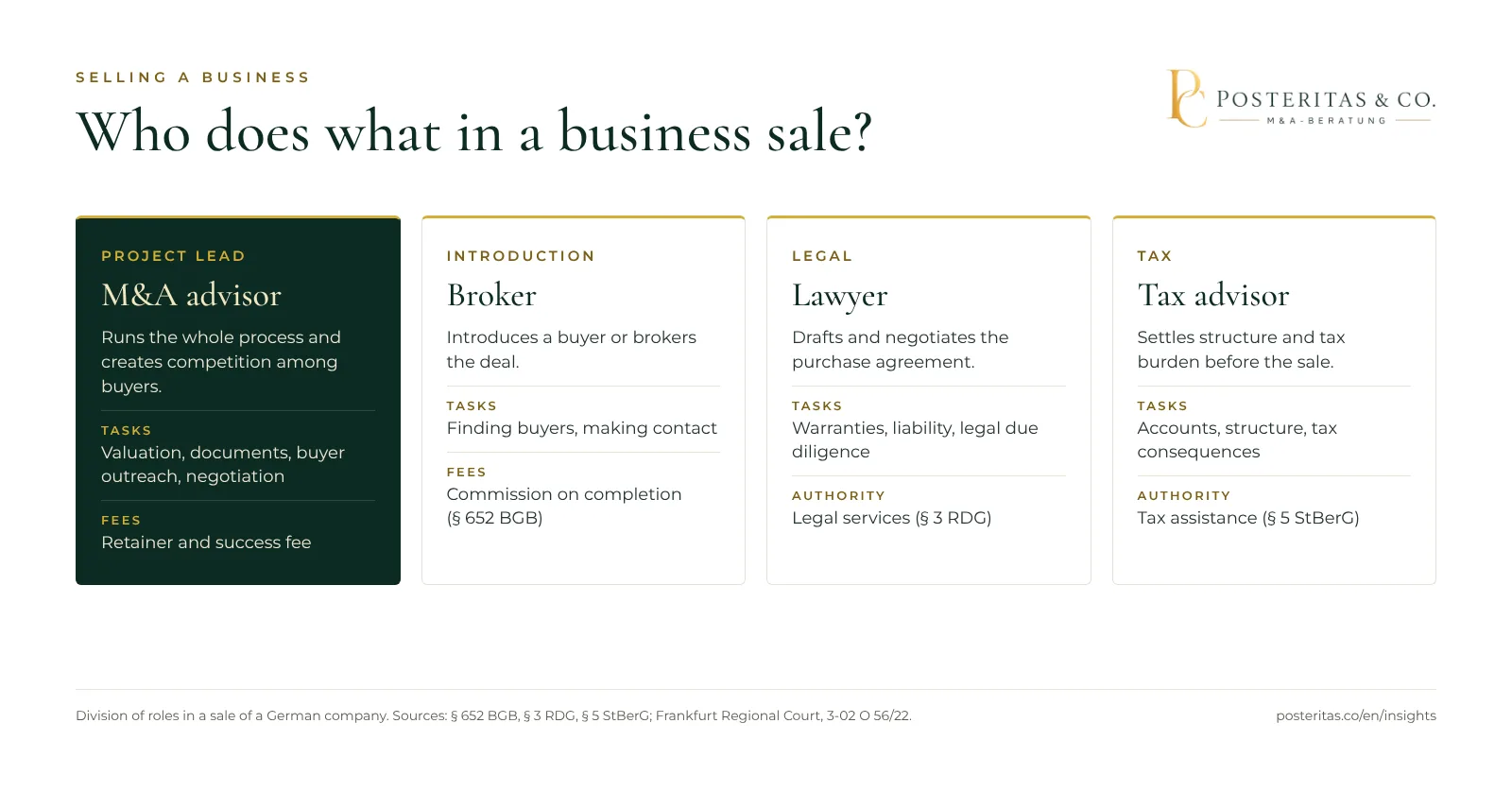
The core of the work is competition. If you run several qualified bidders in parallel, you negotiate from a stronger position. According to the German business magazine Unternehmeredition, a structured bidding process can improve price, warranties and payment terms, but it takes more effort and requires enough serious bidders. How such a process works is described in our guide to the business sale process.
How does an M&A advisor differ from a broker, a marketplace, a lawyer and a tax advisor?
Several specialists work together in a business sale. It is important that everyone knows their role and that nobody takes on tasks they are not authorised to perform.
| Party | Role | Legal framework in Germany | Typical remuneration |
|---|---|---|---|
| M&A advisor | Project lead, buyer access, negotiation | Freely drafted contract, classified by the Frankfurt Regional Court in the case decided as a service agreement for the management of affairs (Geschäftsbesorgungsdienstvertrag) | Retainer and success fee |
| Business broker | Introducing or mediating a buyer | Brokerage contract, § 652 BGB | Commission on completion |
| Business marketplace | Listing, reach | Platform terms | Low or free |
| Investment bank | Large transactions, often close to capital markets | Advisory contract | Retainer and success fee, geared to large volumes |
| Lawyer | Purchase agreement, warranties, liability | Legal services, § 3 RDG | Hourly or fixed fee |
| Tax advisor | Structure, tax burden, accounts | Assistance in tax matters, § 5 StBerG | Fee regulation or agreement |
| Notary | Notarisation, for example of GmbH shares | Notarisation law | Statutory fees |
The difference from a broker is visible in the German Civil Code. Under § 652 BGB, a broker’s commission only arises if the contract comes about as a result of the broker’s introduction or mediation. An M&A mandate, by contrast, usually covers the whole process. The Frankfurt am Main Regional Court (partial judgment of 23 October 2023, 3-02 O 56/22) classified such an advisory agreement as a service agreement for the management of affairs, not as a brokerage contract. In practice the lines blur: what counts is the scope of services written into the contract.
Legal and tax advice are clearly separated. Under § 3 of the Legal Services Act (RDG), legal services, meaning activities that require a legal examination of the individual case, are only permitted where a statute allows them. Under § 5 of the Tax Advisory Act (StBerG), professional assistance in tax matters is reserved for the persons authorised there. A reputable M&A advisor therefore does not draft the purchase agreement or prescribe the tax structure, but brings in a lawyer and a tax advisor early. For an overview of the ways to sell, see our guide to selling a business.
Is M&A advisor a protected profession in Germany?
No. Unlike lawyers or tax advisors, M&A advisors in Germany have no professional statute, no chamber and no mandatory examination. Anyone may use the title. The licensing requirement under § 34c of the Trade Regulation Act (GewO) covers, among other things, brokering real estate, commercial premises and loans; companies or company shares are not mentioned there. If business premises are brokered along with the company, the licensing question should be checked in the individual case.
For you as a client, this means that a title, a certificate or an association membership does not replace your own due diligence on the advisor. What counts are verifiable transactions, references and the people who will actually work on your mandate.
When is an M&A advisor worthwhile?
An advisor is worthwhile when competition, confidentiality and negotiation achieve more than the advisor costs. That is not always the case. The following overview helps you assess your situation.
| Factor | Points towards an M&A advisor | Points rather against |
|---|---|---|
| Buyers | Several conceivable buyer groups, including international or cross-border buyers | Buyer already known (family, employees, neighbouring business) |
| Confidentiality | Competitors as potential buyers, sensitive key customers | Sale is already public knowledge |
| Complexity | Holding company, real estate, several shareholders, earn-out | Simple asset deal without special issues |
| Owner’s time | Day-to-day business leaves little room | Owner has time and negotiating experience |
| Price expectation | Uncertain or disputed | Settled by an independent valuation |
The DIHK Succession Report 2025 shows why a realistic assessment matters: 36 percent of retiring owners have inflated price expectations, and 38 percent prepare the handover too late. A good advisor names both openly, even when that is uncomfortable. How business value is established is explained in our guide to business valuation.
How do you find the right M&A advisory firm?
Talk to two or three firms and ask them all the same questions. That makes the answers comparable.
- References: Which comparable transactions have you completed in recent years? May I speak to two former clients?
- Sector experience: Do you know the value drivers in my sector, such as order backlog, regulatory qualifications or customer concentration?
- Buyer network: Which buyer groups do you see for my company, including foreign buyers, and how do you reach them? A reasoned long list is worth more than a reference to a database.
- Team: Who handles the mandate day to day, and who sits at the negotiating table? How many mandates does that person run in parallel?
- Exclusivity: How long should it last, and what happens to parties who contact me directly?
- Conflicts of interest: Do you accept commissions from buyers? Do you advise investors who could be buyers?
- Fees: What will the mandate cost in total at my expected purchase price? Models and market data are explained in our article on M&A advisor fees.
On conflicts of interest, German brokerage law points in a clear direction: under § 654 BGB, the right to commission is lost if the broker has also acted for the other side in breach of contract. Regardless of how the contract is classified, record in writing that your advisor represents only your interests.
What should you look for in the engagement letter?
The engagement letter (Mandatsvertrag) sets out services, term, exclusivity, fees and how the relationship ends. There is no statutory fee schedule or model contract; everything is negotiable.
- Scope of services: Describe specifically what the advisor delivers (documents, buyer list, process management) and what not (legal and tax advice).
- Term and termination: A fixed term with an option to extend is more transparent than an open-ended mandate. Agree how both sides can terminate and what happens to amounts already paid.
- Exclusivity: Customary, but it should be time-limited. Clarify how direct enquiries and parties already known to you are treated.
- Tail clause: It secures the advisor’s fee if the sale happens after the contract ends. In the partial judgment mentioned above, which is not yet final, the Frankfurt Regional Court upheld a one-year tail even though it did not require the advice to have caused the sale. Absent a specific rule, the court also counted an earn-out towards the fee basis. Limit the tail in time and, where possible, to buyers the advisor can show it approached.
- Confidentiality: Agree which information goes to whom and when, and that every interested party signs a non-disclosure agreement in advance.
This section is not legal advice. Have the engagement letter reviewed by your lawyer before you sign.
How does working with an M&A advisor run in practice?
A sale process is teamwork. The advisor can only work as well as you supply figures, time and decisions. The overview shows what happens on both sides in each phase.
| Phase | What the advisor does | What you as owner do |
|---|---|---|
| Initial meeting and analysis | Assess goals, options and saleability | Name goals, timeframe and red lines openly |
| Preparation | Adjust figures, indication of value, prepare documents | Supply annual accounts, contracts and customer data, involve your tax advisor |
| Approach | Agree buyer list, anonymous teaser, non-disclosure agreements | Approve buyer list, define an exclusion list for competitors |
| Offers | Compare indicative offers, prepare management meetings | Take part in meetings, choose favourites |
| Due diligence | Manage data room and questions | Answer questions on time, keep the business stable |
| Contract and completion | Coordinate negotiation with the lawyer | Decide on the contract with your lawyer and tax advisor |
Allow enough lead time. According to KfW, the German Chambers of Commerce (DIHK) recommend at least three years of preparation for a succession. If you speak to an advisor early, weaknesses such as high owner dependence can still be fixed before the sale. Our article on M&A advisory in Germany covers the market, legal and tax framework in more detail.
How does an M&A advisor work on the buy side?
On the buy side the role is reversed. The advisor develops a search profile with you, identifies target companies and approaches owners discreetly, often before they have even thought about selling. The advisor then supports valuation, financing structure, due diligence and negotiation. For successors, international investors and companies with an acquisition strategy, this is often the route to businesses that are never offered publicly. The KfW figures show the potential: alongside 545,000 planned handovers, 569,000 owners in Germany plan to close their business by the end of 2029, often for lack of a successor.
How do you recognise dubious offers?
The main red flags are:
- A conspicuously high value promised in the first meeting, before the advisor has seen your figures.
- High upfront payments without a specifically described service in return.
- Open-ended exclusivity or a tail not limited to buyers actually approached.
- No references you may contact yourself.
- A reference to a supposedly huge buyer database instead of a reasoned buyer list.
- Commissions from both sides or unclear links to buyers.
- The provider wants to draft the purchase agreement or tax structure without a lawyer and tax advisor.
What is your next step?
First clarify your goals: price, continuity, employees, your role after the sale and your timeframe. Then talk to two or three M&A advisors, ask them all the same questions and get the scope of services and total costs in writing. Posteritas & Co. supports owners on the sell side and buyers on the buy side, confidentially and for one side only.
Note: This article is for general information and does not constitute legal or tax advice. For your specific situation, please consult a lawyer and a tax advisor.
Sources
- Nachfolge-Monitoring Mittelstand 2025 (Fokus Volkswirtschaft Nr. 526), KfW Research, 2026-01
- Unternehmensnachfolge-Report 2025, Deutsche Industrie- und Handelskammer (DIHK), 2025
- Der Vergütungsanspruch der geschassten M&A-Beraterin (LG Frankfurt am Main, 3-02 O 56/22), Rechtslupe, 2023
- § 652 BGB Entstehung des Lohnanspruchs, Bundesministerium der Justiz, gesetze-im-internet.de
- § 654 BGB Verwirkung des Lohnanspruchs, Bundesministerium der Justiz, gesetze-im-internet.de
- § 3 RDG Befugnis zur Erbringung außergerichtlicher Rechtsdienstleistungen, Bundesministerium der Justiz, gesetze-im-internet.de
- § 5 StBerG Verbot der unbefugten Hilfeleistung in Steuersachen, Bundesministerium der Justiz, gesetze-im-internet.de
- § 34c GewO Immobilienmakler, Darlehensvermittler, Bauträger, Baubetreuer, Bundesministerium der Justiz, gesetze-im-internet.de
- Strukturierter Bieterprozess versus bilaterale Verhandlung, Unternehmeredition
Frequently asked questions
What does an M&A advisor do when I sell my business?
The advisor runs the entire sale process: indication of value, preparation of figures and documents, teaser and information memorandum, buyer list, confidential approach, comparison of offers, negotiation and support through to completion. The advisor coordinates the lawyer, tax advisor and notary but does not replace them.
What is the difference between an M&A advisor and a business broker?
Under German law (§ 652 BGB), a broker earns a commission if a contract comes about as a result of the broker's introduction or mediation. An M&A advisor is usually engaged for the whole process and paid through a retainer and a success fee. In practice the lines blur; what counts is the scope of services in the contract.
Does an M&A advisor need a licence in Germany?
There is no professional statute or chamber for M&A advisory in Germany, and the title is not protected. Licensing requirements such as § 34c of the Trade Regulation Act (GewO) cover, for example, real estate and loans. Legal and tax advice remain reserved for lawyers and tax advisors. If business premises are brokered along with the company, the licensing question should be checked.
From what company size is an M&A advisor worthwhile?
There is no fixed threshold. An advisor is worthwhile when several buyer groups come into question, confidentiality is important or the structure is complex. If the buyer is already known, a lawyer, a tax advisor and an independent valuation are often sufficient.
How do I find a good M&A advisory firm?
Talk to two or three firms. Ask about comparable transactions in your sector and size class, references you may call, the team that will handle your mandate and a reasoned buyer list. Have the total costs for your expected purchase price set out in writing.
How long does an engagement letter bind me?
That depends on the contract. Look for a fixed term, a right of termination and a time-limited tail clause. In a partial judgment that is not yet final, the Frankfurt Regional Court upheld a clause under which the fee was also due if a sale took place within one year of the end of the mandate.
May an M&A advisor act for both buyer and seller?
For brokers, § 654 BGB provides that the right to commission is lost if the broker has also acted for the other side in breach of contract. Regardless of the legal classification, you should record in writing that your advisor represents only your side and accepts no commission from the buyer.
Does an M&A advisor also help when buying a company?
Yes. On the buy side, the advisor finds suitable targets, approaches owners discreetly, values the business, manages due diligence and supports financing and negotiation. For successors and companies with an acquisition strategy, this is often the fastest route to businesses that are never offered publicly.