
“How much could I sell my business for?” is the first question almost every owner asks, and the honest answer is a range, not a number. This guide shows how UK buyers arrive at a price, which figures move it, and what you keep after debt, deal structure and tax. For a first range in two minutes, use our business valuation calculator UK.
How do buyers value a UK business?
For profitable small and mid-sized businesses, buyers start with a simple formula:
Adjusted EBITDA × multiple = enterprise value Enterprise value − net debt = price for your shares (equity value)
EBITDA is operating profit before interest, tax, depreciation and amortisation. The multiple reflects risk and growth: the more certain the future earnings, the more a buyer pays per pound of profit. Other methods, such as discounted cash flow or asset value, are used as a cross-check or where earnings are low or volatile. Our guide to calculating business value covers these methods.
Which EBITDA multiple applies to my business?
Two factors explain most of the difference: size and sector.
Size. Dealsuite surveys M&A advisers in the UK and Ireland twice a year about deals with £1m to £200m revenue. For H2-2025 it reports:
| Normalised EBITDA | Typical EV/EBITDA multiple |
|---|---|
| £200,000 | 3.3x |
| Average across all deals | 5.4x |
| £10,000,000 | 8.4x |
Below £200,000 of EBITDA, Dealsuite does not determine a multiple. Very small owner-run businesses are often priced on owner earnings, assets or turnover instead.
Sector. Dealsuite’s H1-2025 sector medians, as published by CLFI, show how much sector matters:
| Sector | Median EV/EBITDA, UK&I, H1-2025 |
|---|---|
| Software development | 8.2x |
| Healthcare and pharmaceuticals | 7.6x |
| IT services | 7.6x |
| E-commerce and webshops | 6.4x |
| Business services | 5.9x |
| Industrial and manufacturing | 5.3x |
| Agri and food | 5.3x |
| Media and communication | 4.1x |
| Hospitality and tourism | 4.1x |
| Automotive, transport and logistics | 4.0x |
| Construction and engineering | 3.8x |
| Wholesale trade | 3.5x |
| Retail trade | 3.4x |
Data sets differ. BDO’s Private Company Price Index, which tracks reported UK private company deals, put trade buyers at 9.4x and private equity buyers at 11.5x EBITDA in Q1 2024. The two data sets cover different deals, so always compare a business with deals of a similar size and sector.
What moves my multiple up or down?
Within the range for your size and sector, buyers adjust for risk. These are the factors we see questioned in almost every deal:
| Factor | Pushes the multiple up | Pushes the multiple down |
|---|---|---|
| Owner dependence | Management team runs daily business | Customers and know-how sit with the owner |
| Customer concentration | No customer above 10% of sales | One customer above 25% |
| Recurring revenue | Contracts, maintenance, subscriptions | Mostly one-off projects |
| Trend | Growth with a credible plan | Declining results |
| Records | Monthly management accounts, clean contracts | Late accounts, verbal agreements |
| Investment | Equipment and systems up to date | Backlog the buyer must fund |
Owner dependence is the most common discount in smaller deals. If you are still the main salesperson, the key engineer and the only contact for your largest customers, start delegating well before a sale.
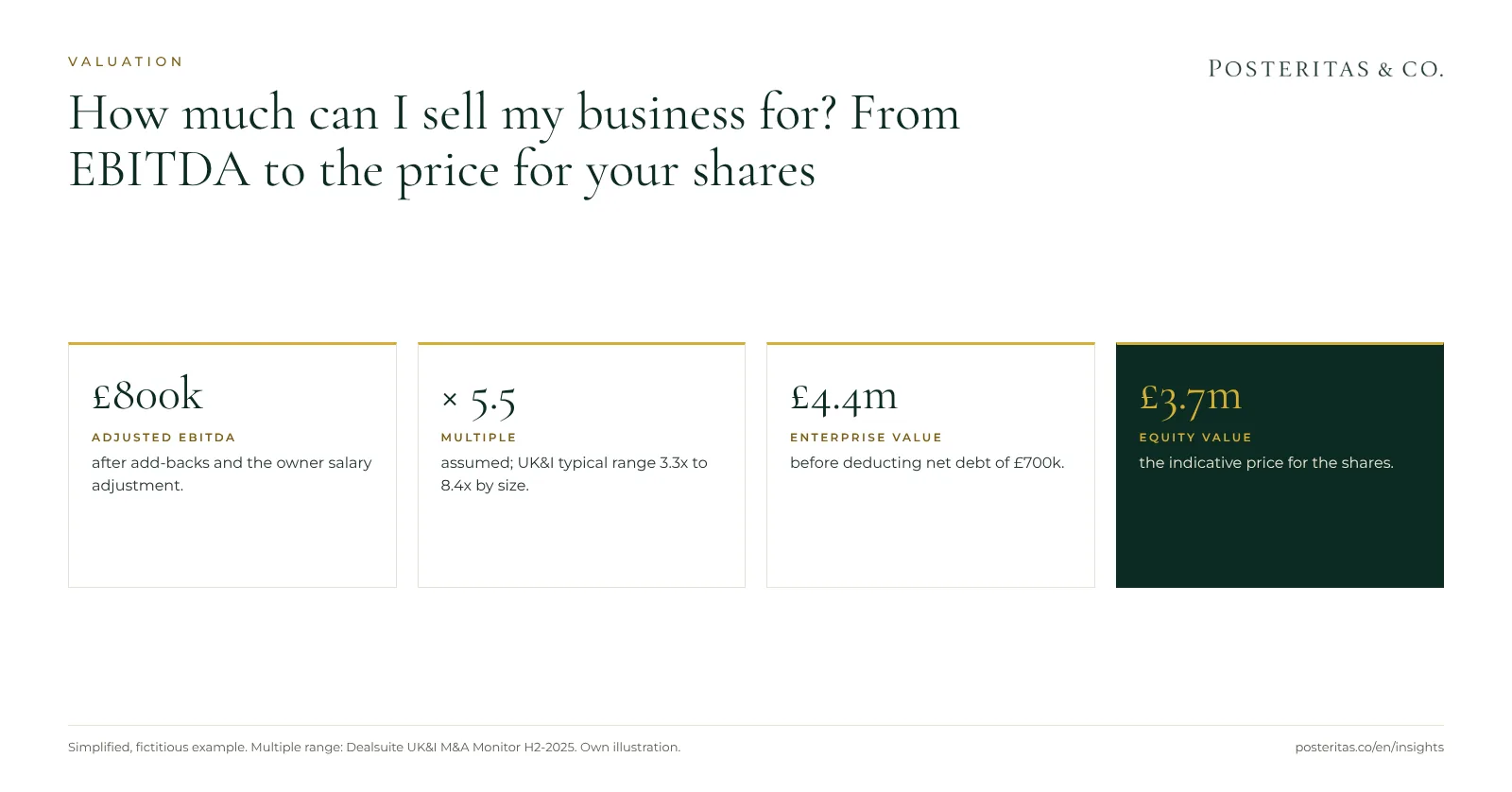
Worked example: from EBITDA to the price for your shares
A simplified and fictitious example. A business services company reports EBITDA of £850,000.
| Step | Amount |
|---|---|
| EBITDA in the accounts | £850,000 |
| Plus one-off legal costs | + £40,000 |
| Plus personal costs paid by the business | + £25,000 |
| Minus salary adjustment (owner paid £15,000, market salary £130,000) | − £115,000 |
| Adjusted EBITDA | £800,000 |
| Multiple assumed for size, sector and quality | 5.5x |
| Enterprise value | £4,400,000 |
| Minus bank loan | − £900,000 |
| Minus overdue corporation tax | − £150,000 |
| Plus surplus cash | + £350,000 |
| Equity value (price for the shares) | £3,700,000 |
Two lessons stand out. The salary adjustment cuts £115,000 of EBITDA and so, at 5.5x, more than £600,000 of value: an owner who pays himself little looks more profitable on paper than the business really is. And every pound of debt reduces the price for the shares by a pound.
Which other valuation methods do buyers use?
The EBITDA multiple is the common language of UK deals, but it is not the only method. Buyers and advisers use others as a cross-check or where the multiple does not fit.
| Method | How it works | When it is used |
|---|---|---|
| Discounted cash flow (DCF) | Future free cash flows discounted at a rate that reflects risk | Larger businesses with reliable forecasts, growth cases |
| Asset-based value | Net assets at market value | Property-rich or loss-making businesses, liquidation scenarios |
| Revenue multiple | Turnover times a multiple | Fast-growing software and subscription businesses with low or negative earnings |
| Owner earnings | Profit including the owner’s salary and benefits | Very small owner-run businesses below the range of EBITDA surveys |
If methods give very different results, that is a signal, not a problem: it shows where the risk in the business sits. A DCF far above the multiple usually means the forecast is more optimistic than the market believes. An asset value above the earnings value means the business earns too little on its assets.
What will I actually receive?
The equity value is not the same as money in your account on completion day.
Deal structure. Part of the price may be deferred, depend on results in an earn-out, or be lent to the buyer as a vendor loan. In Dealsuite’s H1-2025 survey, 39% of UK and Irish advisers saw more earn-outs and 26% more vendor loans. A higher headline price with a large earn-out can be worth less than a lower price paid in full.
Working capital. Buyers expect a normal level of working capital to be left in the business. If stock or debtors are below that level at completion, the price is adjusted.
Tax. For individual sellers, Capital Gains Tax applies to the gain. Business Asset Disposal Relief, if you qualify, gives 18% on qualifying gains from 6 April 2026, up to a lifetime limit of £1 million. Gains above the limit are taxed at 24% for higher and additional rate taxpayers. Our guide how to sell a business in the UK sets out the conditions. This is general information, not tax advice.
Why do so many sales fail on price?
In Dealsuite’s H2-2024 survey, 71% of sell-side assignments in the UK and Ireland closed. Where they did not, 54% of advisers named unrealistic seller valuation expectations as the main reason, and 15% named financing. A valuation based on adjusted figures and real deal data protects you from spending a year in a process that cannot close.
Conclusion: know your range before you talk to buyers
You can sell your business for roughly adjusted EBITDA times a multiple that fits its size, sector and risk, minus net debt. The real price is set by competition between buyers and by how well your figures survive due diligence. Start with the business valuation calculator UK, then let us check the result: our business valuation service gives you a defensible range, and our sell my business UK page explains how we run a sale.
Get your business valued
You receive an initial, market-based valuation indication for your company. Prepared personally, without obligation and strictly confidential. We will get back to you within two business days.
Sources
- UK&I M&A Monitor February 2026 (H2-2025), Dealsuite, February 2026
- UK&I M&A Monitor February 2025 (H2-2024), Dealsuite, February 2025
- EBITDA multiples by industry UK 2025 (citing Dealsuite M&A Monitor H1-2025), CLFI, 23 October 2025
- Private Company Price Index Q1 2024, BDO LLP, May 2024
- Business Asset Disposal Relief, GOV.UK
- Capital Gains Tax rates, GOV.UK
Frequently asked questions
How much can I sell my business for?
For a profitable small or mid-sized UK business, a common starting point is adjusted EBITDA times a multiple, minus net debt. Dealsuite's UK&I survey for H2-2025 puts the typical multiple at 3.3x for £200,000 of EBITDA and 8.4x for £10 million. Sector, owner dependence and customer concentration move you up or down.
Is a business worth a multiple of turnover?
Rarely for a traditional business. Turnover says nothing about profitability. Revenue multiples are used mainly for fast-growing software and subscription businesses or where earnings are temporarily negative.
What are add-backs?
Adjustments to EBITDA that show what a new owner would earn: one-off costs, personal expenses paid through the business and the difference between your salary and a market salary for your role. Add-backs must be documented, because buyers test every one of them in due diligence.
Why do buyers offer less than my valuation?
Common reasons are owner dependence, customer concentration, investment backlog, working capital below normal levels and weak documentation. In Dealsuite's H2-2024 survey, 54% of UK and Irish advisers named unrealistic seller expectations as the main reason a sale mandate ended without a deal.
How much of the price will I receive at completion?
That depends on structure. Part of the price may be deferred, linked to future results in an earn-out or lent to the buyer as a vendor loan. In Dealsuite's H1-2025 survey, 39% of UK and Irish advisers saw more earn-outs and 26% more vendor loans.
Is there a free business valuation calculator for the UK?
Yes. Our business valuation calculator UK uses Dealsuite's UK and Irish size and sector multiples, your adjusted EBITDA and your net debt. It runs in your browser and sends no data.