
Handing a company to the next generation is one of the most personal decisions an owner makes. It touches the business, the family and the tax position at the same time. This guide covers family business succession planning in the UK: choosing and preparing a successor, keeping things fair between children, transferring shares tax efficiently and putting governance in place that lasts.
What makes family succession different?
In a sale, price is the main question. In a family succession, there are three questions, and they often get mixed up:
| Question | What it decides | Typical tool |
|---|---|---|
| Who leads? | The managing director role and day-to-day control | Successor development plan, board roles |
| Who owns? | Shares, voting rights, dividends | Gifts, sales, share classes, shareholders’ agreement |
| How are the parents provided for? | Income and security after stepping back | Dividends, consultancy, deferred price, pension |
Answering them separately prevents a classic mistake: giving every child equal voting shares out of fairness, and then finding that no one can decide anything.
How do you choose and prepare a successor?
Interest is not the same as readiness. Successors who do well usually have experience outside the family business, a defined role with real responsibility inside it, and the respect of the team. A realistic preparation period is several years.
A practical path:
- Agree in the family whether succession within the family is wanted at all, and by whom.
- Define the requirements for the role, as you would for an external candidate.
- Give the successor responsibility for a division, a site or a function, with measurable goals.
- Hand over customer and bank relationships step by step, with you in the background.
- Set a date for the change of leadership, and stick to it.
If no family member is ready or willing, that is not a failure. Our guide on succession planning for business owners compares family succession with a management buy-out, an employee ownership trust and a sale.
How do you keep things fair between children?
Fair is not the same as equal. When one child runs the business and others do not, common approaches include:
| Approach | How it works | Watch out for |
|---|---|---|
| Business to the active child, other assets to the others | Property, investments or cash balance the estate | Business value must be estimated realistically |
| Voting shares to the active child, non-voting shares to the others | All share in value, one controls decisions | Dividend policy must be agreed |
| Active child buys out siblings over time | Part gift, part sale, paid from profits | Financing must not overload the business |
| Equal shares with strong governance | Board and shareholders’ agreement decide | Works only with clear rules for deadlock and exit |
Whatever you choose, explain it to all children while you can. Many disputes arise not from the decision itself but from surprise.
How can shares be transferred tax efficiently?
Three sets of rules interact: Capital Gains Tax on the transfer, inheritance tax if you die within seven years or hold the shares until death, and the reliefs that reduce both.
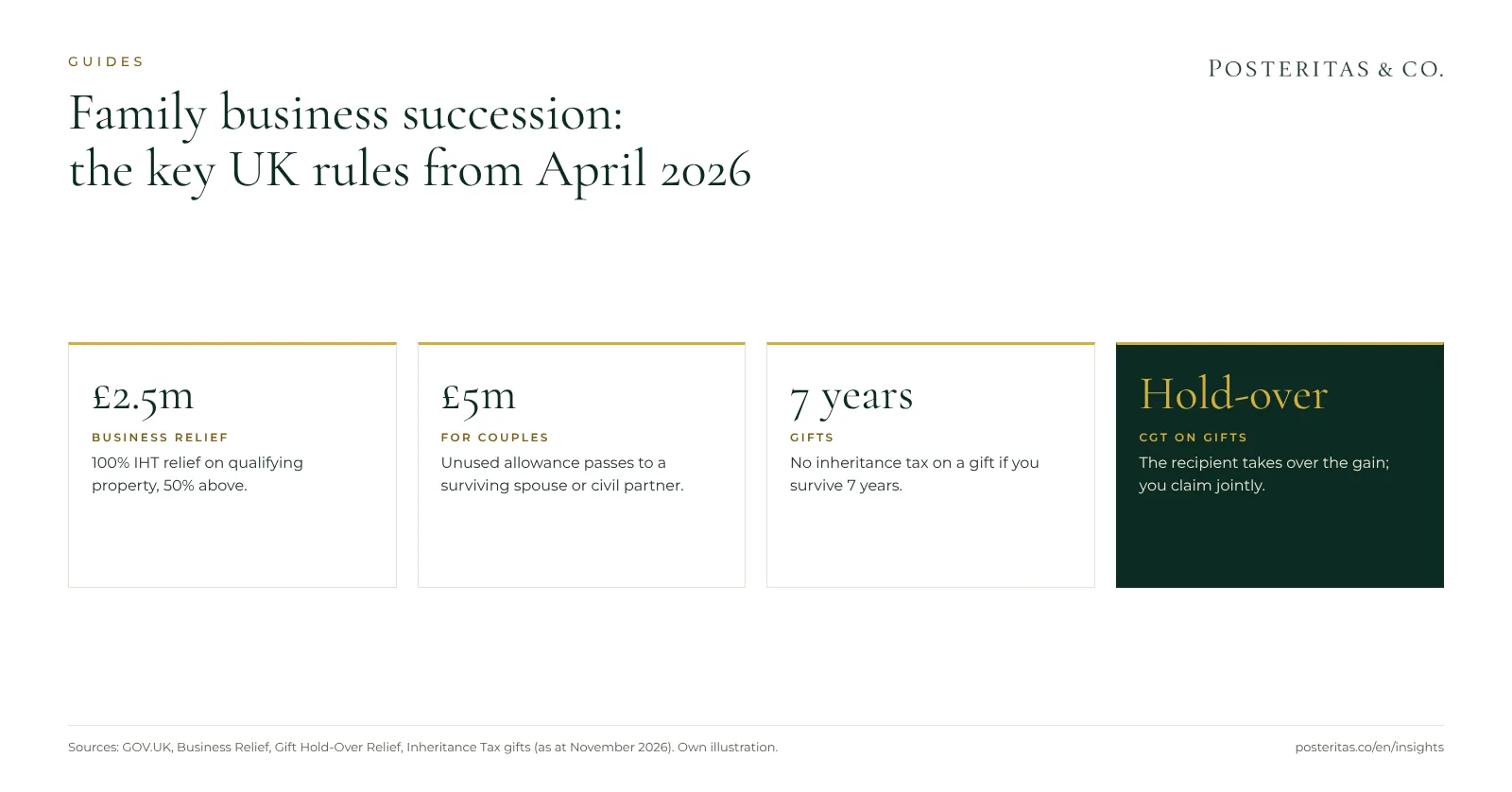
Gift Hold-Over Relief (CGT). A gift is treated as a disposal at market value. With Gift Hold-Over Relief, you pay no CGT on giving away business assets or certain shares; the recipient takes over the gain and pays CGT if they sell later. According to GOV.UK, it applies to shares in a company not listed on a recognised stock exchange or in your personal company (at least 5% of voting rights), where the company’s main activities are trading. You and the recipient must claim jointly.
Business Relief (inheritance tax). From 6 April 2026, 100% relief applies to the first £2.5 million of combined qualifying business and agricultural property; value above that receives 50% relief. Unused allowance can be transferred to a surviving spouse or civil partner, so a couple can have up to £5 million. Shares in an unlisted trading company generally qualify if owned for at least 2 years.
The 7-year rule. According to GOV.UK, a gift is normally free of inheritance tax if you survive 7 years. If you die within 7 years and total gifts exceed the £325,000 threshold, taper relief applies:
| Years between gift and death | Inheritance tax rate on the gift |
|---|---|
| Less than 3 | 40% |
| 3 to 4 | 32% |
| 4 to 5 | 24% |
| 5 to 6 | 16% |
| 6 to 7 | 8% |
| 7 or more | 0% |
Business Relief can apply to such gifts too, subject to conditions at the time of death. Because the rules changed in April 2026 and interact in detail, take advice from a UK tax adviser and solicitor before transferring shares. This guide is general information, not tax or legal advice.
Which governance does a family business need?
Governance turns good intentions into rules that work when family members disagree.
- Shareholders’ agreement: transfer restrictions, pre-emption rights, what happens on death, divorce or leaving the business, and how shares are valued in those cases.
- Family charter: a non-binding statement of values, who may work in the business and on what terms, and how the family communicates with the board.
- Board with an outside voice: a non-executive director or advisory board brings objectivity, especially in the first years after the handover.
- Lasting power of attorney: a property and financial affairs LPA lets a trusted person act for you if you lose capacity. GOV.UK states registration costs £92 and takes 8 to 10 weeks if there are no mistakes.
How are the parents provided for?
Many owners have most of their wealth in the business. A succession plan must therefore answer how you will live after stepping back. Options include dividends from shares you keep, a consultancy agreement for a defined period, a part sale to the successor paid in instalments, or extracting surplus cash before the handover. Each has tax consequences and affects how much financial pressure the business carries. Plan this before you agree the transfer, not afterwards.
Which mistakes should families avoid?
Experience from family handovers shows recurring patterns. The most common ones:
- Waiting too long. The successor gets no real responsibility until the founder suddenly stops.
- Equal votes without rules. Several siblings with equal voting shares and no deadlock mechanism.
- No outside view. Valuation, the successor’s suitability and the parents’ income are discussed only within the family.
- Tax first, people second. A structure optimised for inheritance tax that the family cannot live with.
- Founder in the background, still deciding. The new managing director has the title but not the authority.
- No plan B. If the chosen successor withdraws, there is no alternative route such as a management buy-out or a sale.
Each of these can be addressed with time, clear agreements and, where needed, an independent adviser who is not part of the family dynamics.
Conclusion: start the conversation early
Family business succession planning works best when it starts years before the handover, separates leadership from ownership, and is open with every family member. The April 2026 changes to Business Relief make an up-to-date valuation and tax review more important than before. A realistic value is the starting point for fair decisions; our business valuation calculator UK gives a first range. For a confidential discussion of your family’s options, see our succession planning service.
Sources
- Agricultural property relief and business property relief changes, GOV.UK, updated 3 March 2026
- Business Relief for Inheritance Tax, GOV.UK
- Gift Hold-Over Relief, GOV.UK
- Inheritance Tax: gifts and the 7 year rule, GOV.UK
- Business Asset Disposal Relief, GOV.UK
- Make, register or end a lasting power of attorney, GOV.UK
- Age and lack of succession main reason for business sales in the UK, Dealsuite, 26 February 2026
Frequently asked questions
How do I pass my family business to my children?
Decide who will lead and who will own, prepare the successor over several years, and transfer shares by gift, sale or a mix of both. Gift Hold-Over Relief can defer Capital Gains Tax on a gift of qualifying shares, and Business Relief can reduce inheritance tax. Record the arrangements in a shareholders' agreement and update your will.
How do I treat children fairly if only one works in the business?
Common solutions give the active child the voting control or the business, and the other children other assets, non-voting shares or a share of the value paid over time. Equal shares in the company without clear governance often lead to conflict.
Do I pay Capital Gains Tax when I gift shares to my children?
A gift is treated as a disposal at market value. Gift Hold-Over Relief can defer the tax if the conditions are met, for example shares in an unlisted trading company or your personal company. The child then takes over the gain and may pay CGT when selling later. You and the child must claim jointly.
What is the 7-year rule for gifts?
According to GOV.UK, there is normally no inheritance tax on a gift if you live 7 years after making it. Gifts within 3 years of death are taxed at 40%, and taper relief reduces the rate for gifts made 3 to 7 years before death, provided total gifts exceed the £325,000 threshold.
How much Business Relief is available from April 2026?
100% relief on the first £2.5 million of combined qualifying business and agricultural property, and 50% above that. Unused allowance can be transferred to a surviving spouse or civil partner, giving up to £5 million.
What if no one in the family wants to take over?
Then the realistic options are a management buy-out, an employee ownership trust or a sale to an outside buyer. In Dealsuite's H2-2025 survey, age and the lack of a successor explained 41% of UK and Irish business sales.